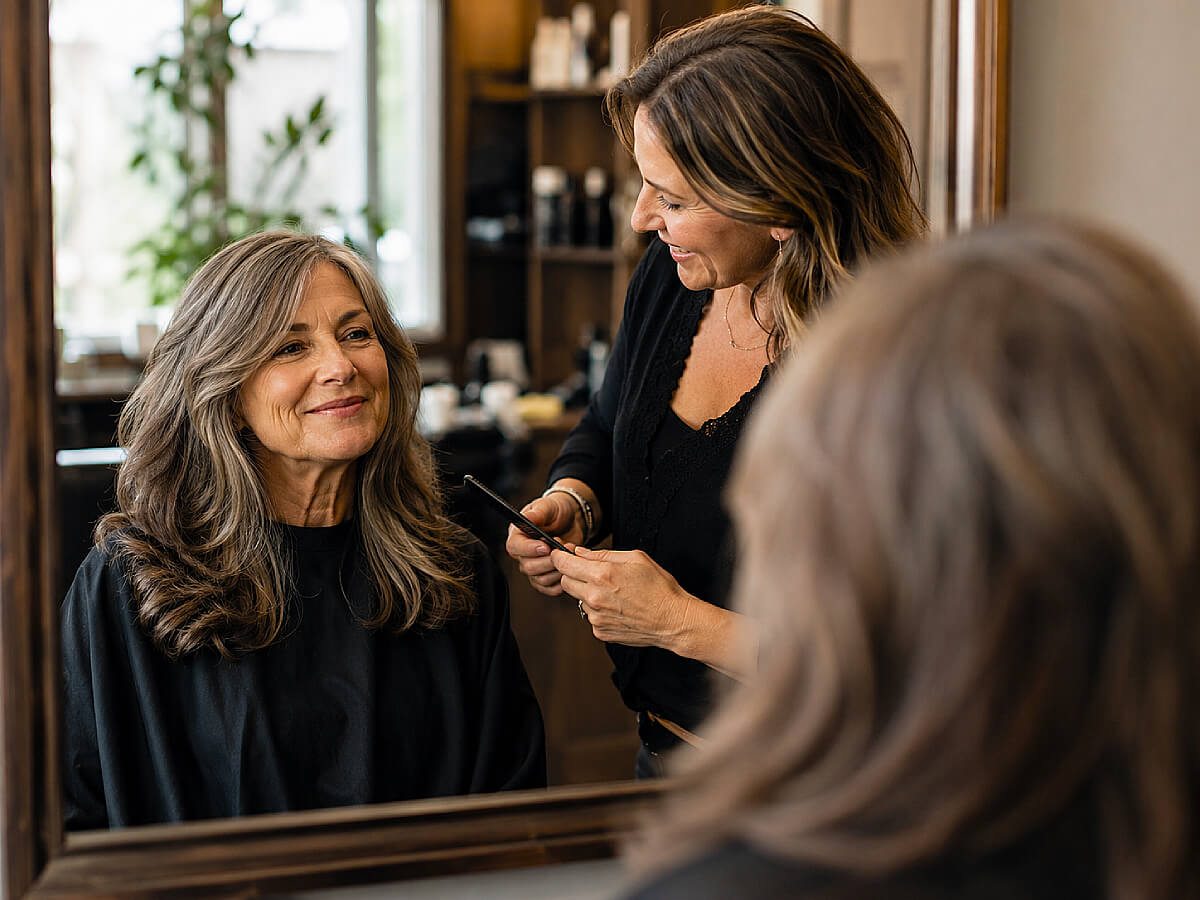

From Sandra Kowalczyk, Muncie, Indiana: “I’m 64 and my hair has completely changed over the last few years. It used to be full and shiny and now it just looks flat, dull, and somehow both dry and limp at the same time. I’ve tried volumizing shampoos, I’ve tried oils, nothing seems to work consistently. My stylist keeps telling me to ’embrace the texture’ but that feels like giving up. Is there actually a fix for this or is this just what happens now?”
Sandra, you are not alone, and I want to say that with more weight than it usually carries because I hear some version of this question almost every single day in my chair. Women come in frustrated, holding their hair away from their scalp and describing it with words like “defeated” and “flat” and “old,” and what I want to do every time is sit down and really talk through what’s actually happening, because the problem almost always has a real solution and it almost never requires accepting that your hair is just done now.
Here is the thing that most stylists, including some good ones, get wrong: the hair problems women experience in their 60s get grouped together and treated as one thing, when they’re actually several different things happening at the same time, and if you only address one of them you’ll keep feeling like nothing is working. I’ve been doing this for a long time, and the fix that genuinely moves the needle for most of my clients over 60 is not a product or a cut on its own. It’s understanding which specific problem you’re dealing with, then treating that problem directly. So let’s get into it.
This post may contain affiliate links, meaning I may earn a small commission at no extra cost to you. I only share products I truly believe in. As an Amazon Associate, I earn from qualifying purchases. Your support helps me continue creating free content like this.
7. Buildup You Don’t Know You Have
Before anything else, I want to talk about buildup, because it is quietly ruining more women’s hair than almost any other single factor and it gets almost no airtime. If your hair feels flat, looks dull, won’t hold a style, and feels kind of waxy or heavy even right after washing, there is a very good chance your scalp and strands are coated in a layer of residue that’s blocking everything else you’re trying to do from actually working.
Silicones from conditioners and styling products, mineral deposits from hard water, dry shampoo residue, and the waxy coating on some drugstore shampoos all accumulate over time, and as hair gets finer and more porous with age, it holds onto that stuff even more aggressively. I had a client, Diane, who came to me convinced her hair was thinning severely. She had been layering product on top of product trying to get lift. When I did a clarifying treatment on her in the salon, she genuinely teared up at how different her hair felt. It wasn’t thinner. It was buried.
A good clarifying shampoo used once or twice a month can completely change things. I like Neutrogena Anti-Residue Clarifying Shampoo for something accessible and inexpensive, and Ouai Detox Shampoo if you want something a bit more gentle but still effective. If you’re on well water or heavily chlorinated city water, look into a filtered showerhead too, because hard water buildup is real and it is relentless. This alone, just getting a clean baseline, has transformed results for more of my clients than any fancy treatment.
6. The Wrong Protein-Moisture Balance for Your Hair Right Now
Hair changes its needs as we age, and most women are still using a routine built for the hair they had at 40 or even 35. Estrogen changes affect hair’s protein structure, and the result is often hair that’s simultaneously lacking protein integrity (so it goes limp, breaks easily, won’t hold a curl) and lacking moisture (so it feels rough, looks frizzy, and behaves unpredictably). The tricky part is that these two problems require somewhat different solutions, and overloading on one when you need the other makes things worse.
Too much protein without enough moisture and your hair snaps and feels straw-like. Too much moisture without enough protein and your hair is mushy, won’t hold a style, and just drapes there doing nothing. I’ve watched clients come in with a bag full of expensive products, all of them moisture-focused, and wondered why their hair won’t cooperate, and the answer is almost always that they need a protein treatment to give their strands something to work with first.
I recommend starting with a reconstructing treatment once every two to three weeks. ApHogee Two-Step Protein Treatment is a professional-level product you can use at home, and it genuinely works. Then follow that with a rich moisturizing conditioner, something like SheaMoisture Manuka Honey and Mafura Oil Intensive Hydration Conditioner. The balance between these two things is the foundation everything else builds on, and getting it right can make a bigger difference than any single product swap you’ve probably already tried.
5. You’re Drying Your Hair in a Way That’s Actively Working Against You
I know this sounds almost too basic to be a real tip, but hear me out, because the way most women over 60 dry their hair was learned decades ago and it genuinely needs revisiting now that the hair itself has changed. Rubbing with a terry cloth towel to get out excess water creates friction along a hair shaft that is already more fragile, already more prone to frizz, and already has a lifted cuticle, and what you end up with before you’ve even touched a styling product is hair that’s frizzy, rough, and structurally stressed.
Then there’s the heat. I’m not going to tell you to throw away your blow dryer, I use mine constantly, but the combination of high heat and certain brush types on fine, aging hair can be genuinely damaging over time. I’ve had clients ask me why their ends always look rough and dry and the answer, when I dig into it, is almost always too-high heat held too long in one place. Your hair when you’re 62 does not need or want the same heat level it did when you were 45.
Switch to a microfiber hair towel, which you can find for practically nothing and which will reduce frizz noticeably from the very first use. Drop your dryer to medium heat and use a concentrator nozzle to direct airflow down the hair shaft rather than blasting it from all directions. And if you’re still using a round brush with metal bristles on fine, fragile hair, consider switching to something like the Denman cushion brush or a soft boar bristle brush, which distributes scalp oils and smooths the cuticle rather than dragging against it.
4. Your Color Service Is Drying Out Your Hair More Than You Realize
Color is one of those things I have complicated feelings about because on one hand I absolutely believe in it, I think the right color can be genuinely rejuvenating for women in their 60s, and on the other hand I’ve seen so many women come in with hair that’s been colored past its threshold and they don’t connect the dots between the color and the condition. Permanent hair color, especially when it’s lifting, uses a developer that opens the cuticle and deposits or removes pigment, and the repeated opening and closing of that cuticle over years is one of the main reasons hair becomes porous, dull, and hard to manage.
Gray hair is already more resistant and more porous, which means it often needs higher developer to grab color, and that higher developer does more cuticle damage. If you’re coloring at home, this is where I’d gently but firmly push back on the box color habit, not because it can’t work, but because box color formulas tend to run hot and they’re designed for the average hair, not yours specifically.
A few things that genuinely help: ask your colorist about demi-permanent or toning options instead of full permanent color for maintenance, because they use much lower developer and are so much kinder to already-stressed hair. Use a weekly bond-building treatment like Olaplex No. 3 Hair Perfector at home between appointments, this stuff actually works and it’s not just marketing. And look for a color-depositing conditioner in a shade close to yours to refresh tone between colorings rather than going back to full color every four weeks. Your hair will feel and look completely different within about six weeks of making this change.
3. The Scalp Health Conversation Nobody Is Having With You
Scalp health is the topic I probably spend the most time on with clients over 60 and the one that gets the least attention in general conversations about aging hair, which honestly baffles me. Your hair grows from your scalp. The scalp’s circulation, oil production, and overall environment dictate so much of what that hair looks and feels like, and after 60, all of those things are changing pretty significantly.
Oil production slows down, which means the natural conditioning that used to happen just by brushing your hair from root to end doesn’t happen as readily anymore. The scalp skin itself can become drier, more sensitive, sometimes flakier, and the follicles are producing finer, slower-growing hair. Washing every day strips what little oil there is. But going too long between washes lets any buildup (see number 7) accumulate faster. It’s a real balancing act and most women don’t even know they’re supposed to be thinking about it.
I love a scalp treatment as a monthly ritual, something like Briogeo Scalp Revival Charcoal and Coconut Oil Micro-Exfoliating Shampoo, which is gentle enough for sensitive scalps but genuinely moves the needle on buildup and circulation. A scalp massager brush used for just a few minutes in the shower increases blood flow to the follicles and costs almost nothing. I’ve seen clients notice real improvement in density and growth with consistent scalp massage over several months, and even if it doesn’t grow a single extra strand, the way it feels is worth it completely on its own.
2. Your Cut Isn’t Working With Your Hair’s Current Texture
Okay, here is where I’m going to be honest in a way that might be a little uncomfortable: most women over 60 are wearing a haircut that was designed for different hair than what they currently have. Not necessarily the wrong length or the wrong general style, but the internal structure of the cut, where the weight sits, where the layers are or aren’t, how much graduation there is, is almost certainly optimized for hair that was fuller, coarser, or behaved differently than it does right now.
When hair gets finer with age, heavy blunt cuts that looked luxurious at 45 can look flat and limp at 62. But very heavily layered cuts on fine, sparse hair can look stringy and thin instead of airy. The sweet spot moves, and finding it requires a stylist who is actually thinking about the architecture of the cut in relation to the volume and density you have today, not the volume and density they see in the reference photo you brought in.
I’ve been cutting hair for a long time and I’ll tell you something that’s almost always true: a well-placed, conservative layer taken at the right point in the haircut can change everything about how fine hair moves and behaves, without making it look sparse. The goal isn’t maximum layers, it’s strategic ones. If your current stylist is giving you the same cut every six weeks without ever asking about how your hair has been behaving, that’s the conversation to start having. Tell them specifically what you said in your question, Sandra, that it feels flat and limp and somehow both dry and heavy at once, because that information should actually change the decisions they’re making with the scissors.
1. You Haven’t Tried a Trichologist or a Hormone-Aware Hair Approach, and It Might Change Everything
Here it is, the one most people haven’t tried, and honestly the one I think has the highest ceiling for real change. Everything above is real and worth doing. But if you’ve been dealing with flat, thinning, dull, hard-to-manage hair for a few years now and you’ve tried adjusting products and getting better cuts and nothing has moved the needle in a lasting way, there is a very good chance that what you’re experiencing is driven by something happening internally, and no shampoo is going to fix that.
After 60, the hormonal shifts of perimenopause and post-menopause have significant, documented effects on hair. Declining estrogen means the hair growth cycle shortens, the resting phase extends, and each hair that grows back can grow in finer than the one before it. Thyroid function, iron levels, ferritin specifically (the stored form of iron, which is different from circulating iron and is what your doctor might miss if they only do a basic panel), vitamin D, and B12 all directly affect hair growth and quality. I have seen women come in with noticeably improved hair density within six months of addressing a thyroid issue or getting their iron up, and it is one of the most satisfying things to witness.
A trichologist is a specialist in scalp and hair health, and they are not the same as a dermatologist, though a good derm can also help. A trichologist will look at your scalp, your hair’s growth pattern, your health history, and often refer you for bloodwork that your general practitioner might not think to order. If you don’t have access to one, starting with your GP and asking specifically for a thyroid panel, ferritin, vitamin D, and B12 is a completely reasonable place to begin. Organizations like the American Hair Loss Association have resources for finding specialists, and products like Nutrafol Women’s Balance (formulated specifically for post-menopausal women) address some of these underlying nutritional gaps and have solid clinical research behind them, though they work best when you’ve also identified what specifically your body is missing.
I want to be clear that I’m not suggesting every woman with flat hair needs a medical workup. But if you’re over 60, if the changes have been noticeable and progressive, and if nothing topical has made a lasting difference, your hair is probably telling you something about what’s happening internally, and that is worth listening to. This is not giving up. It’s actually the most targeted, most proactive thing you can do, and it’s the answer most stylists, including me for longer than I’d like to admit, don’t give you because it’s outside the obvious scope of what we do.
One More Thing Before You Go
Sandra, and anyone else reading this who recognized themselves in that question, I want to end by saying that your frustration is completely valid and the feeling that your hair has changed in a way that nobody is fully addressing is something I hear constantly. The fix isn’t one thing. It’s usually a few things, layered, applied consistently, and adjusted as your hair responds. Start with the clarifying treatment and the protein-moisture balance if you haven’t, because those two things alone often produce results within just a few weeks. And if you’ve been living with this for years without real answers, please ask for that bloodwork. It is not a small thing.
You deserve a stylist who talks to you the way I hope this felt, like a real conversation about your actual hair, not a generic prescription. And if you’re not getting that, it might be time to find one who will.