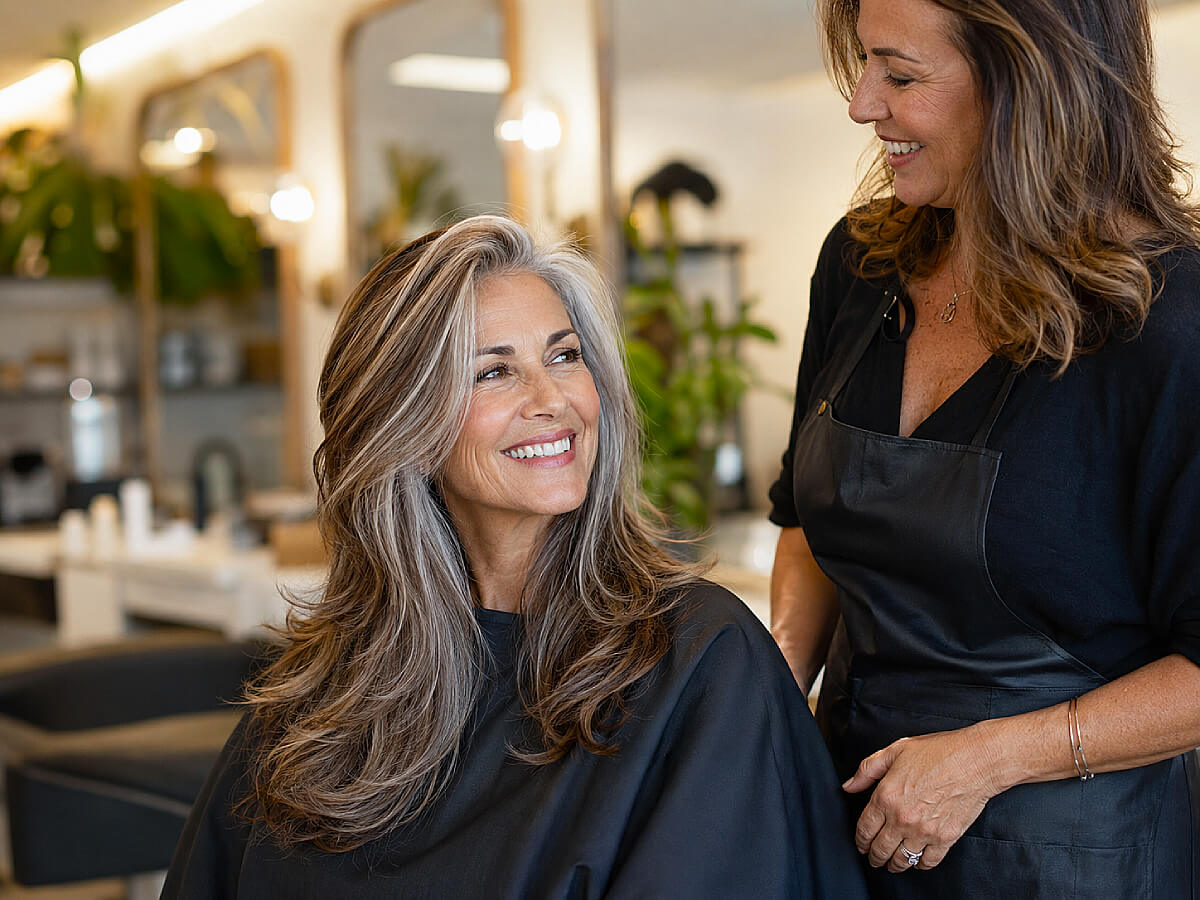

Question from Deborah Kowalski, Fond du Lac, Wisconsin: “I turned 52 this year and my hair has completely changed on me. It’s dryer, thinner than it used to be, and I feel like nothing I do makes it look the way it did even five years ago. I see women my age whose hair looks genuinely beautiful and I always wonder what they’re doing differently. Is it genetics? Money? Are they just lucky? I’d love to know the actual secrets.”
Here’s something I’ve noticed over twenty years behind the chair: the women whose hair looks genuinely good at 50, 60, even 70, are almost never the ones with the most expensive cuts or the fanciest products. They’re the ones who figured out, usually through some trial and error and maybe a few honest conversations with their stylist, what their hair actually needs now, not what it needed at 35.
Your hair changes. Hormones, stress, medication, time, they all leave a mark. The texture shifts, the density drops a little, the scalp gets drier or sometimes oilier, the color loses that natural warmth it used to have on its own. I see it constantly. And I also see women who figured it out, who adjusted, and whose hair looks so good you almost want to stop them in a parking lot and ask what they’re doing. So let me just tell you, because Deborah, you are absolutely not alone in this, and there are real answers here.
This post may contain affiliate links, meaning I may earn a small commission at no extra cost to you. I only share products I truly believe in. As an Amazon Associate, I earn from qualifying purchases. Your support helps me continue creating free content like this.
8. They stopped using drugstore shampoo and switched to something that actually addresses hair loss
I know that sounds a little blunt, but I’ve watched this happen enough times that I feel like I owe it to you to just say it plainly. The shampoo aisle at the drugstore is full of products that smell incredible, lather beautifully, and are genuinely not doing your aging hair any favors. A lot of them contain sulfates that strip the natural oils you’re already producing less of, and some contain silicones that build up over time and make thin hair go completely flat.
After 50, especially if you’ve noticed more hair coming out in the shower or your ponytail feels thinner than it used to, a shampoo formulated specifically for hair thinning and scalp health is worth taking seriously. I started recommending Nioxin System shampoos years ago and the feedback I get is consistently good. It’s not magic, but it keeps the scalp clean and balanced in a way that supports growth rather than working against it. Pura D’Or is another one I’ve seen work well, especially their anti-thinning gold label formula, which a few of my clients swear by after their doctor ruled out anything medical.
The shift in how your hair behaves after switching can take four to six weeks to really show up because you’re working at the scalp level, not just coating the hair shaft. Be patient with it. If you’ve been using the same shampoo for years and your hair has changed, your shampoo probably needs to change too. It’s one of those quiet upgrades that doesn’t feel dramatic but makes a real difference over time.
7. They have a standing appointment, not a “whenever it gets bad” appointment
There’s a particular kind of client I see fairly regularly, she comes in looking a little defeated, and when I ask how long it’s been she says something like “oh, probably eight months, maybe more.” And I never say anything judgmental because I understand life gets in the way, but I will say this: hair over 50 does not forgive a long gap the way it might have when you were younger.
The ends get dry and start to break rather than grow. The shape falls apart faster because the texture has changed. And when you finally do come in, you’re not just getting a trim, you’re doing damage control, which often means losing more length than you wanted to. A regular schedule, every six to eight weeks for shorter cuts, every ten to twelve for longer styles, keeps you ahead of that cycle instead of constantly playing catch-up.
I have a client, I’ll call her Carol because that’s actually her name, she’s 67, beautiful silver hair, always looks like she just stepped out of somewhere nice. She’s been on a nine-week schedule for probably fifteen years. She never misses it. Her hair isn’t extraordinary on its own, but it always looks cared for, and that consistency is the entire reason why. If budget is a concern, look into cosmetology schools in your area where supervised students offer services at reduced prices. Keeping that schedule is more important than where you keep it.
6. They take a collagen or biotin supplement, and they’ve been doing it long enough to see results
I want to be careful here because I’m a hairstylist, not a doctor, and you should absolutely loop your physician in if you’re thinking about adding supplements. That said, I take collagen myself and have for about four years, and the difference in my hair thickness and nail strength was noticeable enough that I kept buying it. I’m not someone who sticks with something out of wishful thinking.
After menopause, estrogen drops, and estrogen plays a role in how long your hair stays in the growth phase. That’s why so many women notice thinning in their 50s that feels different from normal shedding. Supplementing with collagen peptides like Vital Proteins or a quality biotin supplement won’t reverse significant hormonal hair loss on their own, but they can absolutely support the hair you have and help it grow stronger and with a little more density. I’ve seen it enough times to believe it.
The catch is you have to give it real time. Most people quit after three weeks because they don’t see anything. Hair grows about half an inch a month, so the improvements show up slowly, in the texture and strength of new growth, not in a sudden overnight change. Give it three months minimum before you make any judgment calls. Consistency here is everything, same as the salon schedule.
5. They’ve embraced a cut that works with their texture instead of fighting it
This one is a little personal for me because I spent years watching women come in wanting the cut they had at 40, and I understand the impulse completely, but sometimes that cut just doesn’t work the same way on hair that has changed its texture, its density, its natural movement. The hair you have right now might be capable of something genuinely beautiful, just not necessarily the same thing it did before.
Finer hair over 50 often looks better with some internal layers that remove bulk in the right places and create movement, rather than trying to hold onto length that just hangs and looks flat. Women with naturally wavy or curly hair that has gone coarser over the years sometimes find that a shorter cut suddenly lets those waves do something they couldn’t do when the hair was longer and weighed down. I’ve done cuts on women in their 60s that were honestly some of my favorite work, not because the hair was perfect, but because the cut was right for the hair in front of me.
If you’ve been getting the same cut for ten or more years, have an actual conversation with your stylist about whether it’s still serving you. Not just “does it look okay,” but “is there something that would work better for where my hair is right now.” A good stylist will be honest with you. And if yours isn’t the type to have that conversation, that might be worth knowing too.
4. They use a weekly treatment, not just conditioner
Conditioner is not a treatment. I feel strongly about this and I say it to clients all the time. Your daily or every-other-day conditioner is maintenance, it’s keeping things from getting worse. A deep conditioning mask used once a week is actually repair work, and after 50 when your scalp is producing less sebum and your hair is likely color-treated on top of that, repair work matters a lot.
The masks I see make the biggest difference are the ones with ingredients like keratin, argan oil, or shea butter rather than just a thicker version of the same silicone base. Olaplex No. 8 is genuinely worth the price and I say that as someone who does not recommend Olaplex products across the board, some of them I’m not as sold on. But the mask is legitimately good for hair that’s chemically treated or heat styled regularly. SheaMoisture’s Manuka Honey and Yogurt mask is a more affordable option that I’ve seen work beautifully on dry, coarse, or natural hair textures.
The application matters too. Apply it to damp but not soaking wet hair, leave it for at least ten minutes, and actually sit with it rather than rinsing it immediately. I put mine on before I clean the bathroom on Sundays, which sounds unglamorous but honestly that’s just how it works in real life. Even one treatment a week changes the way your hair feels and behaves for the next several days.
3. They’ve made peace with, or fully leaned into, their gray
I’ve colored a lot of hair. I’ve also had some very honest conversations with clients about when the coloring is helping and when it’s starting to work against them. There’s a version of fighting gray that leaves hair looking brassy, overprocessed, and dry, and then there’s the version where a woman lets her gray come in beautifully, gets a great toner or gloss to keep it cool and luminous, and suddenly looks ten years younger because she stopped battling her own hair.
This is not me telling you to stop coloring. If you love your color, keep it, and keep it well-maintained. What I am saying is that gray hair, when it’s cared for, can be stunning. The women I see who fully commit to it, who use a good purple or blue toning shampoo once or twice a week to keep yellow tones out, who deep condition regularly because gray tends to be coarser and drier, those women have some of the most striking hair I see. It has dimension. It has life. It photographs beautifully in natural light.
The transition period is the hard part, I won’t pretend otherwise. But there are ways to make it less painful, like asking your colorist for some strategic highlights or lowlights during the grow-out that blend the two tones rather than leaving a harsh line of demarcation. Shimmer Lights has been a staple for gray maintenance for decades and for good reason. If you’re curious about going gray, it’s worth at least having the conversation before your next all-over color appointment.
2. They actually protect their hair from heat, consistently
Not sometimes. Not when they remember. Consistently. I cannot tell you how many women sit in my chair and tell me their hair is dry and damaged and in the same breath mention they blow dry every day without any product between the heat and their hair. That’s not a mystery, that’s cause and effect.
After 50, the hair shaft is more porous and more vulnerable to heat damage than it was when you were younger. The moisture content is lower to begin with, so high heat pulls out what little there is and leaves the cuticle rough and raised, which is exactly why the hair looks dull instead of shiny. Shine comes from a smooth, flat cuticle, and heat without protection destroys that.
A good heat protectant isn’t optional at this stage, it’s just part of getting dressed. Tresemmé Thermal Creations is a completely solid, affordable option for fine or medium hair. If your hair is thicker or coarser, CHI 44 Iron Guard gives you a bit more protection at higher temperatures. And if you want to reduce your heat use altogether, investing in a quality microfiber towel to reduce drying time and rough friction is one of those small changes that genuinely accumulates over months into noticeably healthier hair. None of this is complicated. It’s just the habit of doing it every single time.
1. They figured out their scalp, and started treating it like skin
This is the one that most people aren’t thinking about, and in my opinion it’s the single biggest factor in why some women over 50 have hair that looks so much better than their peers. The scalp is skin. It ages, it gets drier or more irritated, its natural oils change, and everything that grows out of it reflects the health of the environment it came from. You can use every product on this list, but if your scalp is dry, inflamed, clogged, or just not in good shape, your hair will tell on it every time.
A few years ago I started recommending a weekly scalp massage to pretty much every client over 50, and the ones who actually do it report better growth and less shedding over time. There’s research behind it, regular massage increases blood circulation to the follicles and helps with follicle stimulation. You can do it with your fingers in the shower, or use something like a scalp massager brush, which a lot of women find more relaxing and easier to use consistently.
For dry, flaky scalps, a rosemary oil treatment applied to the scalp before washing has some genuinely compelling research behind it now, with a few studies comparing its effectiveness to minoxidil for mild hair thinning. I started using it myself after reading those studies, diluted in a little jojoba oil, massaged in and left for about twenty minutes before shampooing. My scalp feels better, my hair is thicker at the root than it was two years ago, and I think the combination of the oil and the massage is doing something real.
If you have persistent scalp irritation, significant dandruff, or pain at the follicle level, please see a dermatologist because those things deserve actual medical attention. But for general scalp health as you age, treating it the same way you treat your face, with hydration, gentle exfoliation, and circulation, changes the entire picture of what your hair can look and feel like. It’s the foundation everything else builds on, and it’s the thing most women find out about last, which is exactly why I put it here at number one.
The bottom line
Deborah, your hair can absolutely look beautiful at 52 and beyond. The women you’re noticing aren’t operating on magic or luck. They figured out, usually through some version of the same frustration you’re describing, that the rules changed and they had to change with them. The products matter, the schedule matters, the scalp health matters. But more than any single thing, the mindset of working with your hair where it actually is right now, rather than mourning what it was, makes the biggest difference of all. I’ve watched it happen in my chair more times than I can count.
Start with one thing on this list, whichever one feels most doable, and give it real time. Come back and add another. You don’t have to overhaul everything at once. Hair responds slowly but it does respond, and six months from now you might be the woman someone else is watching in the parking lot, wondering what on earth you’re doing.