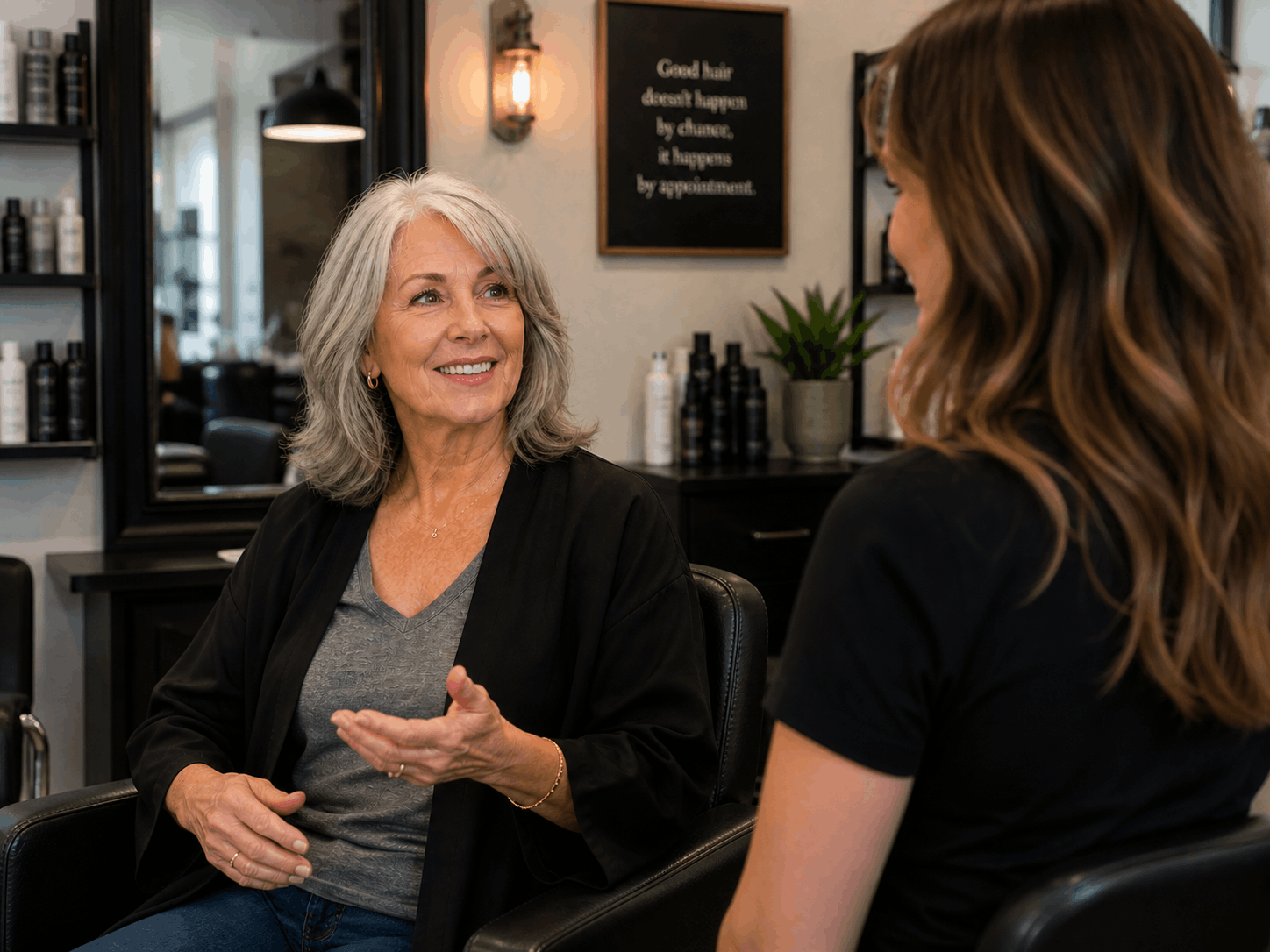

Reader Question from Margaret Ellsworth, Pinedale, Wyoming: “I’m 58 and I’ve decided I want to stop coloring my hair and let my natural gray come in. I told my hairstylist of 15 years and she spent the whole appointment talking me out of it. She mentioned how it would age me, how the transition would look terrible, how I’d regret it within six months. I left feeling smaller than when I walked in. I love her but I also know what I want. Is there something stylists aren’t telling us, and how do I have this conversation without it turning into a full debate every six weeks?”
Here’s something I wish more women in my chair knew before they brought up going gray: a lot of stylists weren’t actually trained on how to take a client through a gray transition. We were trained on color theory, on covering gray, on lifting and depositing and toning out brass. Going the other direction, walking a woman through 18 months of growing out her natural silver while she still feels like herself in the mirror, that’s a separate skill set, and not everyone has it. So when a stylist pushes back hard on going gray, sometimes it’s a real opinion, and sometimes it’s that she doesn’t quite know how to do it well and she’s protecting herself from a result she can’t control.
I’ve been doing hair for 22 years and I’ve watched the gray hair conversation completely change. Five years ago I had maybe one client a year ask about transitioning. Right now I have somewhere between 12 and 15 women in active transition, and the youngest just turned 41. Something has shifted. And the part that nobody talks about, the thing your stylist probably didn’t say to you, is that the right gray, on the right cut, with the right tone work during the awkward middle, can be one of the most flattering things a woman can do for her face after 50. I’ll tell you what I tell my clients when they sit down and say they’re done coloring. There’s a way to do this that you’ll actually love.
This post may contain affiliate links, meaning I may earn a small commission at no extra cost to you. I only share products I truly believe in. As an Amazon Associate, I earn from qualifying purchases. Your support helps me continue creating free content like this.
10. Understand Why Some Stylists Genuinely Push Back
I want to start here because I think it’ll help you walk into your next appointment with more grace than frustration. When a longtime stylist tells you not to go gray, she’s usually coming from one of three places, and only one of them is about you. The first is financial, and I’ll be honest about it because pretending otherwise is silly. A monthly color client is a stylist’s most reliable income, and a woman who stops coloring is, eventually, a woman who comes in three or four times a year for a cut and a gloss instead of every five weeks for a full root touch up with toner. That’s a real income difference for the person cutting your hair, and some stylists react to that before they even realize they’re reacting to it.
The second reason is the one I mentioned in the intro. She may not be confident in transition work. Blending silver regrowth with previously colored ends is genuinely tricky, the demarcation line is unforgiving, and if she botches the dimensional work in the awkward stage, you’re going to be unhappy and she’s going to feel terrible. The third reason, and this is the one worth listening to, is that she knows your hair, your skin tone, and your lifestyle, and she has a real concern. That third one is worth a conversation. The first two are worth politely working around. Knowing which one you’re dealing with changes everything about how you respond.
9. The Awkward Middle Is Shorter Than You Think If You Cut Smart
The thing every woman dreads about going gray is what we in the industry call the demarcation line, that visible band where your natural silver meets your colored ends. I’ll tell you the truth, it’s only as bad as your cut allows it to be. I had a client last year, Diane, who came in with shoulder length hair and about four inches of gray grown in. She was miserable, she’d been wearing it in a low bun for six months, and she was ready to just shave it off. We took her to a chin length bob with some softness around the jaw, and within about seven months she was fully natural. Not 18 months. Seven.
The math on this is simple and a lot of stylists won’t walk you through it. Your hair grows roughly half an inch a month. If your colored hair is 12 inches long, you’re looking at almost two years of growing out. If we cut you to 6 inches, you’re looking at one year. If we cut you to a chin length lob or a longer pixie with some length on top, you might be done in eight to ten months. Most women who say they regret going gray actually regret the length they tried to keep through the transition. The cut is the entire game. I tell every transitioning client that we’re going to take some length off, and we’re going to do it in stages so it doesn’t feel like a shock, and almost every one of them has thanked me on the back end.
8. Tone Is Everything, and Most Natural Gray Needs Help
Here’s something nobody warned my clients about until they were halfway through the process. Your natural gray, the actual color growing out of your scalp, may not be the silver you’re picturing in your head. It might be yellow. It might be brassy at the temples and steel at the crown. It might have a warm cast that makes your skin look tired even though everyone keeps telling you gray is supposed to be flattering. This is where a good stylist becomes irreplaceable, and where a great purple shampoo earns its place on your shelf.
The two purple shampoos I actually recommend, and I’ve tried more than I can count, are Fanola No Yellow Shampoo for hair that needs serious brass correction and Oribe Silverati for the woman who wants something gentler that also happens to smell like a luxury spa. Use them once or twice a week, not every wash, because over-toning gray hair makes it look dull and chalky. In the salon, I’ll often do a quick gloss on a transitioning client, something with a cool violet base, every couple of months to keep the silver looking like silver instead of vintage lampshade. If your stylist won’t do toning glosses on natural gray, that’s a flag. Toning is half the reason women love their gray hair when they finally get there.
7. Stop Asking If Gray Hair Will Age You and Start Asking About Your Cut
This is one of those things I’ll just say plainly because the polite version takes too long. Gray hair does not age you. The wrong cut ages you, the wrong tone ages you, and frankly the wrong haircare routine ages you, but the color itself is not the problem. I have a client, Rosalind, who is 64 with a sharp silver bob and pieces around her face, and she gets stopped in the grocery store by women asking who does her hair. I have another client the same age who has long, thinning, untoned, slightly yellow gray that she wears in a tight ponytail every single day, and she looks 10 years older than Rosalind. Same color situation, completely different outcome.
What ages women is hair that’s pulled too far back, too long for the density they have left, untoned, and unmoisturized. Post menopausal hair changes texture, it gets drier, sometimes coarser, sometimes finer depending on genetics, and it loses some of its natural shine. So when you go gray, you’re seeing all of that at once, and a lot of women blame the gray for what’s actually happening with hormones and aging hair. The fix is moisture, regular trims to keep the ends from looking wispy, and a cut with movement around the face. If your stylist tells you gray will age you and offers no other plan, she’s diagnosing the wrong problem.
6. The Right Haircare Routine Can Make Gray Hair Look Like Real Money
Gray hair behaves differently than pigmented hair, and this is the part where I get a little nerdy because I think it matters. The pigment in your hair, the melanin, actually contributes to how the cuticle reflects light. When that pigment is gone, the cuticle can look duller, and the hair shaft can feel coarser and more wiry, especially around the temples. So your old shampoo, the one you used through your 30s and 40s, might not be doing your gray hair any favors. You need more moisture, more shine, and ingredients that smooth the cuticle.
The products I put on every transitioning client’s shelf, in some combination, are Olaplex No. 3 as a weekly bond builder, especially if you’ve been coloring for decades and your strands are tired, Kérastase Blond Absolu Masque Ultra-Violet for a deep conditioning toning treatment in one step, and a good lightweight oil like Living Proof Perfect Hair Day Oil for the ends, because gray hair shows dryness more than any other color. I’ll also tell you that Oribe Supershine Moisturizing Cream is one of the few finishing products that gives gray hair the kind of soft, expensive looking shine that makes it photograph beautifully. Real silver hair styled well looks like jewelry. Real silver hair neglected looks like neglect. The products are not optional.
5. Find a Stylist Who Has Actually Done This Work, and Don’t Settle
If your current stylist isn’t on board, and you’ve had a real conversation with her and she’s still pushing back, you can quietly start asking around. The way you find a transition specialist isn’t through Google reviews, those are mostly useless for this specific skill, it’s through Instagram. Search hashtags like silver hair transformation, going gray gracefully, gray blending, and embrace the gray, and you’ll find stylists in your area who post their before and afters. Look for stylists who show the awkward middle stage, not just the dramatic reveals. Anyone can post a finished silver bob. The artist is the one who can show you a client at month four and month eight and month twelve and explain what she did at each stage.
I’ll also tell you that going for a consultation at a new salon doesn’t mean you’re betraying your current stylist. It means you’re hiring for a specialty, the same way you’d see a different doctor for a specific concern. Some women keep their longtime stylist for cuts and trims and see a colorist specifically for the transition glosses every few months. That’s a completely reasonable arrangement, and a confident stylist won’t take it personally. If she does take it personally, that tells you something about the relationship that goes beyond hair color. You’re allowed to have what you want. You’ve earned it.
4. Heat Tools and Gray Hair Have a Complicated Relationship
Once you’re growing in your natural color, the way you style your hair has to evolve a little, and this is one of the conversations I have most often with new gray hair clients who didn’t expect it. Gray hair is more porous, it absorbs heat faster, and it can yellow from heat damage in a way that pigmented hair never does. If you’ve been using a curling iron at 410 degrees for 20 years because that’s what works on stubborn hair, you may need to come down to 350 or 360 and use a stronger heat protectant.
The tools I trust on gray hair, and I’ve used most of what’s on the market in the salon, are the Dyson Airwrap for women who blow dry and style at home daily, because it uses air more than direct heat, and the ghd Platinum+ Styler for women who want a flat iron that won’t run hot enough to scorch finer gray strands. For curling, the T3 Whirl Convertible with adjustable heat is forgiving in a way that drugstore irons aren’t. The heat protectant I keep in every drawer is Living Proof Restore Perfecting Spray, which doubles as a leave in. Cooler temperatures, better tools, and a real heat protectant will keep your silver from going yellow at the ends, which is the most common complaint I hear from women a year into their transition.
3. The Conversation to Have With Your Stylist Before You Make a Decision
I’m going to give you the actual script, because I’ve coached enough clients through this conversation that I know which words land and which ones turn it into an argument. When you sit down in the chair, before she puts the cape on, you say something like this. “I’ve made the decision to stop coloring my hair. I’d love your help walking me through this in a way that I’ll feel good about, and I’d love to hear your honest concerns. But I want you to know my mind is made up about the destination. I just need help with the route.” That last sentence does a lot of work. It tells her you respect her expertise, it acknowledges she may have valid concerns, and it removes the decision from the table without being combative.
If she responds with a real plan, length adjustments, gloss schedule, product recommendations, transition timeline, you’ve got the right stylist. If she responds with more reasons not to do it, you have your answer too, and that’s okay. You don’t have to fire her, you don’t have to make it a thing, you can simply book a consultation with someone else for the color portion of the journey. I tell my own clients all the time, hairstylists are people, we have biases and bad days and things we do well and things we don’t, and you should never feel like the relationship is so precious that you can’t ask for what you want. The good ones rise to the request. The rest of them, you outgrow.
2. The Cuts That Make Gray Hair Look Intentional Instead of Accidental
This is where I get genuinely excited because the cuts that work on gray hair are some of my favorite cuts to do, period. The chin length bob with a slight A-line, where the back is just a touch shorter than the front, is the workhorse of the gray hair world. It looks like you meant it. It frames the face. It moves when you turn your head. It works on fine hair, thick hair, straight hair, and most wave patterns. If you want something with a little more attitude, the textured lob with curtain bangs is having a real moment among my 50 plus clients, and the bangs do something specific for gray hair, they soften the contrast between the silver and the skin in a way that makes the whole face look brighter.
For women who want shorter, the modern pixie with length on top is the cut that gets the most second looks in the salon. We’re talking about something with weight on top, softness around the ears, and a slightly tapered nape, not the tight cropped pixie that was popular 20 years ago. On silver hair this cut is striking in a way that’s hard to describe, it photographs beautifully, it’s easy to style with a little texture cream, and it grows out gracefully if you decide later you want length. The cut I almost never recommend on gray hair is anything one length past the collarbone with no layers, because long, flat, gray hair tends to look thinner than it is, and the lack of movement reads as tired even when the hair itself is healthy. Movement is everything.
1. The One Thing Your Stylist Didn’t Tell You, and the Reason So Many Women Love Going Gray
Here’s the part that gets left out of every conversation between a stylist and a client about going gray, and it’s the thing I think Margaret was reaching for when she wrote in. The reason so many women love their gray hair, once they get there, has almost nothing to do with the hair. It has to do with what stops happening in their lives the moment they stop coloring. The five week panic when the roots start showing. The mental math during every vacation about whether the color will hold. The Saturday mornings spent in a salon chair instead of with grandchildren or in a garden or anywhere else. The hundreds of dollars a month, the thousands of dollars a year, that quietly come back to you. The slow recognition that you spent 30 years performing a version of yourself that maybe you don’t need to perform anymore.
That’s the real conversation, and most stylists won’t have it with you because it’s not really a hair conversation. It’s a permission conversation. And here’s what I want you to hear from someone who has been on the salon side of this for two decades. You don’t need permission. You don’t need your stylist’s blessing. You don’t need your husband’s enthusiasm or your daughter’s approval or a magazine’s trend forecast. You need a good cut, the right products, a stylist who can tone the silver when it gets brassy, and the willingness to look in the mirror at month four when it’s awkward and trust that month nine is going to be beautiful. The women I see who go gray with intention almost never come back wanting to color again. They come back wanting a fresh cut, wanting to try a new gloss, wanting to look at themselves and recognize the person looking back. Your stylist may have given you every reason not to do it. The one reason she may not have mentioned, the only one that really matters, is that you might love it. You might love yourself more in it. And at our age, that’s worth more than another monthly appointment.
The Bottom Line on Going Gray After 50
If you’ve read this far, you already know what you want to do, and you’re really just looking for someone to confirm it’s a reasonable choice. So let me confirm it. Going gray after 50, done with intention and the right team, is one of the most flattering, freeing, and quietly powerful changes a woman can make. The transition is not as long as you think if you adjust the length, it’s not as awkward as you fear if you tone the silver as it comes in, and it absolutely does not age you if your cut has movement and your hair has moisture. Your stylist may not be the right partner for this particular journey, and that’s okay. Find someone who is, or have an honest conversation with the one you have. Bring a plan, bring a budget for new products, and bring a little patience for the middle months.
You’re not abandoning your style. You’re updating it. The women who love their gray hair the most are the ones who treated the transition like a project worth doing well, not a surrender. Take your time, find your team, and trust yourself. The mirror is going to surprise you in the best way.