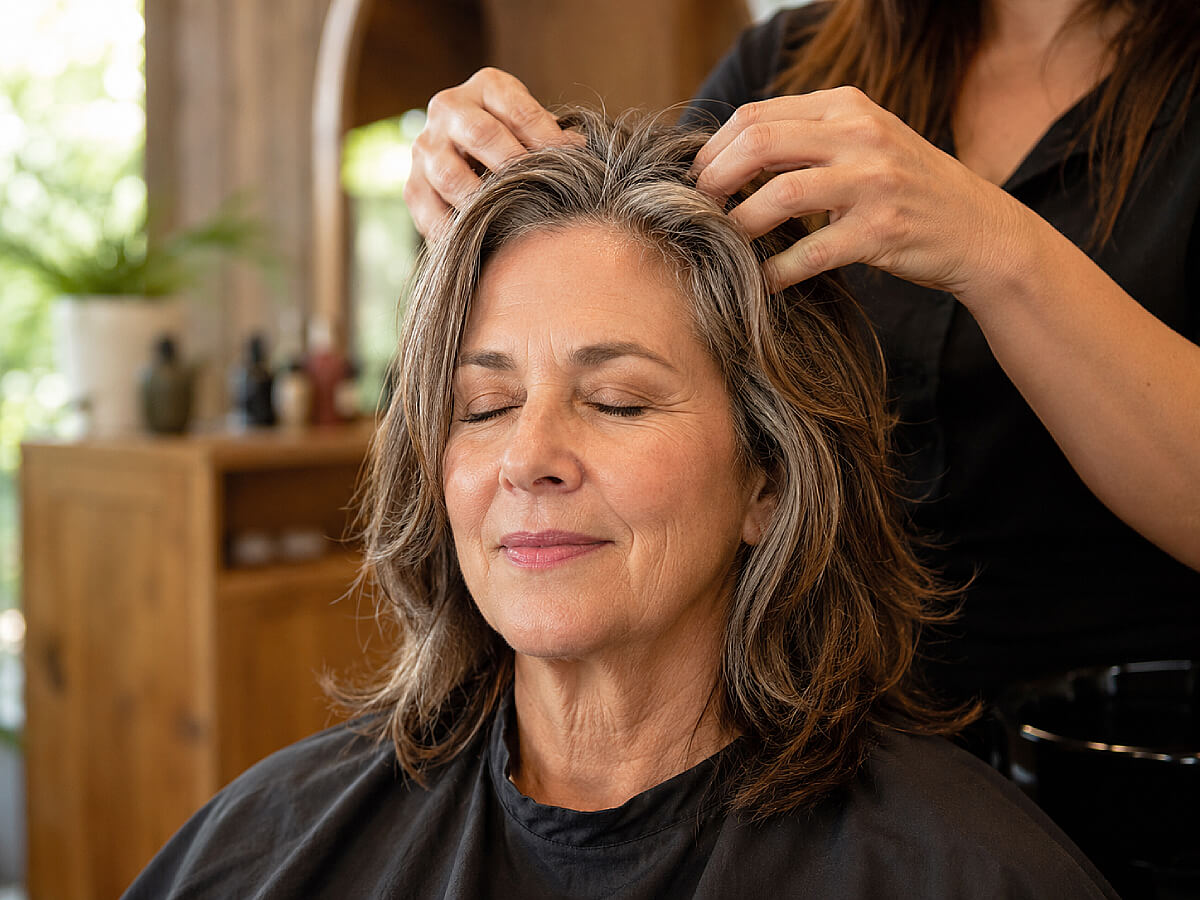

Reader Question from Donna Przybylski, Flagstaff, Arizona:
“I’m 58 and for the past several months my scalp has been so sensitive I can barely run a brush through my hair without it hurting. It’s not itchy exactly, just tender and almost sore to the touch in certain spots. My hairdresser didn’t say much about it and my doctor just told me to switch shampoos. I feel like something is going on but I can’t figure out what. Can you help?”
Scalp sensitivity is one of those things that sneaks up on you and then suddenly it’s all you can think about, because it’s there every morning when you try to get a brush through your hair and every night when you lay your head on a pillow. I’ve been doing hair for over twenty years and I cannot tell you how many clients have sat in my chair and mentioned this almost as an aside, like they’re a little embarrassed to bring it up, or like they think it’s not a real thing worth talking about. It absolutely is a real thing. And honestly, it’s one of the most underconversated topics in the whole world of hair and scalp health.
I had a client, Renata, who came in maybe four years ago with her hair looking completely fine from the outside, but she told me that washing her hair had become something she dreaded because her scalp felt bruised almost, tender in a way that made the whole experience miserable. She’d already seen a dermatologist who gave her a medicated shampoo, which helped a little but didn’t get to the root of it, no pun intended. We ended up talking through almost everything, her products, her stress levels, her hormones, her diet, and it turned out there were about three things happening at once. That’s usually how it goes. It’s rarely one single villain.
So Donna, this one’s for you, and for every other woman who’s been quietly putting up with a scalp that feels way too tender for no obvious reason. Let’s actually get into it.
This post may contain affiliate links, meaning I may earn a small commission at no extra cost to you. I only share products I truly believe in. As an Amazon Associate, I earn from qualifying purchases. Your support helps me continue creating free content like this.
8. Product Buildup Is Quietly Strangling Your Scalp
I want to start here because it’s the one nobody wants to hear, and also the one that’s most fixable. If you’ve been using the same dry shampoo, the same thickening spray, the same leave-in conditioner for months or years without doing a real clarifying wash, there is a very good chance your scalp is suffocating under a layer of residue that’s inflaming the skin and making it hypersensitive to any kind of touch or pressure. Silicones, waxes, and certain conditioning agents don’t fully rinse out with a regular shampoo, they accumulate, and that buildup can make the scalp feel tight, achy, and just wrong in a way that’s hard to describe but you absolutely know when you feel it.
The fix isn’t complicated but you do have to actually commit to it. A clarifying shampoo used once every week or two makes an enormous difference, and I’ve been recommending Neutrogena Anti-Residue Clarifying Shampoo to clients for years because it works without being harsh, it’s inexpensive, and it’s easy to find. If you want something a little more targeted for scalp health specifically, Briogeo Scalp Revival Charcoal + Coconut Oil Micro-exfoliating Shampoo is genuinely excellent and the charcoal does a nice job of drawing out impurities without stripping the scalp completely dry. I also want to mention that dry shampoo, as much as I love it, is probably the number one contributor to buildup-related scalp issues I see in my chair, so if you’re using it more than a couple times a week, that’s worth reconsidering.
Follow up your clarifying wash with a light scalp oil or serum rather than a heavy conditioner applied to the roots, because going right back to heavy product defeats the whole purpose. Give your scalp some breathing room and see if the sensitivity improves over two to three weeks before you decide something else is going on.
7. Your Hair Tools Are Doing More Damage Than You Realize
This is one of those areas where I have strong opinions and I’m not going to pretend otherwise. The wrong brush can absolutely cause scalp pain, and I don’t mean just pulling at tangles, I mean the actual bristles pressing against inflamed skin repeatedly over months can condition your scalp into a state of chronic low-grade irritation. If you’re using a brush with hard plastic bristles, or a very dense paddle brush with tightly packed boar bristles, and your scalp is already sensitive, you are making it worse every single morning.
The Wet Brush Original Detangler is something I recommend constantly, especially for women who are also dealing with some thinning or breakage alongside the sensitivity, because the flexible IntelliFlex bristles genuinely don’t fight the hair or drag on the scalp the way stiffer brushes do. If you want to be a little more deliberate about scalp health, the scalp massage brushes that have soft silicone nubs are wonderful for gentle circulation without friction, and I use one on myself in the shower every few days.
Heat tools can also contribute here in a way people don’t think about. If you’re running a flat iron or curling iron close to the scalp regularly, the heat stress on the skin over time can cause sensitivity and even minor inflammation. Moving your tools a little further from the root than you’re used to, maybe half an inch to an inch, sounds small but it adds up over time. Your scalp skin is thinner and more reactive than the skin on the rest of your body and it deserves to be treated accordingly.
6. The Shampoo or Conditioner You Love Might Be the Problem
I know this one stings, especially if you’ve found something that makes your hair feel amazing and you’ve been using it for a long time. But certain ingredients that are totally fine for most people become sensitizing agents for some scalps, especially as we get older and our skin barrier changes. Fragrance is the biggest offender, and I don’t mean synthetic fragrance exclusively, natural fragrances like citrus oils and essential oils can be just as irritating to a reactive scalp. Sulfates, while they’re not inherently evil the way some internet corners will tell you, can be too stripping for scalps that are already compromised.
Preservatives like methylisothiazolinone, which you’ll see on ingredient lists as MI or MIT, are worth looking up on your current products because they’ve been linked to contact dermatitis on the scalp and are surprisingly common even in products marketed as gentle. I had a client switch away from a well-known salon brand just because of that one preservative and her scalp sensitivity improved dramatically within a month.
If you want to try a genuinely gentle shampoo formulated specifically for sensitive scalps, Free and Clear Shampoo is fragrance-free and dye-free and formulated for people with skin sensitivities, and it’s the one I point clients toward when we need to basically eliminate variables and start clean. It’s not glamorous, it doesn’t have a beautiful bottle, but it works. Pair it with a simple, fragrance-free conditioner and give it six weeks before you judge.
5. Stress Is Showing Up On Your Head, Not Just In Your Head
I can usually tell when a client has been going through something hard because their scalp tells me before they do. Stress does genuinely physical things to scalp tissue, it affects circulation, it can trigger or worsen conditions like seborrheic dermatitis and psoriasis, and it ramps up inflammation throughout the body, including the skin on your head. Elevated cortisol over extended periods also affects the hair growth cycle, which is why a lot of women notice increased shedding during or after a stressful period, and the inflammation that comes with that shift can make the scalp feel tender and sore even when there’s nothing obviously wrong on the surface.
I’m not going to sit here and tell you to just relax, because that advice is useless and a little insulting. But I do think it’s worth acknowledging the connection because sometimes understanding why something is happening makes it feel less alarming, and also because there are things you can do at the scalp level that genuinely help even when the underlying stress is ongoing. Regular scalp massage, either with your fingertips or a silicone tool, increases blood flow and can reduce tension headaches that radiate into the scalp. Using a calming scalp serum with ingredients like niacinamide, panthenol, or bisabolol can help quiet inflammation locally even when the systemic stuff is still being worked on.
The Kiehl’s Caffeine Scalp Energy Serum is one I’ve liked for circulation support and it feels nice to apply, which matters when you’re trying to make a self-care ritual actually stick. Nothing fixes stress overnight, but giving your scalp some intentional attention feels good and does help.
4. Hormonal Changes Are Doing a Number on Your Scalp Skin
Okay, this is the one I talk about most with clients who are in their late forties, fifties, and sixties, because it is so profoundly underrecognized and it explains so much. Estrogen plays a huge role in skin health, including the skin on your scalp, and as estrogen levels decline during perimenopause and menopause, the scalp skin gets thinner, drier, more reactive, and less able to repair itself efficiently. The sebaceous glands that used to keep your scalp naturally moisturized start producing less oil, which sounds like good news if you used to have an oily scalp, but it actually tips the balance toward dryness and sensitivity in a way that can feel new and confusing if you’ve never dealt with scalp issues before.
This is exactly what Donna described, actually. She mentioned she’s 58, and while I’m not in a position to diagnose anything, the timeline she described and the nature of the sensitivity she’s experiencing fit this picture very closely. The hormonal scalp sensitivity that comes with this life stage is real, it’s documented, and it’s genuinely not talked about enough in mainstream conversations about menopause, which tend to focus on hot flashes and sleep and mood rather than things like scalp pain and hair texture changes.
From a product standpoint, focusing on moisture and barrier repair is the direction I’d go. The Ordinary Multi-Peptide Serum for Hair Density is excellent and affordable, and it addresses both the scalp skin health piece and the hair thinning that often accompanies this stage. If you’re working with a gynecologist or primary care doctor about hormonal health more broadly, it’s worth mentioning the scalp changes because they’re part of the same picture.
3. You Might Have an Undiagnosed Scalp Condition That Looks Like Nothing from the Outside
This one matters a lot and I really want you to take it seriously. There are scalp conditions that cause significant pain and sensitivity without being visually obvious, at least not to the untrained eye, and they often go undiagnosed for years because people either don’t mention them or get brushed off when they do. Seborrheic dermatitis, which is related to a naturally occurring yeast on the scalp becoming overactive, doesn’t always present with heavy flaking. Sometimes it’s just a persistently tender, inflamed scalp that hurts when you touch it. Scalp psoriasis can be mild enough that there’s barely a visible plaque but the nerve inflammation underneath is significant. Folliculitis, which is inflammation of the hair follicles, can cause localized soreness that people sometimes describe as feeling like a bruise.
There’s also a less commonly discussed condition called trichodynia, which is literally scalp pain associated with hair follicle sensitivity, and it’s been linked to telogen effluvium (the type of hair shedding triggered by stress, illness, or hormonal shifts), so if you’ve noticed more hair in your brush alongside the sensitivity, those two things may very well be related rather than coincidental.
I’m not saying this to alarm you, I’m saying it because knowing that these conditions exist and have names and have treatments is genuinely useful. If your scalp pain is persistent, a board-certified dermatologist who specializes in hair and scalp, a trichologist if you can find one, is worth seeing. In the meantime, a gentle zinc pyrithione shampoo like Head and Shoulders Clinical Strength addresses the yeast component and can help with seborrheic-related sensitivity, and it’s available without a prescription.
2. What You’re Eating and Drinking Is Affecting Your Scalp More Than You Think
I’ll be honest, nutrition wasn’t something I thought about much in my first decade of doing hair, I was focused on product and technique and that was that. But over time, especially as I’ve started working with more clients going through significant life and health changes, I’ve come to believe that scalp health is body health, and what you put into your body shows up on your scalp probably faster than anywhere else visible. Deficiencies in iron, vitamin D, zinc, and B vitamins have all been connected to scalp sensitivity, inflammation, and hair shedding, and these deficiencies are shockingly common in women over fifty, partly because absorption changes with age and partly because dietary needs change and don’t always get recalibrated.
Dehydration is a big one that almost nobody thinks to connect to scalp issues. When you’re not drinking enough water, the scalp skin gets dry and tight, the follicles are less happy, and sensitivity goes up. I know that sounds basic but I’ve seen it make a real difference for clients who increased their water intake as part of a broader health shift. Inflammatory foods, meaning highly processed foods, excess sugar, and refined grains, are also worth paying attention to because systemic inflammation absolutely affects the scalp.
From a supplement standpoint, I’ve seen clients do well with Nutrafol for Women, which addresses hair and scalp health from the inside and includes adaptogens for stress alongside the nutrients. It’s not cheap, but it’s well-formulated and there’s genuine clinical data behind it. At minimum, getting your iron and vitamin D levels checked with a simple blood test is a low-effort starting point that might tell you a lot.
1. Your Nervous System Might Be at the Center of All of This
I saved this one for last because it’s the most interesting and also the most overlooked, and I think it’s genuinely the piece that ties a lot of the other stuff together for many women. The scalp is one of the most densely innervated areas of the body, meaning it has an exceptionally high concentration of nerve endings, and the nerves that run through the scalp can become sensitized in a way that makes normally non-painful sensations feel painful, a phenomenon that researchers call peripheral sensitization. Once the nervous system in a region becomes sensitized, whether through inflammation, hormonal changes, stress, illness, or even just prolonged low-grade irritation, it takes less and less stimulus to trigger a pain response. So even a light brushstroke, which should feel like nothing, starts to feel like something.
This is actually really important for Donna’s question specifically because she said it’s not itchy, just sore and tender, and that description, sensitivity to touch and pressure without obvious visible cause, is very consistent with nerve sensitization. The good news is that this kind of sensitization is often reversible once you address the underlying contributors, which is why working through the list here matters, because reducing inflammation, balancing hormones, managing stress, and improving scalp skin barrier function all help calm down an overactive nervous system response over time.
From a hands-on care perspective, gentle scalp massage is one of the most effective things you can do here because it works on circulation, lymphatic drainage, and nervous system regulation simultaneously. Using something like a few drops of diluted peppermint essential oil blended with a carrier like jojoba in your massage routine has a mild analgesic and anti-inflammatory effect right at the skin surface and also just feels good in a way that can shift the experience of scalp care from dreaded to something you actually look forward to. The Manta Brush is also something I recommend specifically for nerve-sensitized scalps because its flex-base technology is unlike any other brush I’ve tried in terms of just not fighting the scalp at all, it almost works with it.
Please don’t accept “just switch shampoos” as the end of this conversation, because as you can see, what’s going on under the surface of a sensitive scalp is often layered and interconnected and worth actually understanding. You deserve to get through your morning routine without wincing. That’s a completely reasonable thing to want and to work toward.
So Where Do You Start?
If I were sitting across from Donna in my chair right now, here’s what I’d actually tell her. Start by eliminating variables on the product side, go fragrance-free and clarify once a week for a month. Get your iron, vitamin D, and B12 checked because those results are genuinely useful information. Look at your brush and consider whether it’s time for something gentler. And if the sensitivity is persistent or worsening, please go see a dermatologist who takes scalp health seriously, not just a general practitioner who tells you to switch shampoos, because a real skin specialist can look at your scalp under a dermatoscope and actually see what’s going on in a way no amount of product-switching will reveal.
Scalp health is hair health, and it’s also skin health, and honestly it’s body health, and you’re not being dramatic for caring about it. The women I see who advocate for themselves and push for real answers are the ones who figure this out. Be that person.