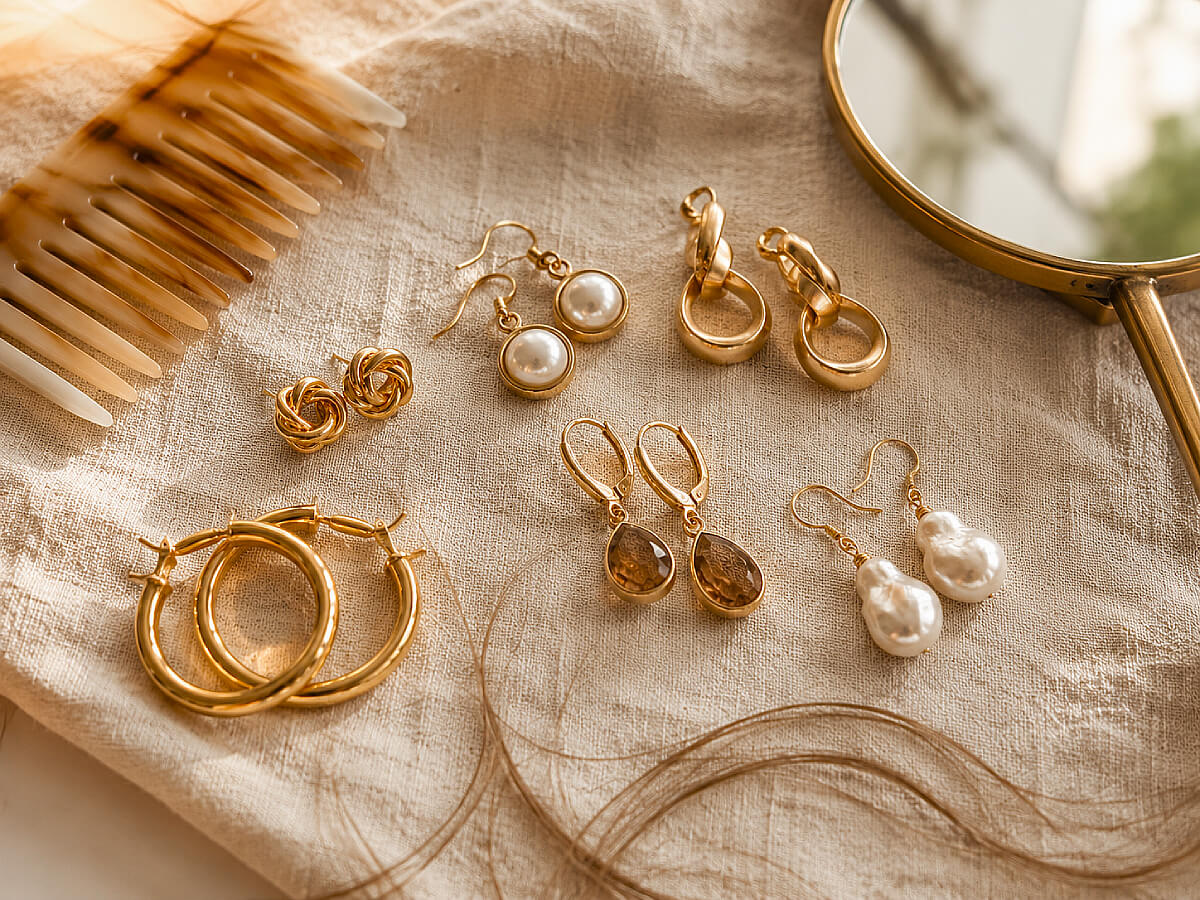

Question from Margaret Holloway, Bozeman, Montana: “I’ve been wearing the same small gold studs for years because I’m honestly scared to mess up my look with the wrong earrings. I recently got a new haircut, a chin-length bob, and I want to start being a little bolder with jewelry. But every time I look at earrings online I get overwhelmed. Is there actually a rule for matching earrings to your hairstyle, or am I overthinking this?”
Margaret, your concerns are completely reasonable. The fact that you’re taking the time to think this through tells me your instincts are already pointing you in the right direction. Here’s something I noticed early on in my years behind the chair: the women who came in saying they “couldn’t do” a certain style almost always could. They just didn’t have the right framing for it. Earrings and hairstyles work the same way. There are patterns to it, real ones, and once you see them you can’t unsee them.
I’ve had clients walk out of my salon looking completely transformed, not because of the cut, but because I handed them a pair of earrings from my own ears and said “just try it for a second.” The right combination does something to the whole face. The wrong one doesn’t ruin anything, but there’s a flatness to it, like a sentence that just kind of trails off. So let’s talk through the pairings that actually work, ranked by how much they tend to change the overall look, starting with the ones that are worth knowing and building up to the one I think matters most.
This post may contain affiliate links, meaning I may earn a small commission at no extra cost to you. I only share products I truly believe in. As an Amazon Associate, I earn from qualifying purchases. Your support helps me continue creating free content like this.
8. Pixie Cuts and Oversized Statement Earrings
Every stylist I know has a version of this opinion, and mine is pretty firm: a pixie cut is basically an invitation to go big with earrings, and most women who wear one don’t take that invitation nearly seriously enough. There’s so much exposed ear and neck real estate happening with a pixie that small studs can almost disappear, and that’s a little bit of a missed opportunity. The short length of the hair draws the eye straight down to your jawline and neck, which means whatever is hanging from your ears becomes a focal point whether you intend it to or not.
So you might as well make it intentional. Big geometric hoops, long chandelier styles, sculptural drops, they all work beautifully here because the hair isn’t competing with them. I’ve seen clients who wore nothing but tiny pearl studs for decades walk out of the salon after their first pixie and immediately go buy something they’d never have touched before. That’s not a coincidence. The cut changes what feels possible. What I’d steer away from is anything too fussy and delicate, like very fine chain earrings with tiny charms, because the contrast between the strong, cropped silhouette of the hair and something overly dainty can read as mismatched in a way that doesn’t serve either one.
If you’re shopping for a good pair to start with, something like the Ettika or Kendra Scott geometric drop styles are excellent entry points. Good weight, good scale, and they come in gold tones that work with almost any skin tone. The investment in one really good pair of statement earrings when you have a pixie pays off more than almost any other jewelry purchase you’ll make.
7. Long Layers and Delicate Chains or Threaders
Long layered hair has a lot going on visually, all that movement and texture cascading down, and there’s a tendency to think you need equally dramatic earrings to keep up with it. In my experience, the opposite tends to be more true. When hair has a lot of natural wave or layered volume to it, something very simple and fine, a thin gold threader, a single small diamond or crystal stud, a delicate ear cuff, actually reads as more intentional than a big chandelier would.
The reason is about visual competition. Long layers already create complexity around the face and shoulders, and a large earring in that mix can start to feel crowded, like too many things are happening at once. A simple, fine earring sits quietly in all of that and lets the hair do the work it’s already doing well. I had a client, a woman in her mid-sixties with the most gorgeous silver waves, and she kept wearing chunky turquoise drops that were honestly fighting her hair rather than complementing it. The day I convinced her to try a pair of simple thin gold hoops, about the diameter of a quarter, her whole face opened up.
For something specific, I really like the Mejuri or Gorjana thin gold threader earrings for this look. They’re understated without being boring, and they have just enough presence to feel like a real jewelry choice rather than an afterthought. Fine jewelry for everyday wear is one of those things worth spending a little more on, because you’ll reach for it constantly.
6. Blunt Bobs and Architectural Earrings
The blunt bob, including your chin-length version, Margaret, is one of my favorite cuts to work with because it has this wonderful geometric quality built right into it. The line is clean, the shape is deliberate, and the whole look has a kind of structural confidence to it. What mirrors that energy really well is an earring that also has some architecture to it, something with clean lines, angular shapes, or a sculptural quality that isn’t overly ornate.
Think about it this way: the bob has a hemline, almost like a well-tailored piece of clothing, and the earrings you wear are like the accessories you’d pair with that outfit. You wouldn’t put a very fussy, beaded, whimsical necklace with a perfectly cut blazer. The same logic applies here. Square or rectangular drops, modern bar earrings, slightly elongated hoops with a geometric finish, these all feel like they belong in the same conversation as a blunt bob rather than pulling against it.
Length matters, too. For a chin-length bob specifically, I’d keep the earring length right around the jawline or slightly shorter, because going much longer can visually compete with where the hair ends and create a kind of muddled edge. A pair from a brand like Baublebar or Jenny Bird in a matte or brushed gold finish tends to hit the right note here. These aren’t wildly expensive but they look considered, and that’s exactly what a blunt bob calls for.
5. Updos and Buns and the Earrings That Earn Their Place
Pulling your hair up is one of those moves that completely changes the visual weight of your whole head, and I think a lot of women underdress their ears when they do it. When your hair is gathered up and away from your face, your neck and ears are the main event. That’s not a subtle shift. It’s a significant one. And wearing the same small stud you’d wear with your hair down is sort of like setting a really beautiful table and forgetting to light the candles.
With an updo, you can go in a few different directions and have it work, which is actually one of the things I love about this particular styling situation. Long drops and chandeliers look absolutely beautiful because the open neck gives them room to move and catch light. But so do very ornate, jeweled studs or cluster earrings, because the stillness of the updo makes even a stationary earring feel more prominent. What I’d avoid with updos is medium-length, medium-weight, medium-everything earrings. That middle ground tends to feel neither intentional nor relaxed, just a little unresolved.
I remember doing hair for a woman’s retirement party a few years back, and she had the most stunning French twist but these sad little pearl drops that were just too small for the moment. We raided my kit and found a pair of longer gold drop earrings, nothing fancy, just from a set I keep around, and the whole look shifted. She looked like someone who had dressed on purpose. For updo occasions, something like Swarovski crystal drops or a quality rhinestone chandelier earring earns its price every time you pull your hair up.
4. Curtain Bangs and Framing the Face With Earrings That Play Along
Curtain bangs are interesting to work around from a jewelry perspective because they already do so much framing of the face on their own. That soft, center-parted sweep that falls on either side of the forehead creates a very specific kind of visual frame, and anything you add below it needs to feel like it belongs to the same mood, which is generally soft, a little romantic, slightly undone in the best way. Hard geometric earrings can feel at odds with that. Very structured, very angular shapes sort of argue with the gentle sweep of the bang.
What tends to work really well here is something with a little movement or organic quality to it. Vintage-inspired drops with soft curves, small hoops in a brushed or hammered finish, or earrings with a little bit of natural material like a small pearl or a stone with texture. The general direction is warm rather than cool, curved rather than angular, relaxed rather than precise. I know that sounds like a lot of rules but honestly, once you hold a pair up to your face with curtain bangs you’ll feel it. There’s a rightness to it that’s kind of hard to explain but very easy to recognize.
One pairing I come back to often for this look is a small baroque pearl drop, nothing too perfectly round and uniform, because the slight irregularity of a baroque pearl matches that relaxed, a-little-lived-in quality that curtain bangs have. The Anthropologie or Lele Sadoughi pearl drop styles are consistently good, and they’re the kind of earring that feels relevant across seasons rather than tied to a trend.
3. Shoulder-Length Hair and Why This Is Actually the Trickiest Length
Nobody talks about this enough, so I will: shoulder-length hair is actually the most challenging length for earring pairing, and it’s not because the hair is difficult, it’s because the hair ends right where earrings typically hang. The ends of the hair and the tip of a medium-length drop earring occupy the exact same visual space, and when that happens you get a kind of visual interference that softens both elements in a way that doesn’t serve either one. It’s like trying to listen to two people talking at the same volume at the same time.
There are a couple of ways to solve this. The first is to wear earrings that are shorter than your hair length, a stud, a small hoop, a tiny drop that sits well above where the hair ends, so they’re clearly visible as a separate element. The second is to go longer than the hair, a chandelier or long drop that hangs below the ends, again making the earring distinct rather than blended into the hair. The one thing I’d avoid is that middle zone where the earring tip and the hair tip are competing for the same inch of space.
Wearing your shoulder-length hair up or tucked behind the ear even partially can also solve this immediately, and honestly, that small styling adjustment opens up a much wider range of earring options. Keeping a few good quality hair clips like the Teleties or Emi Jay styles on hand gives you the flexibility to adjust throughout the day depending on what you’re wearing in your ears. It sounds simple because it is, but it makes a real difference.
2. Wavy or Curly Hair and the Earring Styles That Actually Show Up
Here’s where I’ll say something a little counterintuitive: very intricate, detailed earrings tend to get lost in curly or wavy hair. All that beautiful texture and volume around the face is visually busy in the best way, but it means that a very ornate, detailed earring with a lot of fine filigree or small stones just kind of disappears into the surrounding movement. You end up with something you spent real money on that essentially hides itself.
What I recommend for curly and wavy textures, especially when the hair is worn down, is something bold in shape rather than detail. A large, simple hoop is probably the single most universally flattering earring choice for curly hair, because the clean, continuous line of the hoop reads clearly against the texture of the curls rather than getting absorbed by it. The size of the hoop matters: too small and it disappears, too large and it can feel costume-y, but that middle range, somewhere between a quarter and a silver dollar in diameter, is usually right. Color and finish matter less than silhouette here.
I’ve recommended the Argento Vivo or Madewell large gold hoop earrings to so many clients with curly hair over the years and I’ve never once heard a complaint. They’re the kind of thing you put on and immediately understand why everyone keeps talking about hoops. For women with naturally curly hair who haven’t found their earring groove yet, start with a good hoop and work outward from there.
1. The Short-to-Medium Bob and Why This Is the Earring Sweet Spot
After all these years, if I had to pick one hairstyle that has the most naturally flattering relationship with the widest range of earrings, it would be the short-to-medium bob, and this is actually very good news for you specifically, Margaret, because you’re sitting right in this range with your chin-length cut. The bob is flattering partly because of what it reveals: your ears are consistently accessible, your jawline gets framed and defined by the hemline, and there’s just enough hair to create a backdrop without so much hair that it crowds the earring out of the picture.
What I find so interesting about this length is that it doesn’t prescribe a specific earring type the way some other styles do. A pixie almost demands something substantial. Long hair often calls for something restrained. But the bob has enough structure to support drama without requiring it, and enough simplicity to let a delicate earring read clearly. I’ve seen a chin-length bob look equally good with a small hammered gold stud on a Tuesday morning and a long vintage crystal drop on a Saturday night, and not many styles can say that honestly.
The one pairing I’d most recommend for someone starting to build their earring confidence with a bob is a medium-sized hoop or drop in a warm gold tone, somewhere in the range of an inch in length, with just a little bit of texture or movement to it. Not so large it feels like a costume, not so small it disappears. Something from the Gorjana or Stella & Dot collections tends to hit this note really well, and both brands have enough variety that you can explore without committing to a single style. Start there. Wear them for a week. Then, once you see how the right earring changes the whole picture, you’ll have all the confidence you need to go further.
A Few Last Thoughts From Behind the Chair
The thing about earring and hairstyle pairing is that there genuinely are patterns to it, as I hope this list showed, but the patterns are more like guidelines than rules. I’ve broken most of them at some point and had it work beautifully. What tends to matter more than following any specific formula is developing an eye for proportion and visual weight, which really just means paying attention and trusting what you observe rather than what someone told you should work.
My honest advice to Margaret, and to anyone else in the same boat, is to stop waiting until you have the perfect earring to try something new. Pull out what you have, hold it up to your face in the mirror with your current hairstyle, and look at it with real attention. Does it compete with your hair or complement it? Does it feel like it belongs in the same moment as the rest of your look? That’s really what you’re evaluating, not whether you’ve followed a rule correctly. The women who consistently look like they’ve put themselves together well aren’t necessarily following the most rules. They’re just paying attention to what’s in front of them, and then trusting what they see.
You’ve got a great haircut, Margaret. Now go buy one good pair of earrings and see what happens.