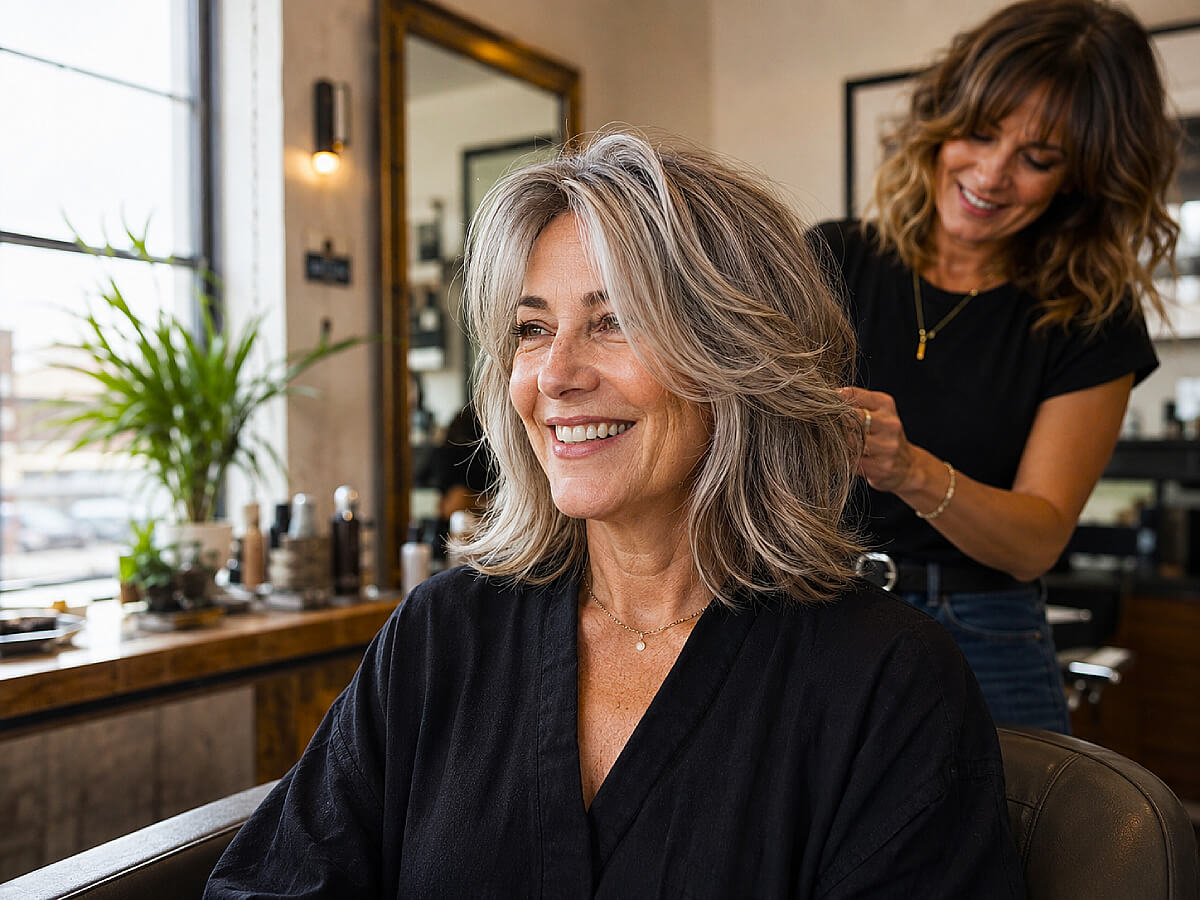

Question from Deborah Calloway, Muncie, Indiana: “I turned 52 last year and my hair has completely changed on me. It’s thinner, the texture is different, it doesn’t hold a style the way it used to, and honestly it doesn’t even feel like my hair anymore. My stylist keeps cutting it the same way she always has but something just isn’t working. What’s actually happening and what should I do about it?”
There’s a moment a lot of women describe to me in the chair, usually somewhere between their early 50s and mid-50s, where they say something like “I don’t know what happened, I just woke up one day and my hair was different.” And I always want to say, it didn’t happen overnight, but I understand why it feels that way. The changes are gradual enough that you keep adjusting, keep buying slightly different products, keep blaming the weather or the water or that one dye job, until one day you look in the mirror and realize you’ve been compensating for years and the hair looking back at you is genuinely not what it used to be.
After more than 20 years doing hair, this is still the conversation I hear the most. The one that feels the most personal, the most frusrating, and somehow still not talked about enough. Women in their 50s whose hair has shifted in ways nobody warned them about, and who are getting advice that was built for a different head of hair. So I want to actually walk through what’s happening, because understanding it changes everything about how you treat it, style it, and cut it going forward.
This post may contain affiliate links, meaning I may earn a small commission at no extra cost to you. I only share products I truly believe in. As an Amazon Associate, I earn from qualifying purchases. Your support helps me continue creating free content like this.
8. Your scalp’s oil production has quietly dropped off, and it changes everything
I want to start here because almost nobody talks about it, and it’s one of the things that affects hair the most. Sebaceous glands, the ones that produce oil along your scalp and hair shaft, slow down significantly as estrogen levels decline. For a lot of women this starts happening in their late 40s but really picks up steam in the early 50s, and what it means practically is that your scalp produces less of the natural oil that used to travel down the hair shaft and keep it flexible, shiny, and protected.
The result can look like a lot of different things depending on your hair type. If you had fine hair, it might suddenly look even flatter because that light natural coating is gone. If you had thicker hair, it might feel more coarse and rough than it ever did before. Almost everyone notices that their hair seems dryer, that it takes longer to feel “dirty,” and that the products they’ve used for years are suddenly either doing too much or not enough. A woman I’ll call Karen, who came to me after moving from Phoenix to Portland and blamed the climate for everything, turned 53 in the chair one appointment and we finally pieced together that her scalp had changed more than her zip code had.
The fix isn’t just adding more conditioner, though that helps. You may need to rethink your whole washing frequency and your product lineup. A weekly scalp treatment with something like a nourishing scalp oil can make a real difference. I personally like recommending Kérastase Elixir Ultime Hair Oil, which you can find here on Amazon, because it’s lightweight enough that it won’t weigh fine hair down but rich enough to actually address the dryness. This isn’t a styling fix. It’s a maintenance fix, and it needs to become part of your regular routine.
7. The diameter of each individual strand has gotten smaller
This one surprises people because we tend to think about hair loss in terms of how many strands we have, but the thinning that happens in your 50s is often as much about the width of each strand as it is about the count. Each hair follicle produces a strand that, over time and with declining hormones, becomes finer in diameter. So even if you haven’t lost a dramatic amount of hair, your overall hair can feel and look significantly thinner because each strand is contributing less visual density than it used to.
This is why a lot of women tell me that their ponytail feels thinner even though they don’t see hair in the drain. Both things can be true at once. The density is changing and the strand width is changing, and they compound each other in a way that can feel pretty alarming if you don’t know what’s driving it. I had a client, a retired teacher named Margaret, who cried in my chair because she thought she was sick. She wasn’t. She was 54 and her hair was doing exactly what hair does at 54, but no one had ever told her it would.
Volumizing products become more important here, but you have to pick the right kind. Heavy mousses and old-school hairsprays can actually make fine strands clump together, which makes thinning look worse. I steer clients toward Oribe Volumista Mist, which you can search here, because it adds body without stiffness. Another thing worth considering is a biotin supplement, not as a miracle cure but as support alongside everything else. And honestly, a good haircut built for fine hair at this stage does more than any product. We’ll get to that.
6. Your hair’s porosity has shifted, so color and products behave differently
Porosity is one of those technical terms I try to explain to every single client because it matters so much and nobody outside a salon seems to know about it. Simply put, porosity describes how easily your hair absorbs and holds onto moisture and color. Hair with low porosity is resistant, slow to absorb, but once it has moisture it holds it well. High porosity hair soaks everything up fast but lets it go just as fast. In your 50s, a combination of hormonal changes, accumulated heat styling, color treatments, and just plain time means that most women’s hair shifts toward higher porosity, and that changes how everything performs.
Color is the most obvious place you’ll notice it. If you’ve been coloring your hair for years, you might find that the color grabs faster now, especially on the ends, which means uneven results. Or that it fades faster. Or that your gray coverage isn’t behaving consistently. These aren’t problems with your colorist, necessarily. They’re problems with porosity, and they need to be addressed with protein treatments and bond-building products before and after color services. I use Olaplex No. 3 Hair Perfector with almost every color client over 50, and you can find it here. It’s not a conditioner, even though it gets treated like one. It actually repairs broken bonds in the hair structure, and at this stage of life, your hair has a lot of broken bonds.
The other thing I’d say here is that switching to a sulfate-free shampoo is not optional anymore. It was a nice idea before. Now it’s necessary. Sulfates strip already-fragile hair and contribute to that dry, rough texture women complain about. This is a small change that makes a noticeable difference within a few weeks.
5. Hormonal hair loss is real and it’s different from the shedding you’re used to
We shed hair every day, always have, and most of us are used to that. But the hair loss that comes with perimenopause and menopause is a different animal, and it tends to show up in specific places: the temples, the part line, and the overall density at the crown. It’s called female pattern hair loss and it’s driven largely by the shift in the estrogen-to-androgen ratio that happens as estrogen levels fall. Androgens, which have always been present in smaller amounts, become more influential on the follicle and can cause those follicles to miniaturize over time.
I want to be honest with you about this one because I think stylists sometimes dance around it. This type of hair loss is worth talking to your doctor about, not just your stylist. There are topical treatments like minoxidil (the generic version of Rogaine, which you can find here) that have clinical evidence behind them, and there are dermatologists who specialize specifically in hair loss in women. I have sent clients directly from my chair to a dermatologist, and I’m not embarrassed about that. A good cut can work with what you have, but it can’t reverse follicle miniaturization.
What I can do is help manage the appearance of it with the right cut and the right styling approach. Keeping hair shorter at the sides and with more weight on top, avoiding heavy layers that expose the scalp, using a root concealer spray on days when the part line is bothering you, these things genuinely help. But the most helpful thing is knowing what you’re dealing with so you can address it at every level, not just the cosmetic one.
4. Gray hair has a completely different texture and it needs different care
Gray hair is not just pigment-less hair. I wish more people understood this because it’s one of the most practically important things I tell clients who are transitioning or who have gone fully gray. When the melanin-producing cells in your follicle slow down and stop, the structure of the hair strand itself changes. Gray hair tends to be coarser, more wiry, more resistant, and more prone to frizz because the cuticle layer sits differently without the influence of melanin. It also tends to have a slightly different wave or curl pattern than your pre-gray hair did.
This means if you’re embracing your gray, and I fully support that, you need a care routine built for gray hair specifically, not just your old routine with the color treatment skipped. There are shampoos and conditioners formulated specifically for gray and silver hair, and they do two things: they tone out the yellow and brassiness that gray hair picks up from the environment and hard water, and they add the moisture and smoothing that coarser gray strands actually need. I love Shimmer Lights Shampoo for toning, which you can look up here, used once a week, and a really rich deep conditioning mask the other wash days.
I had a client who went gray in her early 50s and her hair looked absolutely stunning, silver and full, and she was getting compliments constantly. About a year in she started coming in with this dull, yellowy frizz situation and she thought her hair was deteriorating. It wasn’t. She’d just stopped using the toning shampoo because she ran out and didn’t reorder. We fixed it in two washes. Gray hair is beautiful but it’s a little high-maintenance in ways that nobody tells you going in.
3. Your hair’s elasticity has decreased, and heat styling causes damage much faster now
Elasticity is what allows a hair strand to stretch and then return to its original shape without breaking. Healthy hair has good elasticity. Hair that’s been through decades of styling, coloring, hormonal changes, and protein loss has significantly less of it. And when elasticity is compromised, heat damage happens faster and at lower temperatures than it ever did before. That flat iron you’ve been using on 400 degrees for twenty years? It’s doing a different kind of damage to your 53-year-old hair than it did to your 33-year-old hair.
I see this constantly. Women who have always blow-dried and flat-ironed without much consequence suddenly finding that their hair feels like straw a few days after styling, or that their ends are perpetually dry and snapping off. The hair is not more fragile because something is wrong. It’s more fragile because elasticity naturally decreases with age and with the cumulative effects of everything you’ve put your hair through, and that’s completely normal. But you do need to adjust your approach.
Drop your heat tools down, genuinely, to 300-350 degrees for fine hair and no more than 380 for thicker hair. Use a heat protectant every single time, not occasionally. I have been recommending Chi 44 Iron Guard Thermal Protection Spray for years, it’s affordable, it works, and you can find it here. And if you can give yourself two or three days a week without any heat tools at all, your hair will thank you in a way you’ll actually be able to see and feel within a month.
2. Your hormones are directly changing your curl pattern and wave formation
This one I find genuinely fascinating, and I’ve watched it happen so many times that I’ve stopped being surprised by it. Estrogen plays a role in how the hair follicle is shaped, and when estrogen levels shift during perimenopause and menopause, the shape of the follicle can actually change slightly. A round follicle produces straight hair. An oval or asymmetrical follicle produces wavy or curly hair. So when your hormones shift, women who had straight hair their whole lives sometimes start developing a wave. Women with a wave can find it goes either curlier or flatter. And women who always had lovely defined curls can find those curls becoming looser, less predictable, or developing a strange combination of textures across the head.
I had a client, a woman I’d been seeing for probably eight years, who came in around age 51 with hair that was suddenly doing this strange thing at the back where it wanted to curl under on one side and flip out on the other. She thought something was wrong with her last cut. It wasn’t the cut. Her texture was transitioning, and it kept evolving for the better part of two years before it settled into something consistent. We had to learn her new hair together, and that’s kind of what I want to encourage you to think about. It’s not broken. It’s changing. There’s a difference.
If you’re developing new wave or curl, this is actually an invitation to try a curl-enhancing cream or a diffuser attachment for your blow dryer rather than fighting the texture with more heat. DevaCurl SuperCream, available here, works beautifully for newly wavy hair in this stage of life. Working with a new texture instead of against it is genuinely less work. And sometimes the hair that shows up in your 50s is softer and more interesting than what you had before, you just need someone to help you see it that way.
1. The cut that worked for twenty years may simply not work anymore, and that’s not a small thing
This is the one I save for last because I think it’s the most important and also the one that takes the most courage to act on. The haircut you’ve had since your 30s or 40s, the one that felt like “your” cut, was built for a different head of hair. Different density, different texture, different behavior, different relationship with moisture and color and gravity. When the hair changes as dramatically as it does in your 50s, the cut has to change with it, and a lot of women resist this for a really long time. Some out of loyalty to a look they identify with. Some because change feels like loss. Some because nobody has ever sat them down and actually explained why it isn’t working anymore.
I’ll tell you what I tell clients in this situation. Heavy one-length cuts drag down on fine hair at this age and make it look flat and limp. Blunt bobs can work beautifully but need to be positioned correctly for your face shape and kept very regular because fine hair in a blunt line grows out visibly fast. Long layers can be stunning but only if there’s enough density to carry them, otherwise you end up with thin wispy ends that look scraggly rather than soft. Short cuts, done well, are genuinely liberating for a lot of women in their 50s, not because older women “should” have short hair (I hate that rule) but because a well-executed short cut can restore volume, emphasize your bone structure, and take twenty minutes off your morning routine, and at this point in life that last thing is underrated.
The best thing you can do, and I mean this, is find a stylist who will actually look at your hair, not at the photo you brought in, and have a real conversation about what your hair is doing right now, how it’s behaving through the week, where it’s giving you trouble, and what you actually have time and energy to maintain. A consultation where you’re both looking at your hair in motion, touching it, talking about your lifestyle, that’s where the right cut comes from. Bring the photo if you want to, I’m not anti-inspiration board, but be willing to have the stylist say “let me show you something that’ll do even more for you than that.”
Some cuts I’ve seen work especially well for this stage of life: a textured layered lob that sits right at the collarbone, a cropped pixie with softness at the temple, a modern shag with curtain bangs that adds volume at the crown, and a chin-length French bob that gives the illusion of thickness. Look up styles from stylists who specifically work with mature hair, or search books on mature hair styling if you want a deeper resource. And if your current stylist isn’t engaging with these changes in your hair, it might be time for a second opinion. You deserve a cut that works with the hair you have right now, not the hair you had fifteen years ago.
So what does all this actually mean for you going forward
I want to close by saying something that might sound a little counterintuitive from a hairstylist: your hair in your 50s, even with all the changes, is not your enemy. It’s different, yes, and some of what’s different is frustrating, and some of it takes getting used to. But I have seen so many women in their 50s and 60s walk out of my chair looking genuinely, significantly better than they did in their 30s once we figured out what their hair actually needed. The right cut, the right products built for this specific type of hair, the right color approach, whether that means embracing gray or refining your coloring strategy, it adds up to something that feels like you again, just a more current version.
The biggest thing Deborah’s question gets at, and honestly the thing I hear underneath almost every version of this question, is that feeling of being blindsided. Of nobody having prepared you. And I can’t fix the fact that we don’t talk about this enough, but I can at least say it clearly here: your hair is going to change in your 50s in ways that are significant and real, and you are not imagining it, and you are not doing anything wrong, and there are real, concrete things you can do about it. Start with understanding what’s happening. Then adjust one thing at a time. And find a stylist who will actually talk to you about it, because you deserve that.