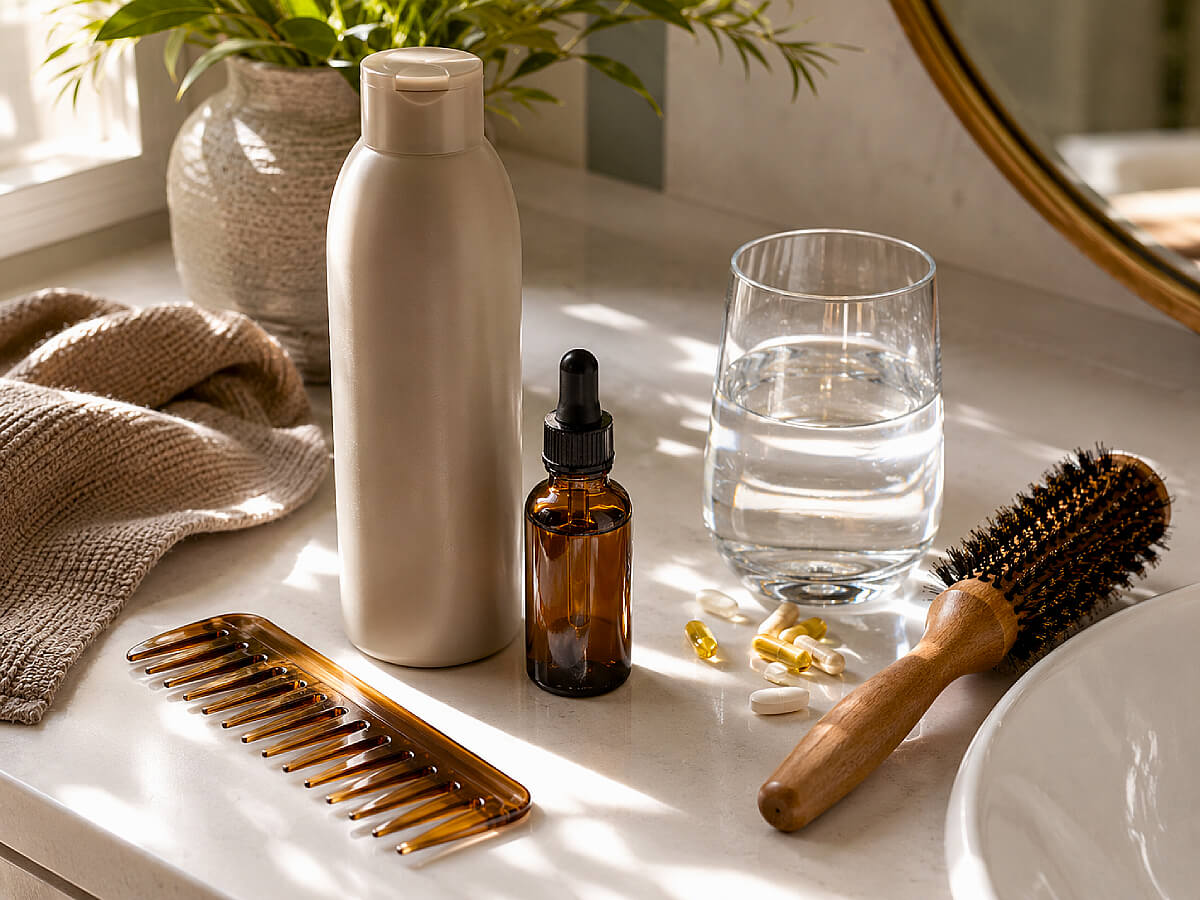

From Sandra Kowalczyk, Muncie, Indiana: “I’ve been noticing my hair feels so much thinner than it did even two or three years ago. It’s not falling out in clumps or anything dramatic, just… less. My ponytail is about half the diameter it used to be and my part looks wider. I wash and style it the same way I always have but nothing seems to be helping. Is there actually a weekly routine I could follow that would make a real difference, or am I just fighting the inevitable at this point?”
Sandra, I hear this exact question at least a few times a week in my chair, and I want you to know you are absolutely not fighting the inevitable. Hair that feels thinner is one of the most common concerns I see in women over 40, and the good news, the real good news, is that how you care for your hair week to week makes a much bigger difference than most people realize. This isn’t about some miracle product or an expensive salon treatment, though we’ll talk about a few things worth spending money on. It’s mostly about building a rhythm, a weekly hair-thickening routine that actually respects what your hair needs right now versus what it needed ten years ago.
I’ve spent two decades transforming hair and I’ve watched women completely transform the density and feel of their hair just by changing their habits. I had a client, a woman in her late 50s named Dolores, who came in convinced she needed to start wearing wigs. Within about four months of adjusting her washing schedule, adding one scalp treatment, and switching out her brush, her hair looked so much fuller that I actually asked her if she’d started something medical. She hadn’t. It was just the routine. So let’s build yours.
This post may contain affiliate links, meaning I may earn a small commission at no extra cost to you. I only share products I truly believe in. As an Amazon Associate, I earn from qualifying purchases. Your support helps me continue creating free content like this.
8. Rethink How Often You’re Actually Washing
I know this might not feel like the most exciting place to start a hair-thickening conversation, but washing frequency is genuinely one of the biggest levers you have, and most women are pulling it in the wrong direction. Over-washing is incredibly common, especially if you’ve had oilier hair in the past and trained yourself to wash daily or near-daily. The problem is that as estrogen levels shift with age, your scalp produces less oil, and stripping it with frequent shampooing can leave the hair shaft dry, rough, and prone to breakage. Thin hair and broken hair can look almost identical from the outside, but they have very different solutions.
What I generally recommend for women dealing with fine or thinning hair is washing two to three times per week at most. I personally went through a phase where I was washing my own hair every single day because I was in the salon touching other people’s hair all day and I just felt like I needed to. My ends were so brittle and see-through, I couldn’t figure out why until I finally took my own advice. Cutting back to every other day made a visible difference within a few weeks.
When you do wash, the technique matters as much as the product. Use lukewarm water, not hot. Concentrate the shampoo on your scalp only, not your lengths, and let it rinse through the ends on its own. If you’re reaching for a good volumizing shampoo, Pureology Pure Volume Shampoo is one I’ve recommended for years, and the Kérastase Densifique Bain Densité is worth every penny if you want something more targeted toward density.
7. Add a Weekly Scalp Massage With the Right Oil
Scalp health and hair density are more connected than most people give credit for, and for a long time this felt like wellness-world fluff to me, honestly. Then I started actually looking at the research around scalp stimulation and blood circulation and changed my tune pretty quickly. There’s a reason dermatologists and trichologists keep coming back to scalp massage as a first recommendation. Increased circulation to the hair follicles means better nutrient delivery, and for follicles that are starting to miniaturize, that can genuinely slow down the process.
Once a week, usually on the evening before a wash day, set aside about five minutes to really work your fingertips through your scalp. Not your nails, your fingertips, using small circular motions across the entire scalp from nape to front hairline. You can do this on dry hair, but doing it with a lightweight oil is even better because it also conditions the scalp itself. I like rosemary oil diluted in a carrier like jojoba for this, and the research backing rosemary oil for hair growth is genuinely solid enough that I don’t feel silly recommending it anymore. There are also some good premixed scalp serums like the The Ordinary Multi-Peptide Serum for Hair Density that work well if you’d rather skip the DIY route.
The consistency matters more than the duration of any single session. Five minutes every week for three months will do more for your hair thickness than a 20-minute marathon session once in a while. I’ve seen women get real results with this, especially when they combine it with the right washing schedule, which is part of why the routine approach works better than any single product alone.
6. Use a Deep Conditioning Treatment, But Do It Correctly
This is where I have to push back on some standard advice, because I see women over-conditioning fine hair all the time and making it worse. The instinct makes total sense. Hair feels thin and brittle, so more moisture must help, right? Not always. Heavy conditioning masks applied root to tip, left on for long stretches, can weigh fine hair down and make it look flatter and thinner than it did before you started. I’ve had clients come in with hair that looked almost plastered to their head and the culprit was a deep conditioning mask they were using twice a week with the best intentions.
What you want is a targeted protein and moisture treatment once a week, applied from mid-shaft to ends only, and rinsed thoroughly. I’m a big fan of the Olaplex No. 3 Hair Perfector for this, because it works on the bond structure of the hair rather than just coating it, and it doesn’t leave that heavy residue. If your hair is particularly fine and fragile, a lightweight protein treatment like Aphogee Two Minute Reconstructor is something I’ve recommended to clients for years and it genuinely firms up the hair shaft without weighing it down.
Apply it on damp, freshly washed hair, wait the appropriate time on the packaging, and rinse with cool water. That cool water rinse at the end closes the cuticle and adds to the appearance of thickness and shine. It’s a small thing but I always mention it because most people skip it.
5. Switch to a Volumizing Blow-Dry Routine Mid-Week
How you dry your hair has a permanent effect on whether it sits flat all week or holds some lift and body. Air-drying sounds gentle and protective, and sometimes it is, but for fine thinning hair it often means the hair dries plastered flat to the scalp and stays that way. A good blow-dry done right can create lift at the root that lasts for days, and when you combine it with the right products it actually looks like more hair than there is.
Start with a volumizing mousse or a root-lifting spray on damp hair before you even pick up the dryer. The Living Proof Full Dry Volume Blast is one of those products that I’ve gone back to again and again, and I’ve tried almost everything. Apply it at the roots, flip your head upside down, and use a medium-heat setting to rough-dry the hair about 80% of the way. Then, flip back up and use a round brush to smooth and lift section by section. The Drybar Double Shot blow-dryer brush is something a lot of my clients have had great luck with at home because it combines the drying and the brush work in one step.
You don’t have to do this every day, honestly. Doing a proper volumizing blow-dry on day one of fresh hair and then refreshing with a dry shampoo or a root-lifting spray on subsequent days is a much more realistic routine and it’s actually better for your hair’s overall health than blasting it with heat daily.
4. Incorporate a Bi-Weekly Clarifying Wash
Product buildup is one of the quietest enemies of hair volume, and it’s something I talk about more than almost any other topic because most women don’t realize it’s happening. Every styling product you use, every dry shampoo, every conditioner, every heat protectant leaves some residue on the hair shaft and scalp. Over time, that accumulates into a film that weighs hair down, dulls the color, and makes even freshly washed hair look limp within hours. When people tell me their hair feels greasy faster than it used to, or that their roots always look flat no matter what, buildup is usually where I start the conversation.
Every two weeks, swap your regular shampoo for a clarifying shampoo and give your hair and scalp a thorough cleanse. The key is not to do this more frequently because clarifying shampoos are strong and using them weekly will strip your hair too aggressively. Neutrogena Anti-Residue Clarifying Shampoo is genuinely one of the best and most affordable options out there, and I’ve never felt the need to upgrade to something fancier. The Ouai Detox Shampoo is a slightly gentler clarifying option if you find the stronger formulas too stripping.
Do this on a day when you have a little extra time, because after clarifying you’ll want to follow up with a good conditioner or that weekly protein treatment I mentioned above. Clarifying strips everything including the good stuff, so you want to replenish right after. Once you start doing this consistently, you’ll notice your styling products work better and your volume lasts longer through the week.
3. Reassess What’s on Your Brush and How You’re Using It
I have pulled so many brushes out of my clients’ bags that made me genuinely wince. Boar bristle brushes with bent, splayed bristles that are tearing through fine hair. Cheap paddle brushes with those little plastic ball tips that have worn off, leaving metal nubs scraping the scalp. The brush situation in most women’s bathrooms is honestly a bit of a crisis and nobody talks about it enough because it doesn’t feel as exciting as a new serum or a treatment.
For fine, thinning hair specifically, a wide-tooth comb for detangling wet hair is non-negotiable, because wet hair stretches and breaks much more easily than dry hair, and a brush on soaking-wet fine hair can cause significant breakage that mimics thinning over time. The Wet Brush Original Detangler is one I recommend constantly because the flexible bristles genuinely reduce breakage compared to conventional brushes. For dry styling, a natural boar bristle round brush is what I reach for when I want to add body and shine without snagging.
Also, always start detangling from the ends and work your way up toward the root, never root to tip. I know you’ve probably heard this before but I still see it done wrong in my chair all the time. Starting at the root and dragging down concentrates tension on the weakest parts of aging fine hair and the breakage is real and cumulative. Take the extra 30 seconds. Your ponytail diameter will thank you.
2. Use a Scalp Exfoliating Treatment Once a Week
Here’s something that took me longer than I’d like to admit to really get behind, because scalp exfoliation felt trendy and gimmicky when it first started showing up everywhere. But I’ve come around completely, and the reason is simple. When dead skin cells, product residue, and sebum accumulate on the scalp and clog hair follicles, it creates a real physical barrier to healthy hair growth. You can use every thickening serum and volumizing spray on the market, but if the scalp environment itself is congested, you’re working against yourself.
A gentle scalp scrub or exfoliating scalp treatment once a week, ideally the same night as your scalp massage, makes a meaningful difference in scalp circulation and follicle health. I use and genuinely love the Briogeo Scalp Revival Charcoal and Coconut Oil Micro-exfoliating Shampoo, which can function as both an exfoliating scalp scrub and a shampoo in one step. For women who want something you apply before washing, the Christophe Robin Cleansing Purifying Scrub is a salon staple that I’ve been recommending to clients for years, and I’ve watched it improve scalp texture and overall hair health pretty dramatically in women who were dealing with stubborn flat, lifeless roots.
The thing about scalp exfoliation is that the results aren’t immediate the way, say, a volumizing mousse is immediate. Give it six to eight weeks of consistent weekly use before you decide if it’s working. Hair growth and follicle health improvements are slow and incremental, but they are absolutely real. Some of the most meaningful changes I’ve seen in my clients’ hair thickness over time came from this single addition to their routine.
1. Commit to a Consistent Supplement and Nutrition Strategy
I’ve saved this for last because it genuinely is the most important factor, and also the one that requires the most patience, and most of us, myself included, don’t want to hear that. But I would be doing you a real disservice if I built out this entire weekly routine and left out the part where I tell you that what’s happening at the root of thinning hair is often systemic, meaning it starts from the inside. No amount of topical product will fully compensate for deficiencies in the nutrients hair needs to grow and thicken.
The big ones to talk to your doctor about are ferritin (stored iron), vitamin D, biotin, and zinc, because these are the deficiencies I see come up most consistently when my clients dig into their bloodwork after noticing thinning. Low ferritin in particular is wildly underdiagnosed in women and is one of the most common correctable causes of hair loss. Your regular iron test can come back normal while your ferritin is in the basement, so specifically ask your doctor to test ferritin levels if you haven’t already.
For supplements, I point clients toward Nutrafol Women more than anything else right now, because it’s the one that has actual clinical research behind it rather than just a pretty marketing campaign. The Viviscal Extra Strength Hair Growth Supplement is another one with solid research, and it’s been around long enough that I’ve personally watched clients use it through full growth cycles and seen real density changes. Eating enough protein is genuinely just as important as any supplement, because hair is made of keratin, which is protein, and women who are under-eating or following very low-fat diets often see thinning as one of the first side effects.
This is the piece that builds on everything else. Your clarifying washes and your scalp massages and your proper blow-dry technique are all doing meaningful work, but when your body has the raw materials it needs to actually grow stronger, thicker strands, the whole routine starts compounding on itself in a way that feels almost dramatic after a few months. Give yourself six months of truly consistent effort across all of these areas, and Sandra, I genuinely think you’ll be surprised by where your ponytail ends up.
Putting It All Together
I know a list of eight things can feel overwhelming when you’re staring at it all at once, so here’s how I’d approach it if you’re starting from scratch. In the first week, just focus on your washing frequency and pick up a good volumizing shampoo. The week after, add in the scalp massage. Build it slowly so it actually sticks rather than trying to overhaul everything at once and burning out by week three, which is what most of us do.
The truth is, a hair-thickening routine is a long game, not a quick fix, and I think that’s actually encouraging once you let it land. It means the work you put in today is creating a scalp environment and hair structure that pays you back for months afterward. Your hair is not finished. It’s waiting for you to figure out what it needs, and now you have a pretty solid map for getting there.