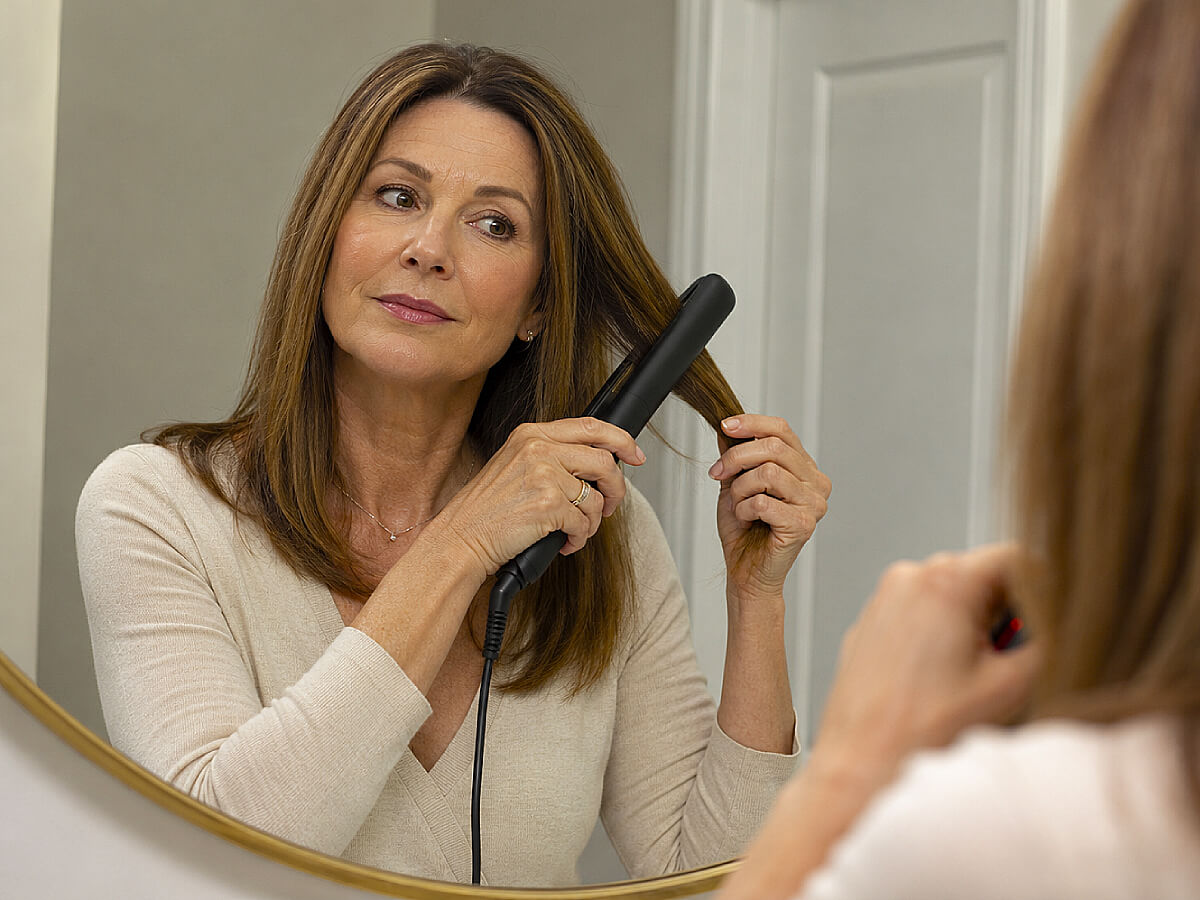

Question from Darlene Hutchinson, Flagstaff, Arizona: “I’ve been using the same flat iron and blow dryer routine for about 20 years and lately my hair just feels… different. It used to bounce back fine but now it looks fried by Wednesday even though I’m doing everything the same. Am I doing something wrong, or is this just what happens to hair as you get older? I’m 57 and really don’t want to give up my hot tools.”
Darlene, I want you to know that what you’re experiencing is incredibly common. In fact, many women in their 50s tell me the exact same thing when they come in for a consultation, often feeling frustrated and wondering what happened to the hair they used to have. They haven’t changed their routine. Their tools are fine. But the hair they have now is genuinely not the same hair they had at 38, and that matters more than most people realize when it comes to heat styling.
What I’m saying is, aging hair loses moisture, density, and a protective layer called the cuticle actually gets thinner over time, which means it has less of a buffer against the same temperatures you’ve always used. That routine that worked perfectly fine for two decades can quietly start doing real damage, and because it happens gradually, you don’t notice until one day your hair just feels like straw and you can’t figure out why. I’ve seen it a hundred times. And the good news is, it’s usually very fixable once you understand what’s actually changed.
This post may contain affiliate links, meaning I may earn a small commission at no extra cost to you. I only share products I truly believe in. As an Amazon Associate, I earn from qualifying purchases. Your support helps me continue creating free content like this.
5. Your Hair’s Moisture Barrier Has Changed, and Heat Plays By Different Rules Now
When I was doing hair in my early career, I had a client, probably mid-50s, came in every six weeks with beautiful silver hair that she flat ironed every single morning. She’d been doing it since the 80s. And one year, I noticed her ends were getting progressively more translucent, kind of see-through at the tips in a way that looked like overprocessed color damage, except she wasn’t coloring at all. It took us a while to figure out that the problem was heat, the same heat she’d always used, on hair that had slowly stopped being able to handle it.
What happens to hair as estrogen levels decline is genuinely interesting from a science standpoint, though I’ll keep this practical. The sebaceous glands in your scalp produce less oil, which means your hair loses a lot of its built-in conditioning. That natural oil was doing a lot of protective work you probably never gave it credit for. At the same time, the cortex of the hair fiber, which is the inner structure that holds moisture, becomes less elastic. So when you apply heat, the hair bends and shapes, but it also loses water content faster and recovers more slowly.
What that means practically is that 380 degrees on a flat iron, which might have been totally fine at 40, is genuinely too high for most women over 50 unless their hair is extremely coarse. The damage isn’t always immediately visible. It accumulates. And the dryness and dullness that Darlene is describing by midweek is almost always the first sign. Before you change anything else about your routine, understanding that your hair’s relationship with heat has fundamentally shifted is the most important starting point, because everything else builds on it.
4. The Temperature Settings You’ve Been Using Are Probably Too High
I have strong feelings about this one, so bear with me. The hair tool industry has spent decades convincing us that higher heat equals better results, faster styling, shinier finish, and while that might be true for thick, coarse, very resistant hair, it is not true for the majority of women over 50 whose hair has thinned and lost density over time. And I think a lot of women are walking around unknowingly using temperatures that are just too aggressive for what their hair can handle right now.
The general guideline most stylists use is this: fine or thinning hair should really stay under 300 degrees Fahrenheit, medium hair can usually handle up to around 350, and only genuinely thick, coarse, or very curly hair needs anything above that. But here’s where it gets complicated, most of us have a mix. You might have fine hair at the temples and thicker hair at the back, or your hair might have changed texture unevenly as you’ve gotten older, which is actually really common, especially around the hairline. So blanket rules only go so far.
What I’d recommend is starting lower than you think you need to and working up, which I know sounds obvious but almost nobody does it. A flat iron with precise adjustable temperature settings is genuinely worth the investment here because the cheap ones often run hotter than they read. Brands like GHD and BaByliss are ones I’ve used professionally for years and actually trust the temperature accuracy on. The GHD Platinum+ flat iron is a splurge but it has predictive technology that keeps the temperature from spiking, which is exactly what aging hair needs. If you’re budget-conscious, the BaBylissPRO Nano Titanium is reliable and goes lower than a lot of tools in its price range.
3. Heat Protectant Is Not Optional Anymore, and Most People Are Using It Wrong
Okay, I’ll confess something. When I was younger, I skipped heat protectant constantly. I knew better, I was literally trained to know better, and I still skipped it because my hair was thick and resilient and honestly it didn’t seem to matter that much. I am paying for that now in my mid-40s and I tell every client this story because I want them to learn from my stubbornness rather than their own.
Heat protectant is doing something specific and important. It creates a barrier between your hair fiber and the heat source, slows down moisture loss during styling, and in some formulas, actually helps the hair hold its shape longer so you need less repeat passes with the iron. That last part matters a lot because one of the biggest causes of heat damage I see in mature hair is not the temperature itself but the number of times the iron or dryer passes over the same section because the style isn’t holding.
The thing most people do wrong is apply it to soaking wet hair right out of the shower and then immediately start blow drying. The product hasn’t had a chance to distribute properly and some of it is basically just evaporating off with the water. Apply your heat protectant to hair that’s been towel dried and gently detangled, so it’s damp but not dripping. Work it through in sections. Give it a moment. The TRESemmé Thermal Creations Heat Tamer spray is an affordable everyday option that genuinely works, and for something more nourishing if your hair is on the drier side, I really like the Olaplex No. 9 Bond Protector, which is both a heat protectant and a treatment in one. It’s a little pricier but a bottle lasts a long time because you don’t need much.
One more thing: spray formulas are not always better than serums or creams for mature hair. If your hair is already on the dry side, a lightweight serum or leave-in cream might give you more moisture alongside the protection. It’s worth experimenting.
2. How You Dry Your Hair Before Styling Matters More Than the Styling Itself
This is the one that surprises people the most when I bring it up, and I’ve genuinely changed the outcome for clients without changing anything about their flat iron routine just by changing what happened before. The blow drying phase, or even just how you handle wet hair before it dries, is where a huge amount of damage to aging hair actually starts.
Wet hair is incredibly vulnerable. The hydrogen bonds that give hair its structure are broken when hair is wet, and at that point the fiber is stretchy in a way that it shouldn’t be. Pulling a brush through soaking wet hair, rough towel drying, or diving straight into a blow dryer on high without any sectioning, these are all things that cause mechanical damage that then compounds whatever the heat does later. I’ve had clients with hair that looked heat damaged but was actually just being physically over-manipulated while wet, and once we fixed that, the condition improved pretty dramatically within a few months.
For anyone using a blow dryer daily or even a few times a week, the microfiber hair towel is something I recommend to almost every client over 50. It absorbs water much faster than a regular towel and without the roughness that causes frizz and breakage. Squeeze, don’t rub. Let the microfiber do the work. Then, when you’re ready to blow dry, use a professional ionic blow dryer on medium heat rather than high, and keep the dryer moving. The Dyson Supersonic is the gold standard and genuinely worth it if you blow dry daily because the motor keeps the temperature controlled in a way most dryers don’t, but if that price point isn’t realistic, the Revlon One-Step Volumizer is one I’ve recommended for years because it combines drying and styling in one pass, which means less total heat exposure.
Stretching your hair taut while blow drying is also something to reconsider if your hair has thinned. That tension adds stress to already fragile strands. Loose sections, moderate heat, keep the nozzle pointed down, and let the hair cool slightly between sections before picking up the flat iron.
1. The Single Biggest Mistake Women Over 50 Make With Heat Styling Is Not Taking Rest Days Seriously
I saved this one for last because it’s the most important and also the one most people resist the most, so I wanted you to be warmed up and on my side before I got here. The number one thing I see cause real, lasting, structural damage to hair in women over 50 is cumulative daily heat with no recovery time built in, and it’s entirely fixable without giving up hot tools at all.
Hair doesn’t recover from heat stress the way it did when you were younger. At 30, you could flat iron every day and your hair would find some equilibrium. The oils would come back, the moisture would redistribute, and the hair would feel reasonably okay. At 55, the recovery window is longer because everything that supports hair health, sebum production, follicle activity, protein synthesis in the hair fiber, has slowed down. Daily heat on hair that isn’t recovering is the definition of cumulative damage, and it’s why Darlene’s hair feels fine on Monday and fried by Wednesday. It’s not doing anything wrong on Wednesday. It’s just exhausted.
Building in two or three rest days a week from heat is the single most impactful thing you can do, and I want to reframe what that looks like because I think “no heat day” sounds a lot more limiting than it actually is. There are gorgeous overnight styles that work beautifully on older hair, braids that dry overnight and give you soft waves, flexi rods used on slightly damp hair before bed, or even just a simple bun with a silk scrunchie and a good hair oil to smooth things down. The Moroccanoil Treatment is something I’ve had on my station for probably fifteen years, and a tiny amount on the ends on an off day gives aging hair that well-nourished look without weighing it down.
On the days you do use heat, the investment you’ve already made in a lower temperature, a good protectant, and careful blow drying pays off more because your hair has actually had time to be ready for it. The results last longer, the style holds better, and over time the overall condition of your hair genuinely improves. I’ve watched this happen with client after client, including one woman in her early 60s who came in with hair that had broken off significantly at the crown and grew it back to shoulder length within a year and a half just by making these adjustments. Same hot tools. Different approach.
The Short Version, If You Need It
Darlene, your hair isn’t broken and you haven’t ruined it. What you’re dealing with is real and it has a real explanation, and most of the adjustments that make a difference are not about giving anything up. Lower the temperature on your tools. Use a heat protectant and use it correctly. Be gentle with wet hair and invest in a microfiber towel. Let your hair rest a few days a week and use that time to moisturize and recover. These are not dramatic changes, but the difference they make after a few months of being consistent with them is genuinely significant.
Aging hair can still be beautiful, styled, and healthy. It just needs a slightly different conversation than the one you were having with it in your 40s. And honestly, once you understand what it actually needs, it’s not that complicated. You’ve got this.