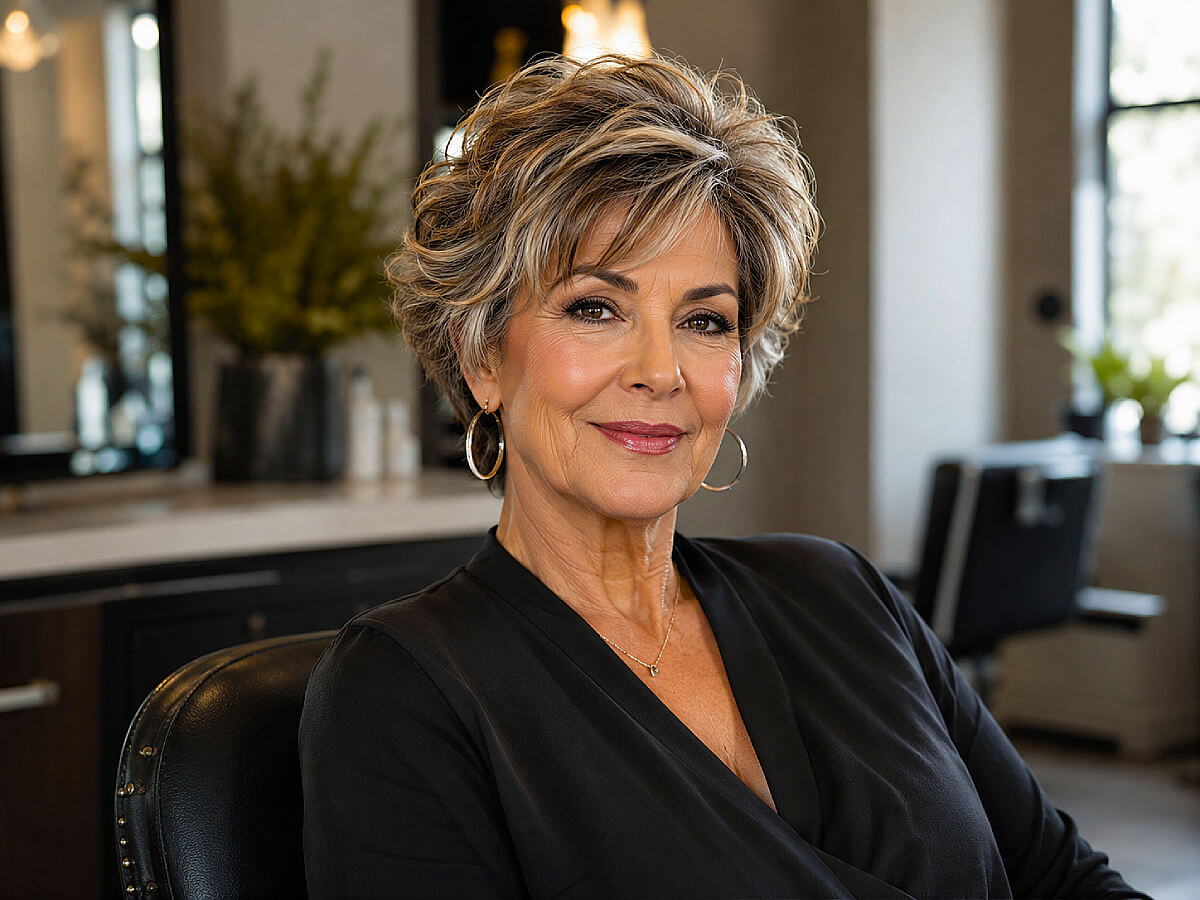

Question from Marguerite Hollenbeck, Bozeman, Montana: “I’m 58 and my hair has changed so much in the last few years. It used to be thick and full and now it feels limp, flat, and like no matter what I do it just lays there. My stylist keeps telling me to ‘add layers’ but it doesn’t seem to help. Is there actually anything I can do, or is this just what getting older looks like? I feel like nobody’s being straight with me.”
Marguerite, I hear you, and I want you to know you are absolutely not imagining it. What’s happening to your hair is real, it’s common, and the reason it feels like nobody’s being straight with you is because, honestly, a lot of people in this industry either don’t take the time to explain it or they don’t fully understand it themselves. Volume loss with age is one of those things that sneaks up on women slowly enough that by the time they really notice it, a lot has already changed, and the fixes they’ve been handed, the layers, the volumizing shampoo, the hot rollers they dug out of a box in the closet, are working with old information.
I’ve been behind the chair for 20+ years now and honestly? I hear this ALL the time from women the second they sit down. Like word for word sometimes. You are defintely not the only one feeling this way. They’re not wrong that something changed. The structure of the hair strand itself changes, the scalp changes, the growth cycle changes, and all of that happens at the same time that most of us are also dealing with hormonal shifts that affect everything from density to texture to how fast our hair actually grows. It’s a lot happening at once. So let’s actually talk about it, because you deserve a real conversation, not just another round of “try a volumizing mousse.”
This post may contain affiliate links, meaning I may earn a small commission at no extra cost to you. I only share products I truly believe in. As an Amazon Associate, I earn from qualifying purchases. Your support helps me continue creating free content like this.
9. Volume loss and hair loss are not the same thing, and confusing them leads you to the wrong solutions
This is where I want to start because it’s probably the most important distinction and it gets blurred constantly, even by people who should know better. When women come to me saying they’re “losing their hair,” what most of them mean is that their hair looks and feels thinner than it used to, that there’s less body, less lift, less of that full feeling they remember. That is volume loss, and it’s almost universal as we age. Actual hair loss, meaning a reduction in the number of follicles actively producing hair, is a different conversation and a different problem, though the two can absolutely happen at the same time and compound each other.
The reason this distinction matters is that the products, treatments, and approaches that help with volume loss do almost nothing for actual thinning, and vice versa. If you’re buying every thickening shampoo you can find but what you’re actually dealing with is a real reduction in follicle density, you’re going to be frustrated because those shampoos are designed to swell the hair shaft, not stimulate new growth. On the other hand, if you’re genuinely dealing mostly with volume loss from texture changes and start going down the clinical hair loss treatment route, you might be overcomplicating something that has a much simpler fix. So before you do anything else, it’s worth having an honest look, and maybe a conversation with a dermatologist who specializes in hair, about which category you’re actually in, or whether you’re dealing with both.
For what it’s worth, most of the women I see in their 50s and 60s are dealing primarily with volume loss rather than true alopecia, though estrogen-related thinning around menopause is incredibly common and very real. Getting clear on what you’re working with is step one, and it shapes every decision after that.
8. The diameter of each individual hair strand actually shrinks, and that changes everything about how you style
Here is something that rarely gets explained in plain terms: as you age, especially after menopause, each individual hair strand gets physically thinner in diameter. This is not about how many hairs you have, it’s about the structure of each one. Fine hair has always existed, but what happens for a lot of women is that hair that was once medium to coarse in texture starts migrating toward fine, and fine hair that was already there gets finer still. The result is that the same number of hairs on your head takes up less space, lays flatter, and holds a style for about a third of the time it used to.
This is why techniques and products that worked beautifully for you at 35 might feel completely useless at 55. Your hair isn’t misbehaving, it’s just genuinely different now and it needs different handling. Heavier products that used to give you texture and definition are now just weighing you down. Styles that relied on your hair’s natural body to hold shape are going to fall flat because that structural support just isn’t there the way it was. I had a client, I’ll call her Diane, who had this gorgeous thick bob for years and came in one day wondering why it suddenly looked stringy and heavy. Her hair hadn’t done anything wrong. The cut that worked with her former texture was now working against her finer strands, and we had to rethink the whole shape from scratch.
This is also why your blow-dry technique matters more now than it ever did before. Finer strands are more responsive to heat styling but also more vulnerable to damage that causes breakage, which creates even more volume loss. A good ionic blow dryer with a concentrator nozzle and a round brush is one of the most powerful tools you have right now.
7. Most volumizing shampoos are doing almost nothing, but the right scalp care actually can help
I’ll be honest with you because I think you deserve it: most volumizing shampoos are doing a cosmetic job at best. They coat the strand with ingredients that temporarily puff it up slightly, which gives you a little something right after washing, and then gravity and your own oils take over by noon and you’re back where you started. I’m not saying they’re completely useless, but I do think the category is wildly overhyped and a lot of women are spending money on products that are essentially giving them a one-morning illusion rather than any lasting change.
What actually can make a difference is scalp health. This one doesn’t get nearly enough attention. Your scalp is skin, and just like the skin on your face, it changes with age. It can get drier, circulation can slow down, product buildup can accumulate on the follicle opening, and all of that affects how well your hair grows and how it looks at the root. A good scalp scrub used once a week, or a scalp serum with ingredients like niacinamide, peptides, or caffeine used regularly, can genuinely improve the environment your hair is growing out of, which over time actually matters.
I’ve been recommending the Briogeo Scalp Revival Charcoal Scrub for years and people always come back for it. The The Ordinary Multi-Peptide Serum for Hair Density is another one I point people toward because it’s affordable, the ingredient list is serious, and several of my clients have noticed a real difference in density over several months of consistent use. Scalp care is slow and unglamorous but it’s real in a way that a lot of the flashier stuff isn’t.
6. The wrong cut is actively making your volume problem worse, and layers are not automatically the answer
Your stylist told you to add layers and it didn’t help. Marguerite, I believe you completely, and here’s why that happens. “Add layers” has become sort of the default prescription for flat hair, but layers are a tool, not a solution, and in the wrong hands on the wrong hair type they can actually remove the little weight and density you have left and make things look even thinner. A lot of stylists reach for layers reflexively without really considering whether the hair has enough density to carry them, and fine hair often does not.
What actually works for volume on finer, aging hair is usually a combination of weight removal in the right places, keeping some weight in others, and thinking carefully about where the perimeter falls. A blunt or slightly blunt line at the ends, for instance, can create the illusion of thickness because all the ends are landing at the same visual line. Going too short too fast can expose scalp that wasn’t visible before. And a cut that sits past the shoulders on fine hair is almost always going to lie flat and lifeless, not because of anything you’re doing wrong but because gravity wins every time when the hair doesn’t have the structure to fight back.
A great cut for volume loss takes into account your head shape, where your density is and isn’t, your lifestyle, and your willingness to style. It’s a real conversation, not a formula. If you’re not having that conversation with your stylist, it might be time for a consultation somewhere new, and there’s nothing disloyal about that.
5. Hormonal changes, especially around menopause, are directly affecting your hair in ways that most doctors don’t mention
The connection between estrogen, progesterone, and hair volume is so significant and so rarely discussed clearly that I think about it all the time. Estrogen and progesterone help keep hair in the growth phase longer, which is part of why so many women have their best hair during pregnancy, when those hormones are surging. As those hormones decline during perimenopause and menopause, the hair growth cycle shortens, meaning individual hairs spend less time growing before they shed. The result is hair that doesn’t grow as long, sheds a bit more, and has less overall density over time.
On top of that, the ratio of androgens to estrogen shifts, which for some women triggers androgenic thinning, a pattern that typically shows up as widening part lines and loss of density at the crown and temples. This is genuinely a medical conversation as much as a beauty one, and if you haven’t talked to your OB-GYN or a hormone specialist about it, it’s worth raising. Some women find that hormone therapy has a meaningful positive effect on their hair, though results vary and it’s not the right choice for everyone. There are also non-hormonal options worth exploring.
What I want you to take away from this is that the changes in your hair are not cosmetic failures. They are physiological. Something real is happening in your body, and you’re not going to fully address it with better shampoo. Products like Nutrafol Women’s hair growth supplements are specifically formulated to address some of the hormonal contributors to hair thinning, and while supplements aren’t magic, Nutrafol has enough clinical work behind it that I feel comfortable recommending it to clients who want to try a systemic approach alongside their topical routine.
4. How you’re applying heat and product is probably creating more flatness than the aging itself
I want to be gentle about this but also direct: a lot of the flatness women over 50 are dealing with is technique-related, and that is actually good news because technique is something you can change. Fine hair is unforgiving about two things specifically, product weight and heat direction, and getting either one wrong flattens everything out in a way that feels like a lost cause by the end of the day.
On the product side, the single most common mistake I see is using too much of anything. With fine aging hair you need amounts that feel almost embarrassingly small. A nickel-sized amount of mousse, a literal fingertip of cream, and that’s it. Heavy styling creams, thick serums, and anything marketed for “smoothing” is almost certainly dragging your hair down because those formulas are designed for coarser, thicker hair that needs taming, which is the opposite of what you’re dealing with. A lightweight volumizing mousse like Kenra Platinum products or a root-lifting spray applied specifically at the root and nowhere else is a much better starting point.
On the heat side, the direction you point the airflow matters enormously. Blowing hair downward smooths the cuticle and eliminates volume. For root lift you want to be working against the direction of growth, lifting sections up and directing heat at the base, using a round brush or even just your fingers, before letting it cool in that lifted position. This one shift alone has changed the whole game for clients who thought their hair was just too far gone to style. It’s not. It just needs different handling.
3. Color, including gray coverage, is affecting your hair’s texture and volume more than you realize, and it can go either way
Color is something I think about a lot in relation to volume because the relationship is more complicated than most people expect. On one hand, chemical color, especially permanent color with developer, deposits pigment molecules inside the hair shaft and actually does temporarily plump the strand slightly, which is why a lot of women notice their hair looks a little fuller right after a fresh color service. That effect is real, even if it’s not the reason we’re coloring. On the other hand, repeated chemical processing over years, especially if the timing or formulation isn’t right for your hair, causes cumulative damage that makes fine aging hair even more fragile and prone to breakage, which obviously makes the volume situation worse over time.
Gray hair also behaves differently from pigmented hair, which is something I wish got talked about more openly. Gray and white hair tends to be coarser in texture, which sounds like it should mean more volume, and sometimes it does, but it also tends to be drier, more wiry, and harder to get smooth, so the tradeoffs are real. Some women find that going gray or transitioning to a lighter, lower-maintenance color with less frequent chemical processing actually gives their hair a chance to recover some integrity. Others find that regular glosses or demi-permanent color help keep the hair looking healthy and full without the damage load of permanent color.
My honest recommendation for most of my clients with aging hair is to get your color from someone who genuinely specializes in it and have a real conversation about damage load. Olaplex No. 3 used at home between services is not just marketing, it genuinely helps maintain bond integrity in chemically processed hair, and I tell my color clients to use it weekly without fail.
2. Your pillow, your ponytail habits, and a few other things you’d never suspect are quietly making it worse
I know this sounds like the kind of advice that gets dismissed as too small to matter, but hear me out because I’ve seen this make a real difference for people. Fine aging hair breaks more easily than the hair you had in your 30s, and breakage at the root and through the mid-shaft is one of the things that destroys volume and makes hair look thin and dull even when the follicles themselves are still doing okay. The sources of that breakage are often completely mundane and totally fixable.
Cotton pillowcases create friction that tugs at fine hair all night, especially if you move around a lot while you sleep. Switching to a silk or satin pillowcase sounds like a luxury purchase but it genuinely reduces mechanical breakage, and once you make the switch you’ll wonder why you waited. Ponytail elastics, especially those little plastic ones, are brutal on fine hair because the tension concentrates on such a small area. Switching to fabric-covered elastics or the spiral-style ones reduces that damage significantly. Even the way you towel-dry matters: rubbing vigorously with a cotton towel is hard on fine hair, and switching to a microfiber hair towel or even an old cotton t-shirt for gentle blotting can reduce a surprising amount of breakage over time.
None of these things alone is going to transform your hair, but they add up, and they’re the kind of changes that cost almost nothing and have zero downsides. When I start working with a client on a hair recovery plan these are always part of the conversation because the big investments in products and treatments work a lot better when you’re not undoing them every night on your pillow.
1. Your hair can genuinely look and feel fuller again, but it requires actually rethinking your whole routine, not just adding one new product
I saved this one for last because I think it’s the most important thing I can tell you, and I want you to really sit with it. The reason most women don’t get lasting improvement when they try to address volume loss is that they change one thing at a time, add a new shampoo, try a different conditioner, experiment with a hot tool, and when that one thing doesn’t fix everything they conclude that nothing works. But volume loss from aging is cumulative, it came from multiple overlapping changes happening simultaneously, and the solution has to be similarly layered.
What actually works is building a complete routine that addresses the issue from multiple angles at once. That means scalp care to optimize the growth environment, the right lightweight products used in the right amounts with the right technique, a cut that genuinely works with your current texture rather than your texture from ten years ago, smart decisions about chemical services and damage load, protective habits that prevent the breakage that’s robbing you of density, and if appropriate, a conversation with your doctor about hormonal factors and whether something like a hair growth supplement or topical treatment like minoxidil for women might be right for you.
I had a client in her early sixties who came to me feeling genuinely hopeless about her hair. She’d been dealing with volume loss for years and had basically given up, wearing it in a bun every day because she didn’t know what else to do. Over about six months we changed her cut, got her off the heavy products she’d been using, introduced a scalp serum, adjusted how she was drying and styling, and had her start using Nutrafol consistently. Her hair did not go back to what it was at 40, and I want to be honest with you: it won’t, and that’s okay. But it looked and felt genuinely fuller, healthier, and more like her own hair again, and she started wearing it down, which she hadn’t done in years. That is a real and achievable outcome, and it is absolutely worth pursuing.
Marguerite, I hope this gives you something real to work with. You asked to be treated honestly and I tried to do that, because you deserve actual information, not just reassurance. The right combination of approaches exists for you, and finding it is worth the effort.