
Reader Question from Diane Kowalczyk, Flagstaff, Arizona:
“I’m 58 and I’ve been coloring my hair for almost 20 years. My colorist recently retired and I’m seriously considering just… letting it go gray. But honestly I’m scared. I don’t know what my natural hair even looks like anymore, and I keep getting conflicting advice from everyone. My daughter says go for it, my sister says I’ll look ten years older overnight. Can you help me figure out if this is actually a good idea, and what I’d be walking into if I made the jump?”
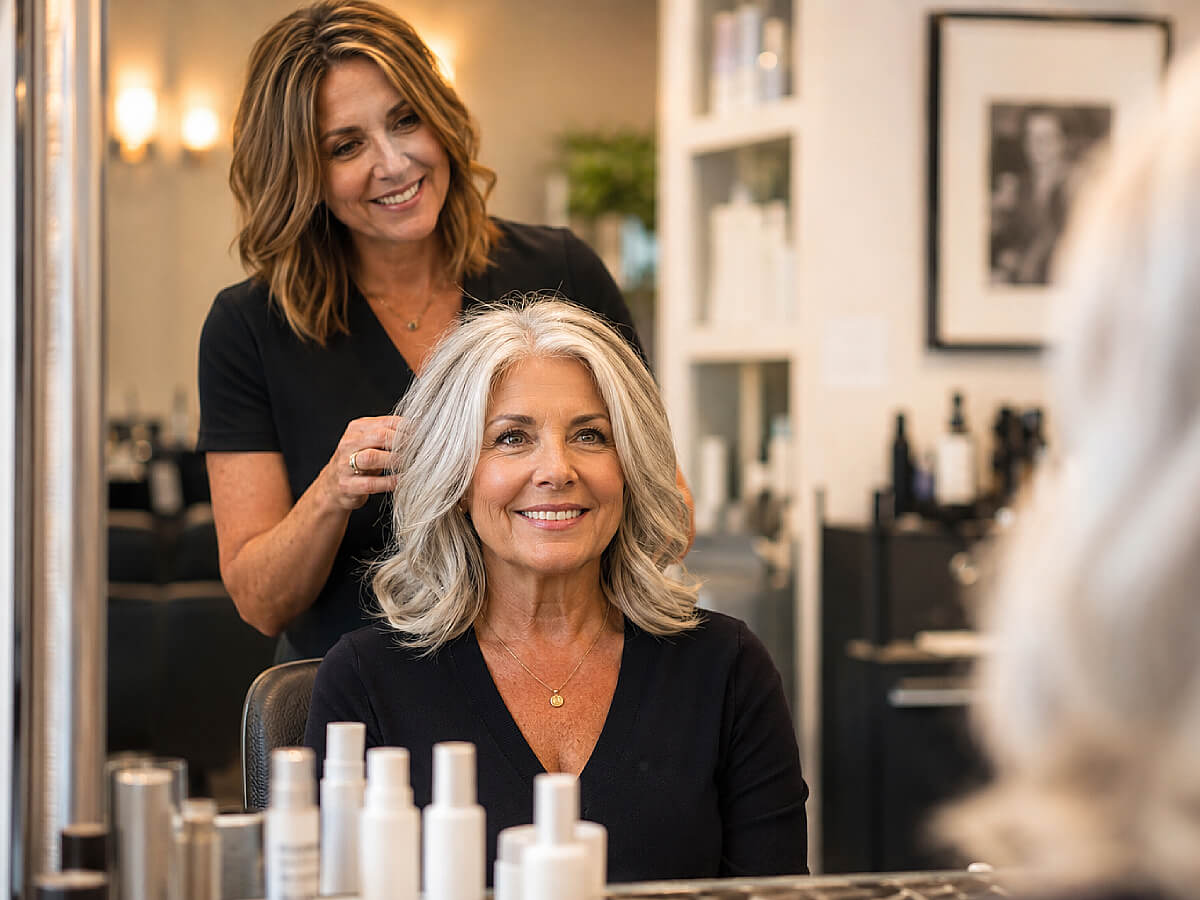
There’s a moment in the salon chair that I’ve seen more times than I can count, where a woman is staring at herself in the mirror and she says, quietly, like she’s confessing something, “I think I’m ready to go gray.” And then she immediately follows it up with “but I don’t know, maybe not,” and I can tell she’s been having that conversation with herself for months. Maybe years.
Been doing hair for so long now and the gray transition is one of those topics where I feel like the internet does women a real disservice. You get the glossy before-and-after photos, the inspiring hashtags, the “silver fox” narrative that makes it sound like you wake up one morning with a gorgeous blunt bob and everyone compliments your confidence. And then there’s the other side, the well-meaning friends and relatives who say things like “but you’re so pretty, why would you do that,” as if gray hair is a form of giving up. Neither of those pictures is accurate, and Diane, your question deserves a real answer, not a pep talk and not a warning label either.
So let me tell you what I actually tell my clients when they sit down in my chair and ask me this. The stuff I’ve learned from doing this for years, the stuff that doesn’t make it into the Instagram reels.
This post may contain affiliate links, meaning I may earn a small commission at no extra cost to you. I only share products I truly believe in. As an Amazon Associate, I earn from qualifying purchases. Your support helps me continue creating free content like this.
8. Your Natural Gray Is Probably Nothing Like What You’re Picturing
Most women who’ve been coloring for decades have genuinely no idea what their gray looks like anymore, and the picture in their head is almost always wrong. I had a client, Renee, who came in convinced she was going to grow out a flat, ashy, mousy gray that would wash her out completely. She’d been dyeing since her mid-thirties and had this whole story built up in her mind about how depressing her roots were. When we finally did a long-term grow-out plan with her and she started seeing her real hair come in, it was this gorgeous mix of silver, white, and a little warm taupe at the nape. She literally teared up a little. Not from sadness.
The truth is, gray hair is rarely one flat color, and the texture often changes too, sometimes coarser, sometimes more wiry, sometimes surprisingly soft depending on your genetics and the condition of your hair. Women with darker natural colors sometimes grow in with this striking contrast of deep brunette and bright silver that looks genuinely striking without a single product on it. Women who were blondes sometimes get this soft, barely-there transition that blends almost seamlessly. You won’t know what you have until you start seeing it, and that is both the scary part and honestly the most exciting part of the whole thing. I’d strongly encourage you to ask your new colorist if they can do a strand test or let a section grow out near the nape before you commit to anything, just so you have real information instead of imagined worst-case-scenario information.
7. The Transition Period Is Real, and It Has a Learning Curve
I want to be honest with you here because I think sugarcoating this part is what leads women to quit halfway through and end up with a chop they didn’t really want. The grow-out phase, roughly the first six months to a year depending on how fast your hair grows and how long it is, can be awkward. There’s no getting around that. You’re going to have a line of demarcation at some point, that visible contrast between your colored ends and your natural roots coming in, and depending on your previous color it can be subtle or it can be pretty noticeable.
What I always tell clients is that this phase is manageable but it requires a plan, not just patience. There are techniques we use in the salon, like a smudge or a shadow root, where we soften that line of demarcation by blending a tone into the root area so it doesn’t look like a hard stop between two worlds. Some women do well with a foil highlight service that starts pulling their colored ends lighter, getting them closer to where the natural gray is coming in so the whole thing reads as intentional. If you’re growing out a very dark all-over color, that’s the most challenging transition visually, and I’d budget for a few salon visits specifically aimed at managing that line rather than just waiting it out. The cost of hair color management during a transition is something to factor in, because doing it right is actually an investment in your hair health too, not just your appearance.
6. Gray Hair Has Different Needs Than Colored Hair, and You Have to Adjust Everything
This one surprises people every single time and I don’t know why we don’t talk about it more. When you stop coloring, your hair doesn’t just go back to being the hair you had at 30, it’s different hair now, with different porosity, different texture, potentially different levels of coarseness, and it needs a different routine. A lot of women switch to gray and keep using the exact same products they’ve been using for years and then wonder why their hair looks dull or frizzy or just… not right.
Gray and white hair tends to be more porous, which means it can pick up yellow or brassy tones from minerals in water, from product buildup, from pollution, even from the sun. This is where a good purple or blue toning shampoo becomes your best friend and I genuinely mean that, not in a “here’s a tip” way but in a “your hair will thank you every single week” way. I personally love Clairol Shimmer Lights for keeping gray hair bright and cool-toned, it’s been around forever, it works, and it costs about a quarter of what some of the trendy alternatives charge. You don’t have to use it every wash, maybe once or twice a week, but it makes a huge difference. I’d also look at adding a moisturizing mask into your routine, something like Olaplex No. 8 Bond Intense Moisture Mask, because gray hair without enough moisture just looks wiry and dull, and moisture is genuinely the most important thing you can give it.
5. Your Skin Tone Conversation Changes, and That’s a Good Thing
Here’s something that I find genuinely fascinating about going gray, and I’ve thought about this a lot over the years because I notice it in the chair constantly. When a woman’s hair goes silver or white, the whole conversation about what colors she can wear near her face kind of opens back up, and sometimes in really liberating ways. There’s this old idea that gray hair “washes you out” and I think it comes from a time when gray wasn’t styled intentionally, it was just neglected, and the combination of flat unstyled gray with whatever someone happened to be wearing read as faded overall. But that’s not the hair’s fault.
What actually happens when you go gray is that the hair stops competing with your skin tone the way dye sometimes does. Warm dyed brunette on a woman with cool undertones can create this subtle mismatch that she’s been living with for years without knowing it. When she goes to her natural silver or white, suddenly there’s this neutrality near the face that lets her skin read more clearly, and her eye color often looks more prominent too. I’ve had clients who spent twenty years avoiding certain colors near their face because “they didn’t work with my hair” and then after going gray they discovered they could wear them just fine. Your makeup will probably shift a little too, and that’s worth playing with rather than dreading, a slightly warmer lip or a little more definition in the brow can do a lot to keep things balanced and fresh.
4. The “You’ll Look Older” Warning Is More Complicated Than People Make It
I have strong feelings about this one. Not because it’s entirely wrong, but because it’s being applied way too broadly by people who mean well but are working off a stereotype rather than a real observation. Yes, there are situations where going gray can add perceived age, usually when the hair is also damaged, thinning, or styled in a way that doesn’t suit the face shape. But the same is true of any hair color that’s poorly maintained or badly cut. I’ve seen badly colored brown hair age a woman significantly. I’ve also seen a beautifully maintained silver pixie make a woman look younger than she did when she was covering her grays, because suddenly her hair had life and texture and was working with her face instead of against it.
The thing nobody says out loud is that a good cut matters infinitely more than the color when it comes to how old or young your hair reads. A flattering haircut that suits your face shape and your lifestyle, whether it’s a longer layered cut that moves well or a shorter crop with some texture, is doing more for you than the shade of your hair ever will. This is where I genuinely think it’s worth investing in a consultation with a stylist who has real experience with gray transitions, not just someone who’ll talk you in or out of it based on their own preference, but someone who can look at your face shape, your texture, your lifestyle, and give you an honest assessment. The haircut conversation and the color conversation are connected, and they’re both worth having thoughtfully.
3. There Are Ways to Make the Transition Faster (and Less Painful) Than People Realize
One of the biggest myths about going gray is that you just have to white-knuckle it through a year or two of awkward roots and then emerge on the other side. And while some women do take that approach and are fine with it, especially if their hair grows quickly and they keep it shorter, there are actually several techniques that can dramatically shorten or smooth out the transition depending on your starting point. I love talking about this with clients because there’s something kind of exciting about having a real strategy instead of just waiting.
If your hair is currently a medium to light brown with some highlights, you might be closer to a relatively seamless transition than you think, especially if we can use a balayage or lived-in highlighting technique to start lightening the ends over a few visits so they’re meeting the incoming gray partway. If you’re working with a darker all-over color, we might look at a color correction process that gradually lifts the artificial pigment. Some women do really well with a big chop timed around a certain point in the grow-out, which isn’t for everyone but is genuinely liberating for the right person. For tools, keeping your hair in great condition during this time matters enormously, and I’d recommend a Wet Brush detangler if you’re not already using one, because gray hair in transition can be more prone to breakage and being gentle during brushing is such a low-effort way to protect it. A good silk pillowcase is another thing I always recommend during transition, because the friction from cotton is genuinely not your friend when your hair is working through this change.
2. How You Style It Matters More Than You’ve Been Told
I saved this one for near the top because I feel like it’s the real secret that gets glossed over in every gray hair conversation I see online. Everyone focuses so much on the color itself, the shade, the transition, the maintenance, that the styling conversation gets pushed to the side, and it shouldn’t be. Gray and silver hair, especially when it’s healthy and well-maintained, has this incredible potential to look absolutely stunning, but it requires a little more intentionality in how you style it day to day because the texture is often different from what you’re used to managing.
Gray hair tends to have more natural texture, sometimes more wave or frizz than the hair you had before, and embracing that texture rather than fighting it can be the difference between hair that looks vital and hair that looks tired. I personally have gotten obsessed with Living Proof curl-enhancing products for clients who have texture in their gray hair and didn’t know how to handle it. For women who want more smoothness, a Dyson Airwrap is an investment but a real one, because it gives you that smooth, styled look without the heat damage that gray hair is particularly susceptible to. Heat tools on gray hair without proper protection can cause it to look yellowish and fried, so if you’re using hot tools regularly, please, please use a heat protectant, something like Kenra Platinum Silkening Mist is one I really like. The overall lesson here is that gray hair rewards you when you pay attention to it, and it shows when you don’t, maybe more than colored hair does.
1. Going Gray Can Be One of the Best Things You Do for Your Hair Health (and Yourself)
I want to end here because I think this is the truth that gets buried under all the debate about aesthetics and age and what other people think, and it’s the one that I’ve watched change women’s relationships with their hair in ways that surprised even me. When you stop chemically coloring your hair, you are giving it a break from a process that, however carefully done, is still a chemical process that affects the hair’s protein structure, its porosity, its overall integrity over time. This is not me saying coloring is bad, I’ve spent my career coloring hair and I love it, but after decades of it, many women’s hair is genuinely compromised in ways they’ve adapted to without realizing.
I had a client, Patricia, who’d been coloring every five weeks for thirty years. When she finally committed to the transition, she told me about six months in that her hair felt different in a way she couldn’t quite explain, fuller somehow, more like hers. We talked about it and what I think was happening is that once her hair wasn’t going through a chemical process on a cycle, her natural texture and density had a chance to express itself more fully. She also, and she said this herself, felt something lift emotionally, this sense that she wasn’t managing her hair to meet an expectation anymore but just letting it be what it was. I’ve heard some version of that from more clients than I can count over the years.
The real reason I’d encourage any woman considering this to take it seriously isn’t about saving money on hair color, though you will, and it isn’t about some philosophical statement about aging. It’s because your hair, the actual physical strands growing out of your head, might be really beautiful if you give it the chance. The silver hair movement, and I do think of it as a real shift in how women are relating to their natural hair in midlife and beyond, is not about giving up or letting yourself go, it’s about making a conscious, informed, genuinely personal choice about what you want your hair to be. And that kind of choice, made thoughtfully with good information, almost always looks good on a person.
So, Diane… Here’s What I’d Actually Tell You If You Were Sitting in My Chair
I’d tell you to find a good colorist who has done gray transitions before and ask them to look at your roots, your current hair health, your face shape, and your lifestyle before you make any decisions. I’d tell you not to make this choice based on what your sister thinks or what the Instagram version of gray hair looks like, because neither of those things is your hair. I’d tell you to get a trim, buy a good toning shampoo, and give yourself permission to be curious about what’s coming in at your roots instead of scared of it. And I’d tell you that if you decide to do it and it takes longer than you thought or goes through an awkward phase, that’s not failure, that’s just hair, doing what it does.
The women I’ve watched go through this transition with intention and a little patience have, almost without exception, told me they wished they’d done it sooner. Not because gray is better than color in some objective way, but because the decision to stop fighting what their hair naturally wanted to do turned out to feel really good. Whatever you decide, make it yours.