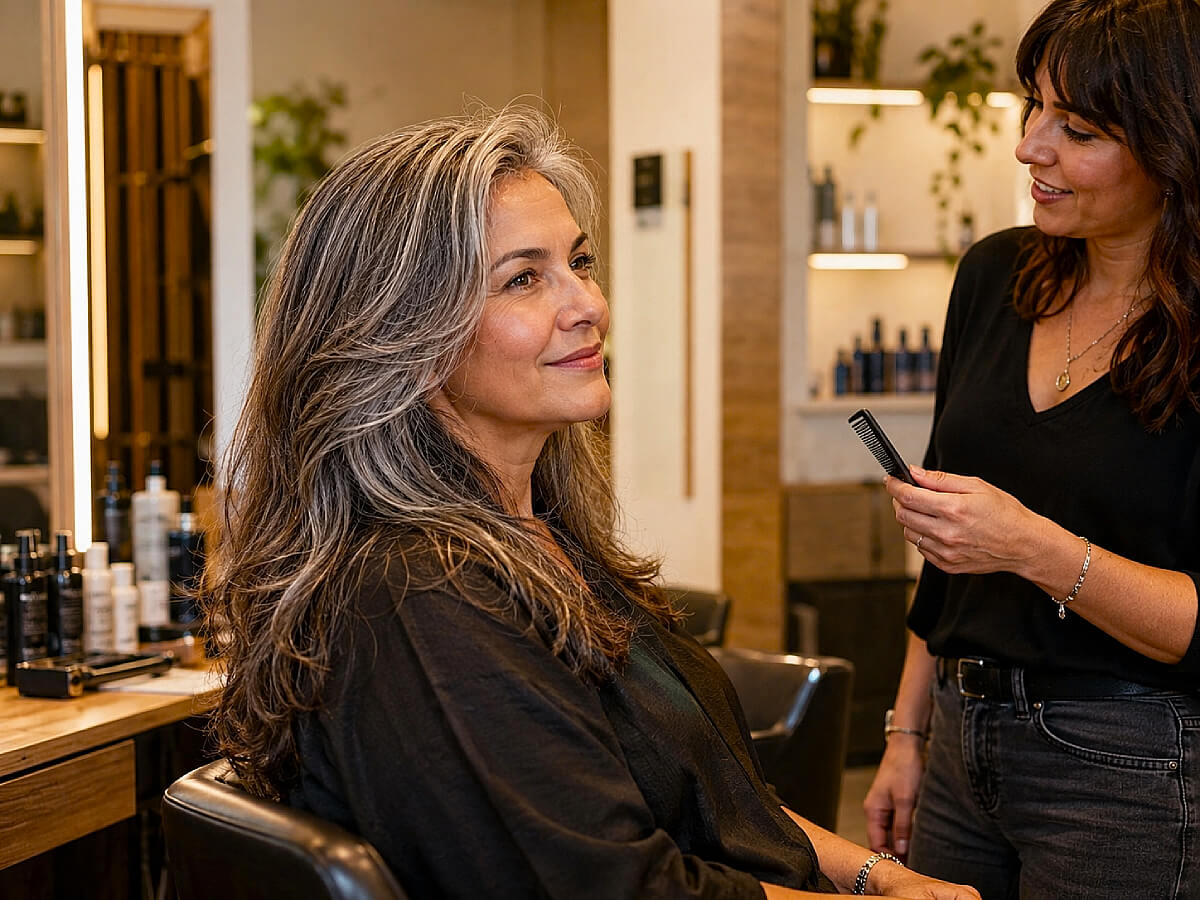

Question from Marlene Kowalski, Sheboygan, Wisconsin: “I’ve been going to the same salon for years and lately I feel like my stylist is just steering me toward the same short, safe haircuts without really asking what I want. Is this just me, or do hairstylists actually make assumptions about women once they reach a certain age? I turned 51 last spring and suddenly it feels like everyone has an agenda for my hair.”
Marlene, you are not imagining it. And honestly, I’m a little embarrassed on behalf of my industry to admit that, but it’s true. There’s this invisible checklist that a lot of stylists, sometimes without even realizing it, start running through the moment a woman walks in and mentions she’s over 50. It happens in consultations, it happens in the way questions get asked (or don’t get asked), and it absolutely happens in the suggestions that follow. I’ve watched it happen with colleagues I respect, and I’d be lying if I said I’d never caught myself doing it too, at least in the early years of my career.
The thing is, the assumptions aren’t always coming from a bad place. Some of them come from training, some from habit, some from a genuine (if misguided) belief that certain rules apply universally to aging hair. But good intentions don’t make the assumptions any less limiting. So let’s actually talk about what those assumptions are, because once you can name them, you can walk into your next appointment and sidestep them entirely.
This post may contain affiliate links, meaning I may earn a small commission at no extra cost to you. I only share products I truly believe in. As an Amazon Associate, I earn from qualifying purchases. Your support helps me continue creating free content like this.
6. You Want to Look Younger
This one comes up almost immediately, before you’ve even sat down in the chair properly. A client mentions her age or her upcoming birthday milestone, and the stylist’s brain quietly shifts into “anti-aging mode,” which means every recommendation that follows gets filtered through the question of what will take years off her face. More volume here, softer layers there, maybe some highlights to brighten things up. And look, some of that advice is genuinely useful. But the assumption underneath it, that looking younger is the primary goal, is one that should be checked before it’s made.
I had a client, Patricia, came to me at 53 after years of what she called “age-appropriate” salon visits. She sat down and said, “I don’t want to look younger. I want to look like myself but better.” That stuck with me. She wanted refinement, not reversal. There’s a real difference between those two things, and when a stylist leads with the anti-aging framework, it can completely override what the client is actually after, which might be something much more interesting, like a strong shape, or a color with real depth, or even something deliberately dramatic.
Some women over 50 are chasing a sharper, more editorial look than they’ve ever had before. Some want to lean hard into their silver. Some want to look powerful rather than soft. None of those goals are about looking younger, and all of them are worth asking about. The fix here is honestly just a better first question, not “what are you struggling with?” but “what do you want more of?” The answers are completely different and they lead to completely different haircuts.
5. Short Hair Is Inevitable (And Probably Imminent)
There’s this deep, stubborn myth in the salon world that long hair past a certain age is either a cry for help or a form of denial. I’ve heard stylists say it out loud in the break room. “She’s holding on.” “She’d look so much better if she just cut it.” And meanwhile the woman in the chair hasn’t asked for anyone’s opinion on her length at all. She came in for a trim and a gloss and she is perfectly happy with her hair, thank you very much.
The bias toward shorter hair does have some logic buried inside it. Fine hair that has lost density over time can look stringy at longer lengths, and that’s a real thing worth discussing. Certain face shapes do respond beautifully to a shorter cut. But those are individual conversations that require individual information, not a default setting applied to every woman who mentions her AARP card. I’ve had clients in their 60s with the kind of thick, healthy hair that most 30-year-olds would hand over a kidney for, and suggesting they cut it short would be genuinely bad advice.
If your stylist starts nudging you toward a bob before they’ve even assessed your actual hair texture, density, and what your daily routine looks like, that’s the assumption talking, not expertise. Long hair on an older woman can be incredibly striking when it’s well-maintained and cut with intention. Products like a good lightweight hair oil can keep longer hair looking polished without weighing it down, and a strong trim schedule handles the rest. Length is not a moral question. It’s a styling one.
4. You Can’t Handle (Or Don’t Want) Something Edgy
This assumption is so ingrained that it often doesn’t even register as an assumption. It just feels like common sense to the stylist who holds it. Of course she doesn’t want a disconnected undercut. Of course she’s not interested in a heavy blunt fringe. Of course bold color is off the table. And so those options never come up, never get floated, never land on the mood board, because the stylist has already quietly decided they’re not appropriate for this particular client’s demographic.
I think about a woman named Diane who came to me a few years ago, early 60s, recently retired, and she pulled up a photo on her phone of a really strong, close-cropped cut with a slight taper at the sides. Very clean, very architectural. She said three other stylists had talked her out of it over the years, one of them telling her it was “a bit severe for someone her age.” I did the cut. It was perfect on her. She had great bone structure, wore minimal jewelry, and the whole thing looked like a deliberate choice, which it was. She cried a little when she saw it, which, honestly, so did I a little bit.
The point is that edge and structure are not reserved for younger clients. Sometimes they work even better on older women because the face has more character to hold the cut. If you’re someone who has always wanted to try something more unconventional and kept getting steered away from it, it might genuinely be worth pushing back on your next visit. Bring the photo. Be specific. A stylist worth their salt will at least have an honest conversation with you about whether it works for your particular hair and face rather than just defaulting to “maybe something softer.”
3. Gray Coverage Is the Priority
Walk into almost any salon at 50-plus and mention you’re starting to go gray, and a huge percentage of stylists will immediately pivot to coverage. Box color alternatives, root touch-up schedules, lowlights to blend, the whole infrastructure of maintenance built around the assumption that the gray is a problem to be managed. And for some women it absolutely is, and there is nothing wrong with that. But the assumption that coverage is the default goal has gotten really loud, and it drowns out a conversation that more women are wanting to have.
Gray hair is having a genuine moment, and not just as a trend among younger women artificially going silver. Women who have come into their natural gray and learned to work with it, with the right toner, the right cut, the right product to handle porosity, look genuinely amazing. I’ve watched clients make the transition and come out the other side with hair that has more personality than anything they were achieving with color. A good purple or violet toning shampoo goes a long way toward keeping silver hair bright and intentional rather than dull and yellowish, and that changes everything about how it reads.
What frustrates me is when a stylist doesn’t even ask. When the recommendation to cover comes before the question of what you actually want. I had a client once who sat down, mentioned she was thinking about embracing her gray, and her previous stylist had apparently responded with “we can definitely get you back to your natural color.” That is a miss. A real one. If you are on the fence about your gray or actively interested in leaning into it, say so directly, and if your stylist immediately redirects to coverage, ask them point-blank whether they have experience with gray blending and transition work, because not all of them do.
2. You Need Low-Maintenance Above All Else
This one gets dressed up as consideration. “Something easy to manage,” “a style that doesn’t need a lot of work,” “wash and wear,” all said with the warmth of someone doing you a favor. And sometimes it is a favor, genuinely. Not every woman wants a high-maintenance style and that’s completely valid. But there’s a version of this assumption that’s actually a little condescending, where the stylist has decided that your time is limited, your patience for styling is thin, and your interest in doing anything elaborate with your hair has probably expired along with your forties.
Some of the most style-invested clients I’ve ever had were women in their 50s and 60s. Women who blow-dry every morning and have a full shelf of products and genuinely love the ritual of it. Women who travel to New York twice a year to get their color done. Women who have more opinions about round brushes than most stylists I know. The idea that maintenance tolerance automatically drops off after 50 is just not true across the board, and when a stylist leads with “let’s keep it easy,” they’re potentially steering someone away from a look that requires a little effort but would genuinely make them feel spectacular.
Tools matter here if you’re someone who does love to style at home. A really good ceramic or tourmaline blow-dryer, like the BaBylissPRO Nano Titanium, makes a real difference in finish quality, and a proper boar bristle round brush gives you that smoothness that a cheap brush just can’t replicate. If you enjoy styling, invest in the tools and don’t let anyone talk you into “easy” before you’ve had the chance to say what you actually want.
1. Your Hair Is the Problem
This is the big one, and it sits underneath all the others. The assumption that something about your hair at this stage of life needs correcting, managing, compensating for, or worked around. Thinning needs to be disguised. Gray needs to be addressed. Texture changes need solutions. The conversation gets framed, almost automatically, as remediation rather than possibility, and once that frame goes up, it shapes every recommendation that follows in ways that aren’t always in your best interest.
Hair does change after 50. I’m not going to pretend it doesn’t. Estrogen shifts affect texture and density, the growth cycle slows down a little, and some women deal with real thinning along the part or the temples that warrants a genuine conversation. Products like Nioxin’s scalp and hair system or a growth-supporting scalp serum can genuinely help with some of those concerns, and I do recommend them when they’re warranted. But the changes in your hair are not a verdict. They’re information.
The stylists I most admire, and the kind I’ve tried hard to be over the years, are the ones who look at a 55-year-old woman’s hair and ask what it can do rather than cataloging what it can’t. Maybe the texture change that happened in her late 40s actually means she now has a wave she didn’t have before, and with the right curl-enhancing cream and a diffuser that wave could be genuinely beautiful. Maybe the silver coming in at her temples is a feature worth framing rather than a flaw worth hiding. The difference between a stylist who leads with problems and one who leads with potential is enormous, and you deserve the second kind. If you’re not getting that, it might be time to find a new chair.
So What Do You Actually Do With All This?
Marlene, you asked if it was just you, and I hope by now you can see it absolutely isn’t. These assumptions are widespread enough that they’ve almost become standard practice in a lot of salons, which means the best thing you can do is walk in prepared. Know what you want before you sit down. Bring reference photos if that helps, not necessarily of a specific cut but of a feeling, a vibe, a level of polish or edge or ease that resonates with you. Say out loud early in the consultation what your actual goal is, and if your stylist immediately reframes it into one of the six patterns above, that’s useful information about whether you’re in the right place.
You are not a demographic. Your hair is not a symptom. And honestly, some of the most interesting, flattering, genuinely alive-looking hair I’ve seen in my career has been on women in their 50s and 60s who found a stylist who treated them like exactly what they are, someone with taste, opinions, and a sense of their own style that’s only gotten more specific with time. That’s what you deserve. Go find it.