
Reader Question from Marlene Kowalski, Terre Haute, Indiana:
“I’ve been coloring my hair the same way for probably fifteen years, and lately I keep catching myself in photos thinking something looks off, but I can’t put my finger on it. My friends say it looks fine but I feel like the color is somehow making me look older instead of younger? Is that a thing? Am I imagining it? What should I actually be doing differently?”
There’s a version of hair color that ages you quietly, and the tricky part is it usually starts as the thing that used to work really well. You found a shade in your late thirties that looked vibrant and natural, your colorist matched it perfectly, and then you just… kept doing it. And for a while, that was completely fine. But skin changes, and the hair changes, and the light you’re living in changes, and sometimes the color that was flattering at 38 is doing something different at 52 without anyone sitting you down and telling you why.
I’ve been behind the chair for over twenty years and I can tell you that this is genuinely one of the most common things I see, clients coming in not because something is dramatically wrong but because something feels off in a way they can’t quite name. Marlene, you are absolutely not imagining it, and you’re asking exactly the right question. The good news is that most of these issues are fixable without blowing up your whole look, and once you know what to look for, you’ll see it everywhere, including in that box color at the drugstore that promises to take ten years off and usually adds them instead.
So here are ten signs your hair color is aging you, and what I’d actually suggest doing instead, starting with the ones that sneak up on you and working toward the one I see causing the most damage, which might genuinely surprise you.
This post may contain affiliate links, meaning I may earn a small commission at no extra cost to you. I only share products I truly believe in. As an Amazon Associate, I earn from qualifying purchases. Your support helps me continue creating free content like this.
10. Your Color Has No Variation in It Whatsoever
Flat, single-process, one-note color, especially when it’s dark, reads as artificial in a way that natural hair just doesn’t. When you were younger, your hair had variation even if you were coloring it, because younger hair has a certain porosity and texture that catches light differently in different places, so even a single color application looked a little dimensional. Over time that changes. And if you’ve been doing a straight dark brown or black all-over color for years, what you end up with is this dense, uniform depth that sits on top of your head like a cap and actually makes the skin around your face look more pale and flat in comparison, which ends up emphasizing every line rather than softening anything.
The fix here isn’t necessarily going lighter overall, though sometimes that helps too. What you really want is to introduce some variation, some pieces that are slightly warmer, some that are a shade lighter, so the whole thing moves when the light hits it. Balayage is one option, but honestly for someone who wants something more controlled and natural-looking, a technique called “foilayage” can be really beautiful because it gives you that soft dimension without the high-contrast streaky result that some people associate with highlights. Ask your colorist about adding in some face-framing pieces that are two to three shades lighter than your base, just that change alone tends to make a significant difference in how your overall color reads against your skin.
9. Your Roots Are Always Showing in a High-Contrast Way
I want to be really clear that I am not anti-gray, and I’m not saying roots are bad, because visible roots done intentionally with the right technique can look incredibly chic and modern. What I’m talking about is the two-inch band of silver or white that appears against a very dark dye job, because that specific contrast, that hard line between your natural color and your applied color, is one of the most aging things I see regularly. It creates a visible stripe that draws the eye right to your regrowth line and sort of announces that the rest of the hair is not your real color, which somehow makes the whole thing look less intentional and less polished even if the rest of your hair looks great.
If you’re going to keep your darker color, blending your roots is so much easier than it used to be. Ask your colorist about a technique sometimes called “root smudging” or “root melting,” where they blur the line between your natural growth and your color so there’s a gradient instead of a stripe. This also means you can go longer between appointments, which is genuinely nice if you’re trying to reduce chemical processing or your salon budget. Olaplex No. 3 Hair Perfector used between appointments also keeps your colored hair in better condition so the contrast isn’t made worse by dryness and breakage at the line. You can find it here on Amazon.
8. You’re Using the Wrong Toner and It’s Reading Gray or Lavender on Your Skin
This one catches people off guard because toning is supposed to be the thing that makes your color look more expensive and finished, and it can absolutely do that, but the wrong toner applied to hair that’s become more porous with age can deposit way too much and leave you with a result that looks cool and ashy in a way that actually competes with your skin tone instead of complementing it. I’ve had clients come in after a color service somewhere else with this kind of flat, slightly lavender-gray cast to their blonde and they couldn’t figure out why they looked washed out, and nine times out of ten it’s the toner sitting too long or the wrong underlying pigment being used.
As skin tends to lose warmth and brightness with age, going too cool with your toner can make everything look a little sallow or dull together. A slightly warmer tone, even just a warm beige or honey-inflected toner, tends to work much more harmoniously against mature skin. If you’re doing any at-home toning, I always recommend Kenra Platinum Silkening Mist as a finishing product after toning because it adds warmth and softness without altering your color, and it smells incredible. You can search for Kenra Platinum products on Amazon to find it. When in doubt, always err toward warmth rather than coolness, especially around the face.
7. Your Blonde Has Gone Too White or Too Yellow and Nobody Told You
Blonde is probably the color I have the most complicated feelings about, which I realize is a strange thing to say, but let me explain. Very white, platinum blonde can be incredibly striking and sophisticated on the right person with the right skin tone and the right cut, but when it’s done without enough care for the warmth of the skin, it tends to bleach out the face in a way that emphasizes rather than softens. And on the other end, brassy yellow blonde that hasn’t been toned or maintained properly looks damaged and inconsistent, and damaged-looking hair does age you, regardless of the color.
The sweet spot for most women over forty-five who are wearing blonde is somewhere in the golden to champagne range, with enough warmth to stay friendly against skin that may have shifted toward more yellow or pink undertones over the years. If your blonde is looking either too stark or too brassy, a good purple shampoo used once or twice a week will help neutralize brassiness without overcorrecting into that gray-lavender situation I mentioned above. I really like Fanola No Yellow Shampoo for this because it’s strong enough to actually do something but you can control the intensity by adjusting how long you leave it on. Three minutes is usually plenty.
6. Your Color Is Making Your Skin Look More Yellow or More Red
This is something I wish more colorists talked about openly with their clients, which is that the undertone of your hair color has a direct relationship to what it does to the perceived undertone of your skin. If your skin has naturally warm or yellow undertones and you’re wearing a very warm amber-red or golden brown, those two warm things together can sometimes tip over into looking a little muddy or sallow, especially in photographs or under certain lighting. Conversely, if your skin runs pink or ruddy and you’re wearing a very warm copper or red shade, you might be inadvertently amplifying that redness in a way that isn’t doing you any favors.
I had a client, a woman in her early sixties who had been wearing a warm chestnut brown for decades, and her skin had gotten a little more pink as she got older, and together they were doing this thing where everything just read a little too saturated and warm, and it was genuinely aging her. When we shifted her to a slightly cooler, ashier brown with just a few lighter pieces around the face, the whole thing calmed down and she looked so much fresher. Getting a color consultation that specifically addresses your current skin undertone is worth every penny, especially if you’ve been on autopilot with your color for a while. This is exactly the kind of thing a good colorist notices.
5. You’re Going Too Dark All Over to Cover Gray
I understand the impulse completely. Gray comes in and the instinct is to cover it, and dark color covers gray really well, so you go with a deep brown or black and suddenly the gray is gone and everything looks solid. The problem is that as we get older, our skin tends to become a little lighter, a little more delicate-looking, and very dark all-over hair color can create this stark contrast against the face that actually makes features look more severe and draws attention to changes in the skin rather than away from them. It’s not that dark hair can’t be beautiful on mature women because it absolutely can, but it needs to be done with real care and usually with some strategic lightness around the face to keep it from looking too heavy.
If covering gray is your primary goal and you’ve been going darker and darker to do it, I’d really encourage you to talk to your colorist about going one or two shades lighter than you have been, and adding some highlights or lowlights around the hairline that soften that contrast zone right at your face. Some people also find that transitioning toward embracing some of their gray, either fully or partially, actually gives them a result that looks more intentional and more flattering than fighting it with very dark dye. The gray blending color trend is genuinely beautiful done right, and it means fewer appointments and less damage over time, which is worth considering.
4. Your Color Looks Great in the Salon and Then Fades Into Something Unflattering
Oh, this one. I see it constantly and it’s frustrating because the client feels like they just got their hair done and it already looks off. What happens is that certain pigments, especially reds and vibrant brunettes, fade faster than others, and the base that’s left behind after the color fades is often brassier or more orange than the final result was supposed to look. So for the first week you look great, and then by week three or four you’ve got this faded, warm, kind of indeterminate color that doesn’t look like what you paid for and doesn’t look particularly flattering against your complexion either.
Part of this is about the quality of color product being used and part of it is absolutely about how you’re maintaining it at home. Color-safe sulfate-free shampoo is non-negotiable if you want your color to last, and I always tell my clients to wash in cool water because hot water literally opens the hair cuticle and lets the pigment rinse out. My honest recommendation is Pureology Hydrate Shampoo, it’s been my go-to for colored hair for years and I’ve tried basically everything. It’s pricey but a little goes a long way and it genuinely makes a difference in how long your color looks intentional rather than faded. A color-depositing conditioner in between appointments also helps maintain tone, especially for brunettes and reds.
3. The Texture of Your Hair Is Making Your Color Look Dull
Color and condition are completely intertwined and this is something I think gets overlooked constantly in conversations about aging hair. When your hair is dry, porous, or damaged, even beautiful color looks dull and lifeless, because light reflects off smooth, healthy hair and scatters off damaged hair, and the difference between those two things is enormous in terms of how your color reads. Chemically treated hair that hasn’t been properly maintained tends to have a sort of flat, chalky quality to it that no shade of color can fix, because the issue isn’t the pigment, it’s the surface it’s sitting on.
As hair gets more porous with age and with repeated chemical services, it also grabs color unevenly, so you might end up with ends that are darker or brassier than your roots, or patches that look different from the rest, and all of that inconsistency reads as damage and dullness. A good bond-building treatment like Olaplex used regularly at home really does help, not as a one-time miracle but as an ongoing maintenance tool. And if your stylist isn’t adding a conditioning treatment to your color service, ask about it. I add a gloss or glaze to almost every service I do for clients with mature hair because it makes such a visible difference in shine and tone, and it’s usually not much extra to add on.
2. You’re Wearing a Color That No Longer Matches Your Natural Complexion
This is one of the more personal things I talk about with clients and sometimes it requires a little bit of a gentle conversation, but it’s important. Your skin changes color as you age, and that’s completely normal, but what it means is that the hair color that was perfect for you at forty may not be the most flattering option at sixty. Skin can become more sallow, more pink, more translucent, or lose some of the contrast it used to have, and your hair color needs to evolve along with those changes rather than staying frozen at whatever worked in a photo from fifteen years ago.
I had a client who showed me a photo of herself in her forties with this gorgeous deep auburn, and she wanted to get back to that, and when we tried it, it just sat really heavily against her current complexion and made her look tired rather than vibrant. We ended up doing a softer, lighter auburn with some caramel pieces woven through, and it was just so much more alive-looking against her skin as it is now. Bringing current photos of yourself to color consultations rather than old ones is something I genuinely recommend. Your stylist needs to be working with who you are today, and a great colorist will look at your skin in the light before they touch a single strand of your hair.
1. You’re Still Doing the Same Color You Did Twenty Years Ago
I know this might sound obvious once I say it out loud, but the single most aging thing I see in my chair is someone who has essentially stopped evolving their color at a certain point in their life and has been maintaining that same look ever since, same shade, same placement, same technique, same everything. And I completely understand why it happens, because when something works, you stick with it, and it can feel risky or even a little sad to let go of a look that felt like you at a really good time in your life. But hair color that’s frozen in time reads that way. It reads as something being held onto rather than something being lived in.
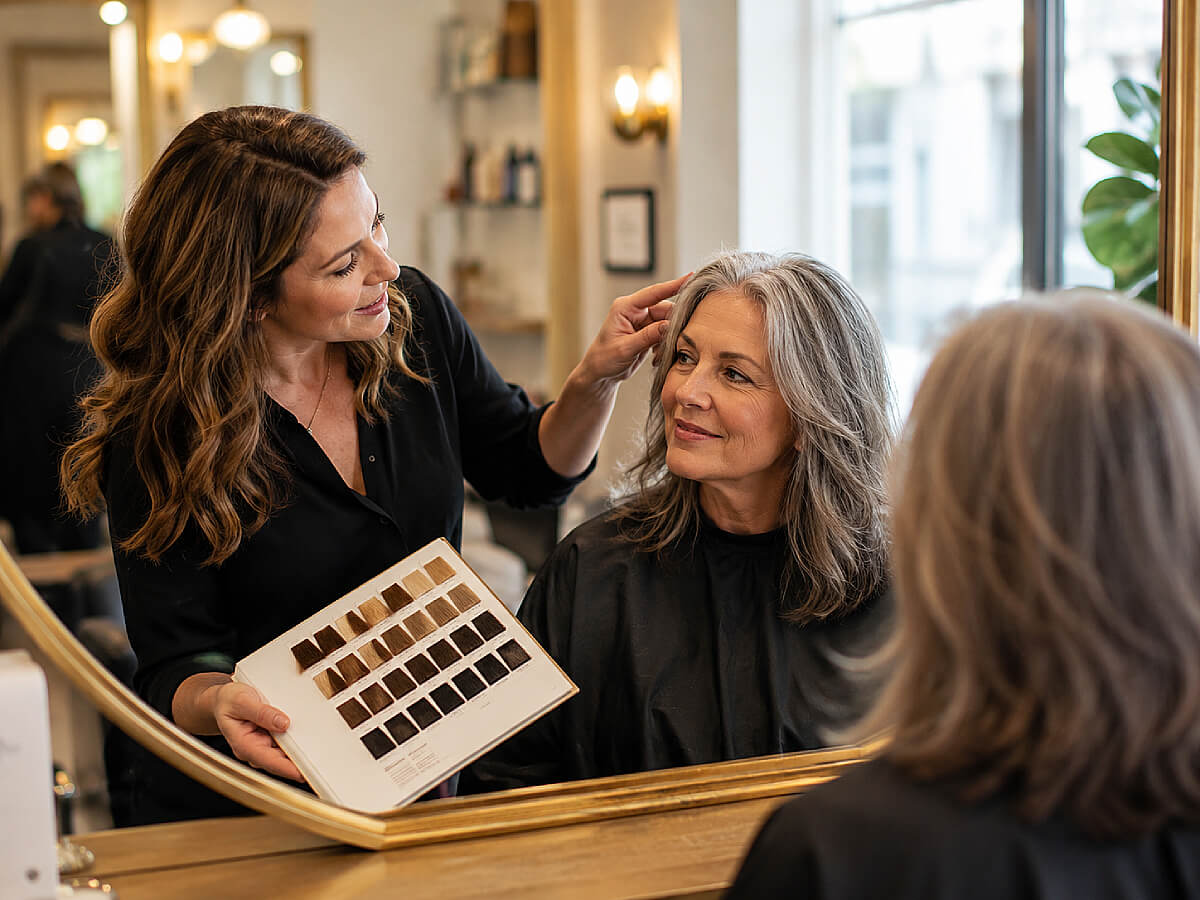
The most flattering, most genuinely age-defying thing you can do for your color is to update it to work with who you are right now, your current skin, your current lifestyle, the amount of time you want to spend in the salon, all of it. That doesn’t mean a dramatic change necessarily, it might be as simple as going a shade lighter overall, adding some soft dimension, adjusting your toner to something warmer, or starting a bond-building routine so your color reflects light the way it’s supposed to. If you haven’t had a real color consultation where someone looks at your skin and your goals and your current hair health and talks to you honestly about what would actually work for you right now, that’s the first thing I’d do. Not a new box color, not a DIY gloss kit, just an honest conversation with someone who knows what they’re looking at.
You deserve color that works for you as you are now, not color that’s a little behind, and the difference when you get it right is genuinely something you feel the moment you look in the mirror.
One Last Thing Before You Go
Marlene, I hope this gives you some real direction, and I hope it helps some of you reading along who have been feeling that same vague sense of something not quite clicking with your color. Hair color consultation with a skilled colorist is truly one of the best investments you can make for your overall appearance, not because there’s anything wrong with how you look now, but because getting your color right for where you actually are makes everything else look better too, your skin, your cut, even your makeup somehow. It’s all connected.
If you’re working with a limited budget for salon services, I’d prioritize a consultation and a gloss or glaze treatment over a full color service, because understanding what your hair actually needs is more valuable than just throwing more color at it. And if you’re maintaining color at home, please invest in a good sulfate-free shampoo, a regular bond-building treatment, and learn how to use a toning shampoo without overdoing it. Those three things alone will keep your color looking intentional and healthy between appointments, and they’re genuinely worth the cost.
Feel free to drop your questions in the comments below, I read everything and I love hearing what you’re working with.