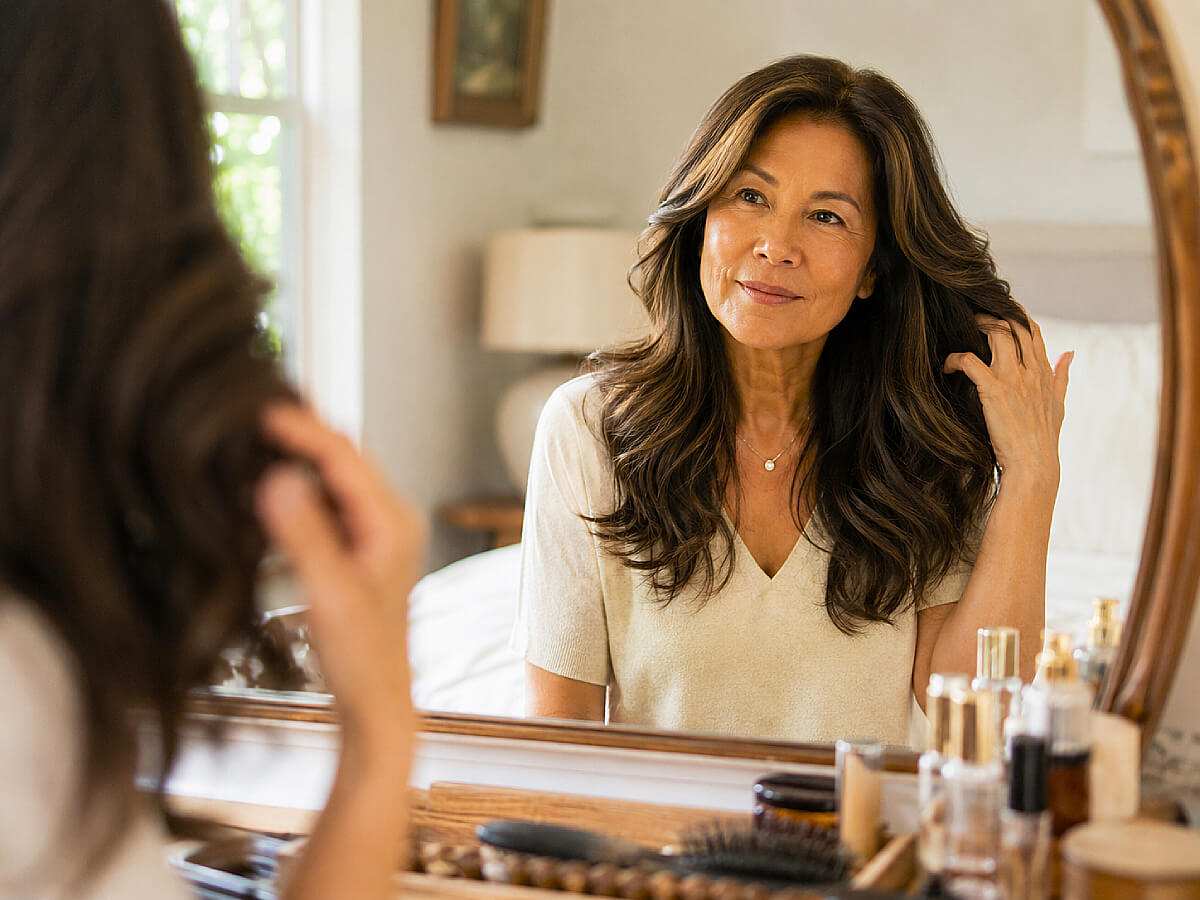

From Patricia Hendelman, Flagstaff, Arizona: “I’m 58 and my hair has been thinning for about three years now. My ponytail used to be thick and long and now it’s honestly embarrassing to me. My doctor says my labs are ‘normal’ but something feels off. I’ve tried biotin and expensive shampoos and nothing is working. Is there actually a way to grow back thick, long hair naturally, or am I just fighting my age at this point?”
Patricia, first of all, I hear you, and I want you to know you’re not overreacting. “Normal” on a lab report and “optimal” for your hair are two very different things, and that distinction took me years in this industry to really understand. I’ve had clients sit in my chair in tears over their thinning hair, women who used to have gorgeous thick ponytails, and the shift in how they carry themselves once they figure out what’s actually going on is remarkable. This is a solvable problem more often than people realize.
The honest truth is that most hair loss advice aimed at women over 50 is either too vague to be useful or it’s trying to sell you something that won’t move the needle. What actually works involves understanding your hormones, your stress response, your gut, your sleep, your scalp, and yes, the products you use, but in a very specific order of priority. I’m going to walk you through what I’ve seen work, what I’ve tried myself, and what the research actually supports. We’re counting down to the most important thing, so stick with me through all of it.
This post may contain affiliate links, meaning I may earn a small commission at no extra cost to you. I only share products I truly believe in. As an Amazon Associate, I earn from qualifying purchases. Your support helps me continue creating free content like this.
8. Stop Washing Your Hair Every Day and Be Smarter About How You Cleanse
This one might feel too simple to matter, but hear me out, because the way you’re washing your hair could genuinely be making the thinning worse, especially if you’re already dealing with a sensitized scalp or fluctuating estrogen levels, which affect how much sebum your scalp produces. Over-washing strips the natural oils that protect the follicle environment, and if you’re compensating with dry shampoo, you might be clogging the follicles even more without realizing it.
When I started going through my own hormonal transition in my early 50s, I noticed my scalp got both drier and more reactive at the same time, which felt unfair honestly. I switched to washing every three days and it made a real difference in shedding. The key is using a sulfate-free, scalp-focused shampoo that isn’t stripping. I really like PURA D’OR Original Gold Label Anti-Thinning Shampoo, which has been around long enough that I trust it, and my clients who’ve switched to it consistently report less shedding within about six weeks. It’s not a miracle product, but it’s genuinely one of the better options on the market for thinning hair.
When you do wash, take the time to actually massage your scalp for two or three minutes before rinsing. Not scrubbing, massaging with your fingertips in slow circular motions. There’s solid research showing that consistent scalp massage increases hair thickness over time by stimulating blood flow to the follicles. Do it in the shower while the shampoo sits, do it while you’re watching TV, whatever makes it a habit. A silicone scalp massager can help you get more consistent pressure without your hands cramping up.
7. Your Gut Health Is Showing Up on Your Head
This is the one that surprises women the most when I bring it up, but the gut-hair connection is very real and very underappreciated in mainstream hair loss conversations. Your gut microbiome is responsible for absorbing the nutrients that feed your follicles, and if absorption is compromised, it doesn’t matter how many supplements you take. You can spend a hundred dollars a month on biotin and see nothing because the underlying absorption issue is still there.
Signs that your gut might be contributing to your hair thinning include bloating after meals, a history of antibiotic use, chronic stress (which we’ll talk about more in a bit), blood sugar swings, and anything diagnosed as IBS or leaky gut. Low stomach acid, which becomes more common as we age, can specifically impair your ability to absorb zinc, iron, and B12, all of which are essential for hair growth. A lot of women over 50 are low in these and don’t know it because standard panels don’t always test for them, or they test for them but not at the right sensitivity.
Getting a good quality probiotic into your routine is a reasonable starting point, something like Garden of Life Dr. Formulated Probiotics for Women, which I’ve recommended to clients for years. But also consider adding fermented foods to your diet, not just supplements. Real kimchi, real sauerkraut, plain kefir, these things change the environment over time in ways that a capsule alone might not. It takes about three months to notice a meaningful shift in your gut, which means it takes about three months to start seeing it reflected in your hair growth cycle.
6. Iron and Ferritin: The Most Overlooked Piece of the Hair Loss Puzzle
Here’s something that frustrates me about how hair loss gets addressed, or not addressed, by general practitioners. Ferritin is the storage form of iron in your body, and it needs to be at a certain level for your follicles to cycle correctly into the growth phase. Most labs flag ferritin as “low” only when it drops below around 12 ng/mL, but hair loss research consistently shows that hair growth starts being impaired at ferritin levels below 40, and optimal for hair regrowth tends to be closer to 70 to 80 ng/mL. So you can have ferritin at 25, be told your levels are normal, and be losing hair because of it.
If you haven’t specifically asked your doctor to test your ferritin, ask at your next appointment and ask for the actual number, not just whether it’s in range. Then look up what the hair loss research says about optimal levels, not just the lab reference range. This was genuinely one of the most clarifying things I learned when I started digging into why some clients responded beautifully to everything else we tried while others didn’t budge.
If your ferritin is low, dietary iron from grass-fed red meat and dark leafy greens is going to absorb better than most supplements, but if you need to supplement, Thorne Iron Bisglycinate is well-tolerated and doesn’t cause the GI issues that cheaper iron supplements are notorious for. Take it with vitamin C to improve absorption, and not with calcium or coffee, both of which block it. Pair it with a diet that’s consistently protein-rich because iron without adequate protein is still not enough to support regrowth.
5. Scalp Health Is a Whole Separate Conversation from Hair Health
A lot of women focus entirely on their hair strands when they should be thinking about the scalp as a living ecosystem. The scalp is skin, and it ages, it gets inflamed, it can develop fungal overgrowth or seborrheic dermatitis, and all of those things affect follicle function in a pretty direct way. I’ve seen women with genuinely significant thinning whose main issue turned out to be chronic scalp inflammation that nobody had ever treated because it didn’t look dramatic from the outside.
If your scalp itches, or flakes, or feels tight or tender, or if you notice redness anywhere along your part line, those are signs worth paying attention to. An inflamed scalp is not an ideal environment for hair to grow, and all the supplements in the world won’t fully override that. A once-a-week treatment with something like tea tree oil scalp treatment can help calm things down, or if you want something more targeted, Neutrogena T/Sal Therapeutic Shampoo used once a week alongside your regular shampoo is one of those quiet workhorses that dermatologists have recommended for decades.
Beyond products, I want to mention rosemary oil because the evidence on it is genuinely worth knowing about. A 2015 study published in SKINmed compared rosemary oil to minoxidil 2% for hair growth, and found comparable results at six months with less scalp itching. I add a few drops of rosemary essential oil to a carrier oil like jojoba and apply it to my part line two or three times a week. It’s one of those things I’d been casually recommending to clients for years before the research caught up with the anecdote, and now that it has, I recommend it with much more confidence.
4. Protein, Collagen, and Why What You Eat for Breakfast Actually Matters
Hair is made of keratin, which is a protein, and if your diet is consistently low in protein, your body will deprioritize hair growth in favor of more essential functions. This is not controversial nutritional information, but the degree to which it affects hair is something women, especially women who’ve been dieting on and off for years or who’ve transitioned to plant-based eating without thinking carefully about protein, frequently underestimate. I am not anti-plant-based eating at all, but I am pro-eating-enough-protein, and the two require more intentionality together.
For most women, getting somewhere in the range of 100 to 130 grams of protein a day is a meaningful target for supporting hair regrowth, and most women are eating considerably less than that. Eggs, salmon, Greek yogurt, chicken, legumes combined with whole grains… these are the building blocks. A good quality collagen peptide supplement added to your morning coffee or smoothie can genuinely contribute to hair thickness over time, and I like Vital Proteins Collagen Peptides because they’re unflavored, dissolve well, and the quality is consistent. I’ve been using them for about two years and my nails and hair both reflect that.
Biotin comes up constantly in this conversation and I want to address it directly, because I think it’s overhyped for most people. If you’re genuinely deficient in biotin, supplementing will help. But true biotin deficiency in people eating a reasonably varied diet is not common. What is common is women spending money on high-dose biotin supplements and being frustrated when nothing happens. Zinc, silica, and vitamin D tend to be more impactful for the average woman experiencing hair thinning, and they’re discussed far less. A comprehensive hair-specific supplement like Nutrafol Women covers a lot of these bases in one place and has actual clinical data behind it, which I appreciate.
3. How Chronic Stress Literally Stops Your Hair From Growing
Stress-related hair loss, telogen effluvium, is one of the most common causes of diffuse thinning in women over 40 and 50, and it works in a way that’s deeply frustrating because there’s a lag. The hair you’re losing right now is responding to stress your body experienced two to four months ago. Which means by the time you notice the shedding, the stressful event is already in the past, and if you don’t know that’s how it works, you spiral trying to figure out what’s currently wrong when the trigger has already passed.
But chronic, ongoing stress, the kind that lives in your nervous system as a baseline, is different from acute stress events, and it’s the kind that more steadily disrupts your hair growth cycle over time. Cortisol, the primary stress hormone, in elevated amounts essentially signals your follicles to shift out of the growth phase and into the resting or shedding phase. This is your body making a resource allocation decision. Hair is not a survival priority when your nervous system thinks you’re under threat constantly.
What actually moves the needle on chronic stress is not occasional bubble baths. It’s consistent, daily nervous system practices that retrain your baseline response over time. Magnesium glycinate supplementation at night has been meaningful for me personally, something like Doctor’s Best High Absorption Magnesium, because most women are deficient in magnesium and it plays a central role in cortisol regulation and sleep quality. Breathwork, genuine meditation practices, time outside, and reducing your overall stimulant load (yes, that means looking honestly at your caffeine intake if you’re sleeping poorly) all compound over time in ways that show up in your hair. This isn’t soft advice. It’s physiology.
2. Understanding Your Hormones: What Estrogen, Progesterone, and DHT Are Actually Doing to Your Hair
This is where I want to spend real time, because hormonal hair loss in women is so misunderstood and so under-treated, and it makes me genuinely frustrated on behalf of my clients. Estrogen is protective of hair follicles. It prolongs the growth phase and keeps DHT (dihydrotestosterone) from doing as much damage to sensitive follicles. As estrogen declines in perimenopause and menopause, DHT’s effects become more pronounced, which is why you start seeing thinning at the top of the scalp and along the part line, which is the classic androgenic pattern, but in women it presents more diffusely than it does in men.
Progesterone matters here too, more than it gets credit for. Progesterone actually inhibits the enzyme that converts testosterone to DHT, so when progesterone drops (which often happens before estrogen in perimenopause), you can start seeing hair changes earlier than women expect. If you’re in your late 40s and thinking “I’m too young for menopause-related hair loss,” you might be in early perimenopause and experiencing the progesterone drop before significant estrogen decline. This is worth a real conversation with a hormone-literate provider, not just a general practitioner who runs a standard FSH test and calls it a day.
Functional medicine doctors and practitioners who specialize in bioidentical hormone replacement therapy can test a more comprehensive hormone panel including free testosterone, DHEA-S, SHBG, progesterone, and estradiol, and these numbers together tell a much clearer story about what your follicles are experiencing than a single FSH result does. I’m not here to tell you what to do about your hormones medically because that’s your decision with your provider. But I am here to tell you that if your hair is thinning and you haven’t had a full hormone workup with someone who actually specializes in women’s hormonal health, that is the most important call you can make. Supplements like DIM (diindolylmethane) can support healthy estrogen metabolism and are worth discussing with your provider as well. Some of my clients have had meaningful results with it alongside other hormonal support.
1. Consistency Over Everything, and Building a Routine That You Can Actually Sustain
Here we are at the thing I actually believe matters most, and it’s not a product or a single supplement or even a hormone test, it’s the compounding effect of doing the right things consistently over a long enough period of time. Hair growth cycles are slow. The active growth phase of a hair follicle is two to six years, and each cycle takes months to show visible results. Women quit their routines at six weeks because they don’t see dramatic changes, when the truth is that the follicles that were in the resting phase are still making their way back into growth. Three to six months is the honest minimum timeline for any meaningful intervention to show up in the mirror.
The routines that actually work are the ones built around what you’ll really do every day, not the most aggressive or expensive protocol you can find online. If you’re not going to remember to take four separate supplements at two separate times of day, consolidate. If a 20-step scalp treatment routine will last exactly one week before you abandon it, do one thing instead and do it without fail. I had a client, a woman in her early 60s who’d been dealing with significant thinning for five years, and what turned it around for her wasn’t anything complicated. She committed to a consistent protein intake, started sleeping seven hours a night instead of five (she’d been chronically undersleeping for years), and did a rosemary oil scalp massage every other night. Fourteen months later she had noticeably thicker hair and was growing it out for the first time in a decade.
A derma roller designed for scalp use, specifically a 0.25mm to 0.5mm size used weekly, is something I’ve added to my own routine and would add to yours if I were building out a sustainable protocol from scratch. Microneedling the scalp stimulates collagen and increases topical absorption, which means any oil or treatment you apply afterward penetrates more effectively. It takes about five minutes. Pair that with your rosemary oil application and you have a powerful, evidence-supported combination that costs very little and takes almost no time once it’s a habit.
Track your shedding in a very simple, non-obsessive way, count hairs on the shower floor or in your brush once a week and just notice the trend over time. Are you shedding less at week 12 than you were at week one? That’s signal. Hair regrowth rarely announces itself dramatically. It tends to show up first as baby hairs along your hairline, then as density gradually returning at the part, then as your ponytail slowly feeling more substantial. Patricia, I’d bet on you. Your body wants to grow healthy hair, it just needs the right environment to do it. Give it that, and give it time.
Final Thoughts
If there’s one thing I want you to walk away with from all of this, it’s that hair thinning in women is almost never just one thing, and it’s almost never permanent if you address the underlying causes. Hormones, stress, nutrition, gut health, scalp health, and your daily habits are all contributing and they’re all addressable. You don’t have to tackle everything at once. Start with your protein intake and your hormone workup because those two things will tell you the most about where to focus next. Add the scalp massage because it costs nothing and the evidence is genuinely good. And please, be patient with your timeline in a way that our culture makes very difficult, because your hair is worth the long game.