
Reader Question from Deborah Winslow, Flagstaff, Arizona:
“I’m 63 and I’ve had the same basic routine with my hair for probably fifteen years now. My sister keeps telling me I need to change things up but honestly I’m comfortable with what I do. My stylist retired last year and I haven’t really clicked with anyone new yet. Can you tell me what habits older women should actually stop doing to their hair? I want real advice, not just someone trying to sell me something.”
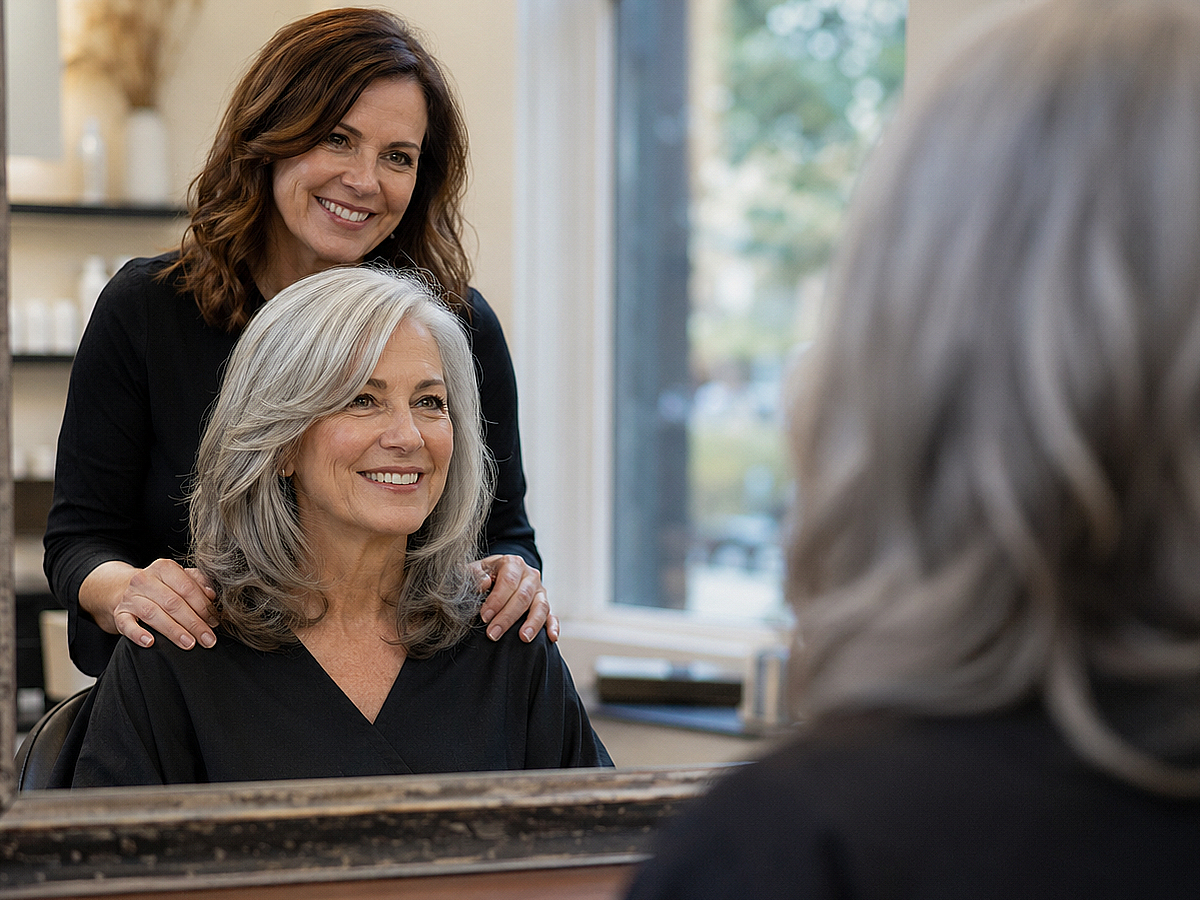
There’s a client I had for years, sharp woman, retired teacher, came in every six weeks like clockwork, and every single time I’d finish her blowout she’d pull a can of Aqua Net out of her purse and just… go to town. And I adored her, I really did, but watching that happen after an hour of my work was like watching someone put ketchup on a good steak. I never said anything for the first year because it wasn’t my place. By year two I finally just sat down next to her and said, “Can we talk about this?” and what came out of that conversation changed the way I think about how women relate to their hair as they get older.
Because the thing is, most of the habits women hold onto aren’t born out of laziness or not caring. They come from a time when that habit was actually the right call, or when it solved a real problem, or when someone they trusted told them it was the way to go. Hair advice has a long shelf life in our heads, even when the products have changed, the techniques have evolved, and honestly, our hair itself has changed too. So this isn’t about shaming anyone. It’s about having the kind of conversation I wish more women got to have with someone who’s been doing this long enough to have seen what holds up and what really, genuinely doesn’t.
This post may contain affiliate links, meaning I may earn a small commission at no extra cost to you. I only share products I truly believe in. As an Amazon Associate, I earn from qualifying purchases. Your support helps me continue creating free content like this.
8. Over-washing her hair, especially if it’s color-treated or going gray
This one is so common and I get it, it feels clean, it feels like you’re taking care of yourself, and honestly there’s something psychologically satisfying about washing your hair every day. But as hair gets older, it genuinely does not have the same oil production it did at 30, and when you’re stripping away what little natural moisture is there every single morning, you are working directly against yourself. Color-treated hair especially, whether that’s gray blending, highlights, or a full color service, loses vibrancy so much faster when it’s being washed daily with anything other than a really gentle sulfate-free formula.
The sweet spot for most of my clients over 55 is honestly two, maybe three times a week, and I know that sounds like a lot to someone who’s washed her hair every day since 1987, but your scalp will recalibrate within a couple of weeks and stop overproducing oil to compensate for the constant stripping. In the meantime, a good dry shampoo is your best friend, and not just any dry shampoo. I’ve been recommending Klorane Dry Shampoo with Oat Milk for years to clients with finer, more delicate hair because it doesn’t leave that chalky white cast and it actually adds a little softness rather than just masking oil. When your hair is clean but not stripped, color stays truer, gray looks more luminous and intentional rather than dull, and the overall texture of your hair from roots to ends starts to feel more balanced over time.
7. Using the wrong brush, and brushing too aggressively when hair is wet
I have seen women brush their wet hair like they are detangling a sheepdog, and I understand the impulse because when hair is knotted it feels like you need to just power through it, but wet hair is at its most fragile state and older hair that’s gone through years of color, heat, hormonal shifts, and general life is even more so. The cuticle is raised when hair is wet, meaning every aggressive stroke is lifting and roughing up the surface of the strand, and over time that contributes to breakage, frizz, and that kind of general puffiness that women often blame on humidity when it’s actually just mechanical damage accumulating.
What I always tell my clients is to start at the ends, work your way up, and use the right tool for the job. For wet detangling, I genuinely love the Wet Brush Original Detangling Brush, it’s one of those products that seems almost too simple but the flexible bristles genuinely do make a difference when your hair is fragile. For dry styling, a good boar bristle brush is worth every penny because it distributes natural oils down the shaft and gives finer hair a smoothness and polish that synthetic bristles just can’t replicate the same way. The Mason Pearson brush is the obvious recommendation and yes it’s expensive, but I’ve had mine for eleven years and it still performs the same as it did on day one, so when you think about cost per use it’s actually quite reasonable.
6. Holding onto a length or style because it’s always been “her look”
This is the one that makes me feel the most tender toward my clients, because I understand exactly why it happens. You found something that worked, someone complimented you on it, you felt like yourself in it, and then years went by and the style stayed the same even though everything around it changed, your face changed, your hair texture changed, the color changed, your lifestyle changed. And nobody wants to feel like they’re giving up something that’s part of their identity. I had a client in her late sixties who had worn a long, single-length bob with a center part since her thirties, and when I finally convinced her to let me add some soft layering and shift the part slightly to the side, she cried in the chair, happy tears, because she hadn’t realized how much a small shift could feel like she was meeting herself in the mirror again.
The hard truth is that the same cut does not work the same way on hair that has changed in density, texture, and growth pattern, and most hair does all three of those things noticeably as we get into our fifties and sixties. A style that was flattering at 45 might be dragging the face down at 62 simply because the weight distribution is wrong for where your hair is now. This doesn’t mean you have to go short, it doesn’t mean you have to do anything dramatic, but it does mean having an honest conversation with your stylist about what your hair is actually doing now versus what you want it to do, and being open to the idea that a small adjustment might do more than a decade of trying to style your way out of the problem.
5. Applying heat without proper protection, or using tools that are too hot
I know heat protectant has been talked about so much that it almost feels like background noise at this point, but I still see it skipped constantly, and I get why, it adds a step, some of them feel heavy, some of them make fine hair limp, so women just stop using them. But here’s what I want you to actually understand about heat and older hair specifically: the structural integrity of your hair strand is not what it was, hormonal changes alone affect the protein bonds and moisture levels inside the hair, and when you add 400 degrees of flat iron on top of hair that’s already dealing with all of that, you are doing damage that is genuinely very hard to come back from.
The product I recommend most consistently right now is Olaplex No. 7 Bonding Oil, because it works as both a heat protectant and a finishing oil so it doesn’t add an extra step so much as it replaces one, and it’s genuinely lightweight enough that fine hair can wear it without going flat. On the tool side, I am a big fan of the GHD flat irons for older clients specifically because they max out at 365 degrees, which is enough to style but not enough to cause the kind of acute damage you get from irons that go up to 450. Most women are using way more heat than they actually need because they think higher means faster, but it mostly just means more damage for the same result.
4. Over-relying on box color, especially to cover gray
Okay, I have to be careful here because I don’t want to be the person who just tells you to spend more money at a salon, that’s not really my point and it’s not the whole story. But I do need to be honest with you about what box color does to hair that’s dealing with a significant amount of gray, because the gray hair conversation in particular is one I have almost every week and there’s a lot of misinformation floating around out there. Gray hair, and especially coarse gray hair, is often more resistant to color uptake, so box color formulas tend to be made with a higher developer volume to compensate, and that higher volume developer is more aggressive on your hair structure over time, especially when applied root to end every single cycle without really assessing what the ends need.
The other issue is that matching your own color at home, when gray is coming in unevenly and your natural base is shifting, is genuinely difficult even for people who know what they’re doing, and the result is often a flat, one-dimensional color that actually reads more aging than the gray itself would. I’m not saying never color at home, but I am saying if you’re doing it every three to four weeks because the gray is coming in that fast, it’s worth looking into options like gray blending, a toner service, or even a partial color approach with a professional that reduces how often you need to touch up the whole head. Products like Madison Reed Root Touch Up are a genuinely better option than most drugstore boxes for in-between maintenance because the formula is less aggressive, but it should still be a bridge, not the whole plan.
3. Using heavy, moisturizing products meant for thick hair on fine or thinning hair
This is probably the habit I see causing the most visible damage to how women’s hair looks on a daily basis, and it’s almost always rooted in good intentions. Hair gets drier and more brittle as we age, so women reach for the richest, most moisturizing products on the shelf, and they end up with hair that is weighed down, limp, greasy-looking at the roots, and somehow both over-moisturized and still feeling rough at the ends. It’s a confusing result and it makes women feel like nothing works, when really the issue is that the product was working exactly as designed, just for a different hair type than theirs.
Fine hair, hair that’s lost density with age, and hair that’s been processed needs moisture, yes, but it needs the right kind, lightweight, penetrating moisture rather than coating moisture. There’s a real difference between a product that hydrates the inside of the strand and one that just sits on top of it. I’ve been recommending Redken Acidic Bonding Concentrate Conditioner for clients in this situation because it focuses on strengthening and smoothing without the heaviness, and you use it mid-shaft to ends only, not at the roots, which is something a lot of women skip over in the instructions. Keeping products off your scalp area is genuinely one of the simplest things you can do to improve how your hair looks and feels starting basically immediately.
2. Ignoring scalp health entirely and focusing only on the hair itself
Your hair grows out of your scalp. That sounds almost too obvious to say out loud, but the amount of attention we collectively pay to the ends of our hair versus the environment those strands are actually originating from is so lopsided that I feel like I have to keep saying it. Scalp health becomes more relevant, not less, as we get older, because circulation changes, hormonal shifts affect oil production and can contribute to thinning at the crown, and a lot of the heavy styling products women have been using for years can build up in ways that clog follicles and slow down healthy growth over time.
I started really paying attention to this issue in my own practice about six years ago when I had a cluster of clients all experiencing thinning around the same time and realizing that a lot of them had very similar product habits, heavy dry shampoos used multiple days in a row, no exfoliation, and conditioners applied all the way to the root. Incorporating a scalp scrub or exfoliating treatment once a week or even once every two weeks makes a noticeable difference in how much volume hair has at the root and how healthy the new growth looks. I like Briogeo Scalp Revival Charcoal + Coconut Oil Micro-Exfoliating Shampoo for this, it’s gentle enough for regular use but actually does something, which is more than I can say for a lot of scalp products that are mostly just marketing. Pair it with a scalp massager brush in the shower for a couple of minutes and your scalp circulation will genuinely thank you over time.
1. Giving up on her hair entirely because she believes the best years are behind it
I saved this one for last because I think it does the most damage, not just to hair but to how women feel about themselves, and it’s something I see so often in my chair that it genuinely breaks my heart a little every time. A woman comes in, she’s somewhere in her late fifties or sixties, and within the first five minutes of the appointment she says some version of “it doesn’t matter that much anymore” or “just do whatever, it grows back” or “my hair is so bad now there’s not much you can do.” And I always want to stop and say, where did you get that idea, and how long have you been carrying it?
The belief that hair care and hair investment is something that belongs to youth is so deeply embedded in our culture and it is so genuinely wrong that I could talk about it for an hour. Women’s hair at 60, 65, 70 can be extraordinary. I have clients in their seventies with some of the most beautiful hair I have ever worked with, silver and rich and healthy, because they kept caring, they kept adjusting, they kept showing up for their hair the way they do for other things in their lives. The investment in a good haircut, the right hair thinning treatment, quality hair care products for mature hair, salon services designed around where your hair actually is now rather than where it was fifteen years ago, all of it is not vanity. It’s maintenance of something that genuinely contributes to how you feel when you look in the mirror, and that matters every single decade.
What I’d encourage you to do, if any of this sounds familiar, is find a stylist you can actually talk to, because the conversation is half the service. If your current one isn’t asking you questions and listening to the answers, that’s information too. Your hair is still worth the attention, still worth the care, and still capable of things that might genuinely surprise you. I’ve seen it happen too many times to think otherwise.
One more thing before you go
Deborah, I hope somewhere in here you found what you were actually looking for, which I think was less about a list and more about feeling like someone was being straight with you. Your instinct that you might need to shake some things up is probably right, not because what you’ve been doing is wrong exactly, but because hair changes and our routines need to change with it at some point. Find a stylist who makes you feel heard, bring your questions, and don’t let anyone talk you out of caring about how you look and feel. You’re worth a great haircut at every age, and that’s the one thing I’ll say with zero hesitation.