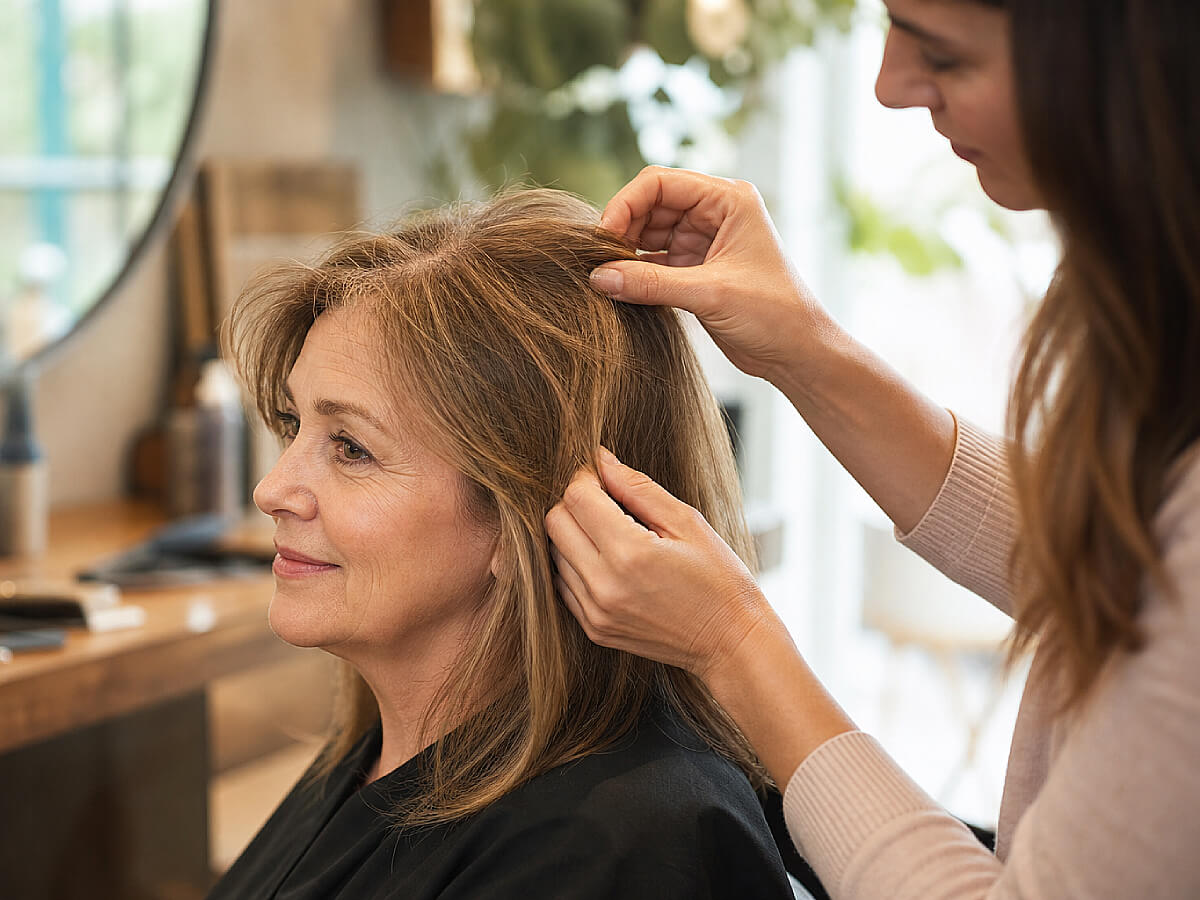

From Sandra Kowalczyk, Bozeman, Montana: “I’m 54 and my ponytail used to be thick enough that I had to use those big scrunchies. Now it fits in a regular hair tie with room to spare. My doctor ran some basic bloodwork and said everything looked normal, but something is clearly off. My hair is noticeably thinner on top and I’m losing more in the shower than I used to. Where do I even start trying to figure out what’s going on?”
Here’s something I notice a lot in my chair, and I don’t think enough people talk about it honestly: the women who come in worried about thinning hair are almost never doing anything wrong. They’re not over-processing, they’re not being rough with it, they’re not neglecting it. A lot of them are actually doing more than ever, taking vitamins, using gentle shampoos, being careful with heat, and the hair is still thinning anyway. That disconnect is confusing and it makes them feel like they’re missing something obvious, when really what they’re missing is just the right information.
I’ve been doing hair for a looong time and the thinning conversation comes up in my salon probably three or four times a week now, mostly with women in their 50s and 60s. What I’ve learned from being in the room with so many of these conversations, and from dealing with some of this myself, honestly, is that thinning after 50 almost always has a reason, sometimes more than one, and a lot of those reasons are addressable once you know where to look. So Sandra, this one’s for you, and honestly for about half the women I see on any given week.
This post may contain affiliate links, meaning I may earn a small commission at no extra cost to you. I only share products I truly believe in. As an Amazon Associate, I earn from qualifying purchases. Your support helps me continue creating free content like this.
6. Your Shampoo Might Be Working Against You
I know this sounds like a small thing, and I used to think it was too, until I started paying closer attention to what my clients were actually using when they came in and described their hair history to me. A lot of women switch to “volumizing” shampoos the moment they notice thinning, which makes total sense on the surface, but a lot of those formulas have sulfates and other stripping agents that are way too aggressive for hair that’s already in a fragile state. And then there are the ones who swing the other way and use something super heavy and moisturizing because their hair also feels dry, which is really common after menopause, and those formulas can weigh down fine hair and make the scalp environment less than ideal for growth.
What I actually recommend, and what I’ve seen make a real difference for a lot of women, is a scalp-focused shampoo that’s gentle but effective, something that keeps the follicle environment clean without stripping the scalp’s natural oils completely. I really like Pura D’Or Anti-Thinning Shampoo for this because it’s got biotin and a bunch of botanical ingredients that support the scalp without being dramatic about it, and it’s not going to break the bank. I also think Nioxin System 2 is genuinely useful for fine, thinning hair, though I’ll be honest that it’s a little overmarketed and some people find it too drying if they use it every single day. Every other day, fine. Daily, it might be too much depending on your scalp.
The other thing I want to mention here is buildup. Women who use a lot of dry shampoo, which again, totally understandable when your hair is flat and you’re trying to get through the day, can end up with significant product buildup on the scalp that actually inhibits healthy hair growth over time. A clarifying shampoo once every two weeks or so can make a real difference, something like Neutrogena Anti-Residue Shampoo, which is cheap and effective and doesn’t need to be fancy.
5. The Stress-Hair Connection Is Real and It Has a Delay
This one trips people up all the time because the timing is so misleading. When you go through a period of significant stress, whether that’s emotional stress, physical stress like a surgery or illness, or even something like rapid weight loss, the hair shedding that results from that often doesn’t show up until two to four months later. It’s called telogen effluvium and it’s incredibly common, especially in women over 50 who are often managing a lot at once, aging parents, career changes, health scares of their own, kids leaving or coming back, menopause itself which is its own full-time physical stressor. By the time the hair loss shows up they’ve usually moved past whatever caused it, so they don’t connect the two.
I had a client a few years back, lovely woman, early 60s, came in absolutely panicked about her hair. We went through everything and couldn’t figure it out until she mentioned almost offhandedly that she’d had a pretty significant respiratory infection about four months prior. That was it. That was the whole answer. Her body had prioritized recovery over hair growth, which is exactly what it’s supposed to do, and the shedding caught up with her months later. Once we knew what it was, we could stop worrying about permanent loss and focus on supporting regrowth.
The good news about telogen effluvium is that it’s usually temporary, but your hair does need support during the regrowth phase. I’ve seen good results with clients who add a scalp serum into their routine during this time, something with peptides and growth-supporting ingredients. The Ordinary Multi-Peptide Serum for Hair Density is honestly impressive for the price point, and I recommend it a lot. If stress is ongoing rather than a past event, that’s a bigger conversation to have, but even some basic stress-management support, magnesium, better sleep, reducing what you can reduce, does show up in the hair eventually.
4. Your Thyroid Deserves a Closer Look Than a Basic Panel
Okay, this is where I have an actual opinion that sometimes surprises people. Sandra mentioned that her doctor ran bloodwork and everything came back normal. I hear this constantly. And I’m not saying her doctor is wrong, but I am saying that a standard thyroid panel, which usually just checks TSH, can miss a lot. Thyroid issues are incredibly common in women over 50, and the connection between thyroid function and hair thinning, specifically that diffuse all-over thinning and the loss of the outer third of the eyebrows, is well established. But subclinical hypothyroidism, where your numbers are technically within range but your body is still struggling, can absolutely cause hair loss and it can absolutely get missed on a basic test.
What I tell clients who suspect thyroid might be involved is to go back and ask specifically for a full thyroid panel, meaning TSH, Free T3, Free T4, and thyroid antibodies like TPO and TgAb, because Hashimoto’s in particular can cause hair loss even when TSH looks fine. I’m a hairstylist, not a doctor, and I want to be clear about that, but I’ve sat with enough women who eventually found their answer in a more thorough thyroid workup that I feel like I’d be doing you a disservice not to mention it.
In the meantime, if you’re supporting your thyroid through diet and you want to look at supplements, make sure any hair supplement you take doesn’t have excessive iodine, which can actually aggravate some thyroid conditions. I’m pretty cautious about recommending supplements because the market for women’s hair loss supplements is, frankly, a little wild, but Nutrafol Women’s Balance, which is specifically formulated for women in perimenopause and menopause, does address some thyroid-related stress pathways and has better clinical backing than most. It’s expensive. I won’t pretend it isn’t. But it’s one of the few I feel okay recommending.
3. Hormonal Changes After Menopause Are Doing More Than You Think
This is probably the most common underlying factor I see in the thinning conversation with women over 50, and I think it’s also the one that gets explained in the vaguest, least helpful way. Yes, estrogen and progesterone decline after menopause and yes, that affects hair. But here’s what that actually looks like and why it matters to understand the specifics: estrogen helps keep hair in its growth phase longer. When estrogen drops, the growth phase shortens, meaning your hair doesn’t grow as long or as dense before it sheds, and the shedding can pick up. At the same time, the relative increase in androgens that comes with menopause can cause hair follicles on the scalp to miniaturize over time, which is the beginning of what’s technically called female pattern hair loss or androgenetic alopecia.
This is different from the stress-related shedding I mentioned earlier because it’s more gradual and it’s hormonally driven, which means it may need a different kind of support. Some women find that hormone replacement therapy helps their hair significantly, and that’s worth a real conversation with a gynecologist or a menopause specialist, not just a general practitioner, because the nuances of HRT and hair are more specific than a lot of doctors have time to get into in a regular appointment. I have clients who’ve been on HRT for other reasons who’ve mentioned their hair improving as a kind of side benefit, and that tracks with what the research shows.
From a topical standpoint, minoxidil for women is the most clinically proven topical treatment available for androgenetic alopecia, and the 5% foam version tends to be better tolerated than the liquid. It’s not glamorous and it requires consistency, but it genuinely does slow loss and support regrowth for a lot of women. I’ve had clients use it with real success. The main thing is you have to keep using it, because the benefit goes away if you stop, which is worth knowing going in so you’re not caught off guard.
2. Your Nutrition Gap Is Probably Not What You Think It Is
Women over 50 are pretty nutrition-aware, in my experience. They’re reading labels, they’re taking supplements, they’re trying. So when I bring up nutrition they sometimes get a little defensive, which I completely understand because it can sound like I’m implying they’re not taking care of themselves. That’s not it at all. What I’m actually saying is that the specific nutritional deficiencies that affect hair most are often the ones that don’t show up in how you feel day to day, and they’re often the ones that a basic multivitamin doesn’t fully address.
Iron is the big one, and specifically ferritin, which is your stored iron, not just the iron in your blood. You can have normal hemoglobin and still have low ferritin, and low ferritin is strongly associated with hair shedding in women. A lot of doctors don’t check ferritin unless you ask for it specifically, so that’s another test worth requesting. Optimal ferritin for hair health is generally cited as above 70 ng/mL, which is higher than the low end of the normal range, so again, “normal” bloodwork doesn’t always mean the level is optimal for hair.
Zinc, vitamin D, and B12 are also worth looking at, especially if you’ve reduced red meat, eat a mostly plant-based diet, or have any gut absorption issues. I’m not a huge supplement pusher, honestly I think most of the hair gummy market is more marketing than substance, but a few specific ones I do think are worth considering are a good biotin supplement paired with an iron supplement if your ferritin comes back low, like Thorne Iron Bisglycinate, which is gentle on the stomach compared to a lot of iron supplements. And please, get your vitamin D level checked if you haven’t recently, because the number of women I see with low D who also have thinning hair is not a coincidence.
1. How You’re Styling and Handling Your Hair Might Be Accelerating Everything
I put this one last because I think it’s the one that deserves the most honest conversation, and also because I see it doing the most immediate damage that we could actually stop fairly quickly. I want to be careful here because I’m not trying to blame anyone, and I’m definitely not saying styling is the root cause of hormonal hair loss or nutritional deficiency. But what I am saying is that mechanical damage, heat damage, and tension from styling can significantly worsen hair that’s already in a vulnerable state, and a lot of women don’t realize how much their daily routine is adding to the problem.
Let me get specific. Tight hairstyles, and I mean anything that creates consistent tension at the hairline or crown, ponytails, buns, even clip placements that you use in the same spot every day, can cause traction alopecia, which is hair loss from repeated pulling. In women who are already experiencing hormonal thinning, this can accelerate the loss in those areas significantly and it can become permanent if it goes on long enough. I have clients who’ve lost a good inch of their hairline from years of pulling their hair back tight, and it’s one of the saddest things I see because it’s so preventable once you know about it.
Heat is the other big one. I know everyone says use a heat protectant and a lot of people do, but the issue is often the temperature, not just the protection. Hair that’s already fine and fragile does not need 400 degrees. It just doesn’t. I use the Dyson Airwrap on myself and I recommend it to clients whenever the budget conversation allows, because it uses significantly lower heat to achieve the same results and the difference in how the hair feels over time is genuinely noticeable. If that’s not in the budget, a Revlon One-Step Volumizer is a much more affordable option that combines drying and styling so you’re using less total heat overall. And Kenra Platinum Silkening Mist is my go-to heat protectant for fine, mature hair because it protects without any weight.
The last thing I’ll say about handling is wet hair. Wet hair is at its most fragile, especially after 50 when the hair shaft itself tends to be more porous and more prone to breakage. Brushing wet hair aggressively, wrapping it in a rough towel, even sleeping on a cotton pillowcase when your hair is damp can all contribute to breakage that reads as thinning over time. A silk pillowcase is one of those things I used to think was a bit precious until I actually used one consistently and noticed a difference in my own hair, so now I just recommend it without apology. And a Wet Brush for detangling is a genuinely low-cost change that makes a real difference in how much hair you’re losing in the process of just getting through your morning.
One Last Thing Before You Spiral
Sandra, I hope this gives you a real starting point rather than more noise. The thing I want to leave you with is that thinning hair after 50 is incredibly common and it is rarely one thing, which can feel overwhelming but is actually kind of useful because it means there are usually multiple places where you can make a real difference. You don’t have to figure it all out at once. Start with the bloodwork, specifically ferritin, full thyroid panel, vitamin D, and B12, and see what that tells you. Look at your styling routine with fresh eyes. Give your scalp some attention. And be patient with yourself, because hair responds slowly and the wins often come quietly, a little more density here, a little less in the drain there, until one day you realize things have shifted.
I’ve seen women make real progress with their hair health in their 50s and 60s, not by doing something drastic but by getting a clearer picture and addressing things one at a time. If you’re in the thick of menopause or perimenopause and dealing with hair loss, please know that you’re not imagining it, it’s not vanity to care about it, and there is genuinely more you can do than just accept it. Your hair is worth the effort, and so are you.