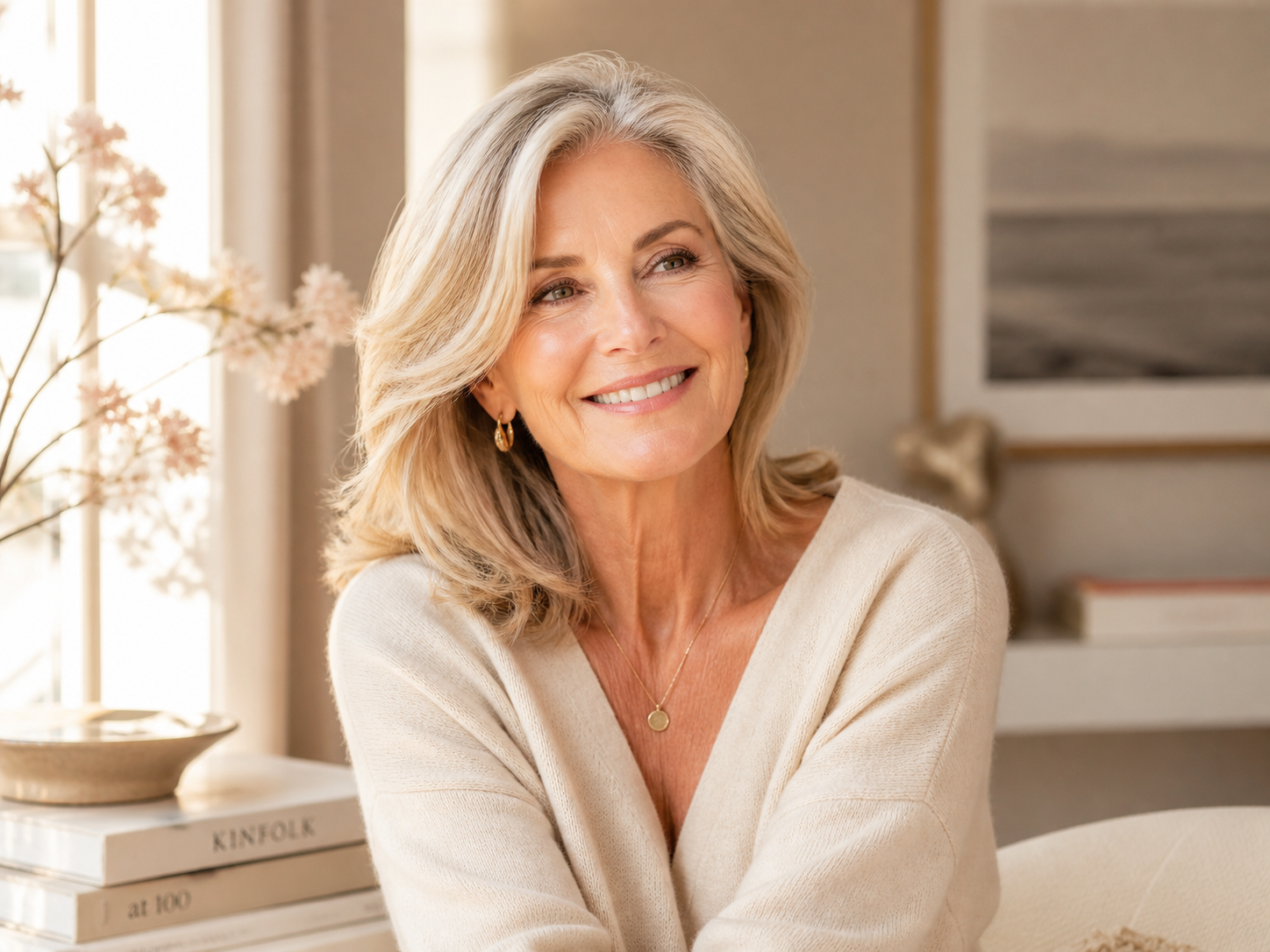

Reader Question: “I’m 58 and recently caught my reflection in a store window and didn’t recognize myself. My hair has been the same for probably fifteen years and suddenly it just looks… off. I can’t put my finger on what I’m doing wrong, but something is definitely making me look older than I feel. What are the most common hair mistakes women my age make, and how do I actually fix them?” — Margaret Holloway, Coeur d’Alene, Idaho
The other day a woman sat down in my chair, looked at herself in the mirror, and said the saddest thing I’ve heard all month. She told me she felt invisible. Not in a dramatic way, just matter of fact, like she was reporting the weather. And I knew before she said another word that we were going to talk about her hair, because nine times out of ten when a woman tells me she feels invisible, the conversation that follows is about her hair.
Here’s the thing I’ve learned in twenty-something years of doing this work. The cuts and colors and habits that worked for us in our forties don’t always carry us through our fifties and sixties, and a lot of women don’t realize they’ve quietly aged into a look that’s working against them. It’s rarely one big dramatic mistake. It’s usually a small handful of things, all stacking up at once, that add years you don’t actually have. The good news is that fixing them isn’t hard, and most of the time the changes are smaller than you’d think.
This post may contain affiliate links, meaning I may earn a small commission at no extra cost to you. I only share products I truly believe in. As an Amazon Associate, I earn from qualifying purchases. Your support helps me continue creating free content like this.
5. The Outdated Cut You’ve Had Since Your Daughter’s Wedding
I’m going to be honest with you because I think you deserve honesty more than flattery. The cut you got in 2009 because it looked great then is not doing you favors now, and I see this every single week. The most common version is the chin-length bob with the heavy blunt fringe, the kind that sits flat against the forehead like a curtain rod, and it adds years the second a woman walks past a mirror. Same goes for the very short pixie that’s been trimmed into the same shape for a decade, getting a little tighter and a little more helmet-like every visit.
What modern feels like for women over fifty is softness around the face, some intentional length variation, and a shape that moves when you move. A long layered bob, what people call a lob, with the front pieces hitting somewhere between the collarbone and the jaw, will take five years off most faces. The bixie, that bob-pixie hybrid that’s having a real moment, works beautifully if you have decent texture and want something low maintenance. Bring a picture to your stylist, even if it feels silly, because the words we use for cuts mean different things to different people.
Beverly K. from Asheville, North Carolina, told me last month that her husband actually did a double take when she came home with a face-framing lob after fifteen years of the same blunt cut, and she said it was the most flattered she’d felt in years.
4. Treating Your Hair Like It’s Still 35
Your hair is not the hair you had at thirty-five and pretending otherwise is one of the fastest ways to look older than you are. The cuticle gets more porous with age, the strands get finer, and the natural oils your scalp produces drop off significantly after menopause. So when you keep doing the same routine you did twenty years ago, daily hot tools at 410 degrees, harsh clarifying shampoos, the same drugstore conditioner you bought because it smelled good, you end up with hair that feels like straw and looks dull no matter what you do with it.
What I tell my clients is to think of mature hair the way you think of a cashmere sweater. You don’t throw cashmere in the regular wash. You take care of it. That means a sulfate-free shampoo a couple times a week instead of daily, a real bonding treatment like Olaplex No. 3 once a week, and a leave-in that has actual slip to it. Living Proof Restore is one I reach for constantly because it doesn’t sit on top of the hair, it actually absorbs.
And please, if you’re going to use heat, use a real heat protectant and turn the temperature down. There’s no reason a fine, mature strand needs the same heat as thick twenty-year-old hair. A good Dyson Airwrap or even a quality ghd flat iron at a lower setting will give you the look without the damage.
3. The Volume Problem Nobody Wants to Talk About
Thinning hair is something almost every woman over fifty deals with to some degree, and I think we don’t talk about it enough because it feels embarrassing, but it really shouldn’t. Hormonal changes, stress, genetics, medications, all of it adds up, and the result is that the hair you used to be able to throw up in a ponytail without thinking now looks limp and flat against your scalp by lunchtime. When the crown goes flat, the whole face looks heavier, and that’s where the aging really kicks in.
The fix is layered, and I mean that literally and figuratively. First, the cut matters more than the products. Long layers cut into the crown and around the face create the illusion of density even when there isn’t much there, and a stylist who knows what they’re doing with point cutting will give you movement that flat one-length hair just can’t produce. Then comes the styling, and this is where I’ll contradict the standard advice. Forget mousse. Mousse is what we used in 1993 and most of them are too heavy for fine hair now.
What you want is a volumizing spray at the roots before you blow dry, a round brush, and the discipline to actually lift the sections up and away from the scalp while you dry. Oribe Maximista is genuinely worth the money. For something more affordable that actually performs, I keep recommending Living Proof Full Dry Volume Blast because it gives you that lifted texture without the crunch.
2. The Way You’re Handling Your Gray
This is the one that gets people heated, and I’ll just tell you what I actually believe. There is no single right answer about gray hair, but there are absolutely wrong ways to handle it. The wrong ways are these: ignoring an obvious harsh root line for weeks because you’re avoiding the salon, dyeing your hair the same flat dark brown you wore in your forties when your skin tone has shifted, or going completely platinum without putting in the work to keep the tones right because brassy yellow gray is more aging than almost anything I can think of.
If you’re going to color, please go softer than you think you need to. The contrast between dark dyed hair and aging skin is brutal, and most women look ten years younger going two or three shades lighter than their old “natural” color. If you’re growing it out, get a stylist to do a smudge root or a soft balayage to blend the line so you’re not walking around with a stripe across your head for eight months.
And if you’re already gray and embracing it, which I love, you have to use a purple shampoo to keep the cool tones from going yellow. Kérastase Blond Absolu is the gold standard. Redken Color Extend Graydiant is the more affordable option I tell clients about when they balk at the price.
Patricia M. in Gulfport, Mississippi, finally let her gray come in fully last spring after years of monthly box dye, and she told me strangers started complimenting her hair within a month. That’s the silver lining, pun absolutely intended, of doing it right.
1. Long, Flat, Lifeless Hair Past the Shoulders
Here it is, the big one, and I save it for last because it’s the mistake I see most often and the one with the biggest payoff when you fix it. Long hair on a mature woman is not aging by itself. I want to be clear about that because there’s a lot of nonsense floating around the internet about how every woman over fifty has to chop her hair off, and that’s just not true. What is aging is long hair that’s flat, thin at the ends, parted down the middle, hanging straight down on either side of the face like two heavy curtains pulling everything south. That look adds a decade. I’m not exaggerating.
The fix isn’t necessarily a haircut, though for some women it is. The fix is movement and intention. If you want to keep the length, you need layers cut into it, real layers, not just a few face-framing pieces snipped at the ends. You need a side part instead of a center part nine times out of ten because the asymmetry lifts the face. You need to actually style it, even if that just means rough-drying it with your fingers, flipping it over for a minute, and giving it a quick wave with a curling iron at the mid-shaft.
For tools, a T3 Whirl Trio or a quality 1.25-inch barrel will give you that soft modern bend without the tight curls that read dated. And if you’re losing length to breakage, which is part of why so much long hair on mature women looks stringy, get serious about Nutrafol or a real scalp care routine. Long hair after fifty is absolutely possible. It just takes more effort than it used to, and the women who pull it off are the ones who’ve accepted that and put in the work.
Pulling It All Together
Margaret, if you’re still reading, I hope some of this clicked for you, because the truth is most women I see who feel like their hair has suddenly turned on them are dealing with two or three of these at once, not all five. Pick the one that hit closest to home and start there. Book the appointment, have an actual conversation with your stylist about what you want your hair to do for your face now, not what it did fifteen years ago, and don’t be afraid to try something a little different. The women who look the most beautiful to me, across every age group I work with, are the ones who keep updating themselves with curiosity instead of fear. You’re allowed to evolve. Your hair is allowed to evolve with you.