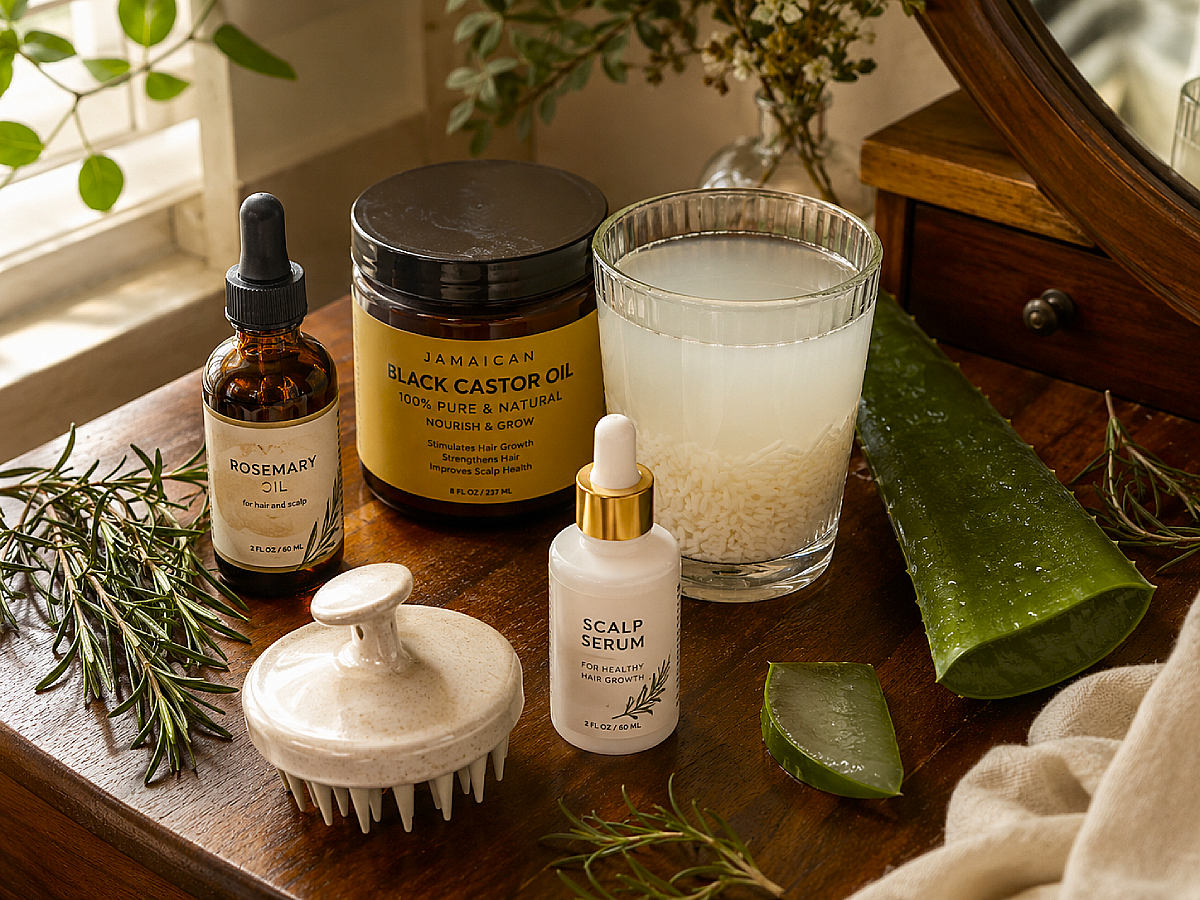

From Sandra Kowalczyk, Bozeman, Montana: “I’ve been struggling with thinning edges and slow growth for about two years now. I feel like I’ve tried everything, but I’m starting to wonder if I’m washing out the very things that could actually be helping me. Are there natural ingredients I should be leaving in my hair instead of rinsing out? What actually works for hair growth and what’s just hype?”
Sandra, I love this question, honestly, because you’re asking the thing most people don’t think to ask. They’re so focused on what to put on their hair that they never stop to wonder whether they’re just sending it all down the drain before it has a chance to do anything.
Hair has been my passion and profession for a long time, and one of the biggest shifts I’ve seen in the last several years is women starting to treat their scalp the way they treat their skin. Leave-on treatments, overnight masks, scalp serums, ingredients that actually need time and contact to penetrate the follicle. That shift matters. Because some of the most effective natural growth ingredients are essentially useless if you rinse them off five minutes after applying them. The scalp needs to absorb them. The follicle environment needs to change. And that doesn’t happen in a quick rinse-out conditioning treatment, it happens when you leave something on and let it work.
This post may contain affiliate links, meaning I may earn a small commission at no extra cost to you. I only share products I truly believe in. As an Amazon Associate, I earn from qualifying purchases. Your support helps me continue creating free content like this.
8. Peppermint Oil, Diluted and Left on the Scalp Overnight
Most people have heard of peppermint oil for hair growth, but almost everyone uses it wrong. They mix a drop into their shampoo and call it a day, which means whatever circulation-boosting benefit it might have lasts approximately as long as their shower. The research around peppermint oil is actually pretty compelling for a natural ingredient, and a 2014 study found it outperformed minoxidil in certain growth markers in the test group, which, I know, sounds dramatic, but it got my attention at the time.
The key is leaving it on. You dilute it properly, and I want to be very clear about that because undiluted essential oils on the scalp will irritate and cause more harm than good, we’re talking about 2 to 3 drops per tablespoon of carrier oil like jojoba or fractionated coconut. You massage it into your scalp for a few minutes before bed and leave it on overnight. In the morning, wash it out. The tingling you feel is vasodilation, blood vessels expanding and increasing circulation to the follicle. That’s not just a sensation. That’s the mechanism.
I’ve recommended this to several clients dealing with stress-related shedding, the kind that hits about three months after a hard season, and the ones who actually followed through and left it on consistently reported visible difference in density around month two. Not miraculous. Not overnight. But real. For peppermint oil, I like plant-based, pure peppermint essential oils without any synthetic fragrance added.
7. Rosemary Oil, Because the Science Caught Up to the Old Wives’ Tale
If peppermint oil is the one people misuse, rosemary oil is the one that used to get dismissed as folk remedy territory and is now backed by enough clinical literature that even dermatologists are recommending it. There was a study published in 2015 comparing rosemary oil to 2% minoxidil over six months, and the results were close enough that the researchers considered them equivalent in efficacy, with rosemary oil producing significantly less scalp itch as a side effect. That’s the kind of data that makes me sit up straight.
Rosemary works through a combination of pathways, improving scalp microcirculation, reducing DHT activity at the follicle level, and having some antioxidant and anti-inflammatory effects on the scalp environment. But again, it needs contact time. Rinsing it out is just throwing money and effort away.
What I recommend is making a simple leave-in scalp oil by combining rosemary oil with a lightweight carrier, something like squalane or jojoba, because neither of them sits heavy or causes buildup, and applying it to your scalp every two to three days. You don’t have to cover your whole head, just the thinning or slower-growing areas. Then leave it. Let your scalp drink it in. Some of my favorite formulations are already done for you, the Mielle Organics Rosemary Mint Scalp Oil has a cult following for a reason, and the slightly more clinical Vegamour GRO Serum uses a rosemary-forward formula alongside other botanicals. Both are designed to stay on.
6. Castor Oil, Specifically the Jamaican Black Kind, Applied to the Edges and Scalp
Here’s where I’ll contradict myself a little because I have complicated feelings about castor oil. It’s incredibly thick, it can absolutely cause buildup if you go overboard, and I’ve seen it make fine hair look weighed down and limp. But for edges, for thinning hairlines, for the kind of sparse areas that come from years of tight styles or hormonal shifts, it has a track record I can’t argue with.
Jamaican black castor oil in particular, the kind made from roasted castor beans, has a higher ash content which some practitioners believe increases the pH slightly and may help with scalp circulation and nutrient absorption. Whether that’s the exact mechanism or not, I’ve watched women’s edges fill back in using it consistently, so I’m not going to argue with the results. The difference between the regular kind and Jamaican black is noticeable in texture and color, the black version is darker and thicker, and I think it performs better for edge restoration specifically.
The application matters. You’re not slathering your whole head, you’re using a small amount on your fingertip or a soft bristle brush, working it into the hairline and sparse patches, and leaving it on. Overnight is ideal. A silk bonnet or scarf over it so you’re not smearing it on your pillowcase. In the morning wash your edges out with a gentle cleanser. If you do this three to four nights a week, give it ninety days before you judge it. Tropic Isle Living makes a solid Jamaican black castor oil that I’ve recommended for years.
5. Onion Juice, Yes Really, and Here’s How to Not Smell Terrible
I know. I know what you’re thinking. But hear me out before you scroll past this one, because onion juice is one of those ingredients where the research is surprisingly solid and the results I’ve seen with clients who committed to it were hard to dismiss. A study published in the Journal of Dermatology followed patients with patchy hair loss who applied onion juice to their scalps twice daily and found that after six weeks, over 86% of participants showed regrowth. That’s not a small number.
The mechanism is the sulfur content. Sulfur supports keratin production and collagen synthesis, both of which are essential for strong hair structure and growth, and it has antimicrobial and anti-inflammatory properties that create a healthier scalp environment overall. The problem, obviously, is that onion juice smells like onion juice.
The way to make this livable is to apply it to your scalp only, not your hair, and to leave it on for at least 30 minutes before washing, or if you can tolerate it, a couple of hours. Some people do it before a workout so the sweat and washing afterward handles the odor removal naturally. Adding a few drops of lavender or peppermint to the juice helps significantly, and following up with a fragrant conditioner finishes the job. You can juice a few onions yourself at home and keep it in the fridge for up to a week, or look for pre-made onion scalp serums that have taken some of the sulfurous edge off while preserving the active compounds.
4. Aloe Vera Gel, Pure and Left on as a Scalp Treatment Between Washes
Aloe vera might be the most underestimated ingredient in hair growth conversations because people think of it as a styling product or a soothing agent for sunburn, not something that’s actively doing anything for the follicle. But fresh or high-quality pure aloe gel has proteolytic enzymes that repair dead scalp cells, reduce scalp inflammation, and help balance the scalp’s pH, and a healthier scalp environment is, genuinely, one of the most important factors in whether your hair grows consistently or stalls.
Inflammation is a bigger deal in hair loss than most people realize. Chronic scalp inflammation, even low-grade stuff you don’t necessarily feel as itching or flaking, can miniaturize follicles over time. Aloe’s anti-inflammatory properties address that directly when you leave it on and give it time to absorb.
What I like about aloe as a leave-on treatment is that it’s lightweight enough to use on any hair type without leaving a heavy residue. You apply it to sections of your scalp, massage it in gently, and leave it. Some people wear it under a protective style. Some apply it at night. It doesn’t have a strong smell, it dries down almost like nothing, and it plays well with other ingredients, so you can layer it under a lightweight oil if your scalp runs dry. The catch is you need actual aloe, not the bright blue gel with a list of alcohols and synthetic additives on the label. Look for pure aloe vera gel with minimal ingredients, or if you want to go full commitment, a little aloe plant on your windowsill gives you fresh gel any time you want it.
3. Bhringraj Oil, an Ayurvedic Ingredient That Deserves Way More Attention in Western Hair Care
This one doesn’t get enough airtime outside of Ayurvedic hair care circles, and that’s a shame because bhringraj, sometimes called false daisy, has centuries of use as a hair growth and scalp health remedy and is increasingly showing up in peer-reviewed research as well. It’s traditionally infused in sesame or coconut oil and applied to the scalp as a leave-in treatment, often overnight, which is exactly the format we’re talking about for maximum benefit.
Bhringraj is believed to work by stimulating blood circulation to the scalp, reducing scalp inflammation, and potentially influencing the anagen phase of the hair growth cycle, which is the active growth phase. Keeping hair in anagen longer means longer, denser hair over time. Some research in animal models showed bhringraj extract outperforming minoxidil in follicle stimulation, which, again, I want to be careful not to overstate, but it’s worth paying attention to.
I started recommending bhringraj oil to clients a few years ago, mostly women who were postpartum or going through menopause and dealing with significant shedding, and the feedback has genuinely surprised me. Several of them came back saying their hairdressers elsewhere had commented on increased density. That’s an external observer noticing a change, which is the kind of result I pay attention to. You can find it as a standalone infused oil or as part of multi-herb Ayurvedic blends. Khadi Natural and Banyan Botanicals both make versions that I’ve looked at the ingredient labels on and felt good about recommending.
2. Rice Water, Fermented and Used as a Leave-in Spray
The Yao women of the Huangluo village in China are probably the most cited example in hair care content and for good reason, they’ve been using fermented rice water on their hair for generations and have hair that routinely grows past their waists and stays strong and dense well into old age. I’m not saying rice water is magic, but I’m saying there’s something worth taking seriously in a centuries-long practice with visible outcomes.
Fermented rice water specifically contains inositol, a carbohydrate that can penetrate the hair shaft and repair it from within, along with amino acids, B vitamins, and antioxidants. The fermentation process increases the concentration of these compounds and lowers the pH slightly, which helps smooth the cuticle and reduce breakage. And reduced breakage is, honestly, one of the most underappreciated components of length retention and the appearance of growth.
The way I tell clients to use it is as a leave-in spray after washing. You dilute the fermented rice water a bit because concentrated fermented rice water can over-protein the hair if you’re using it constantly, spritz it through damp hair focusing on the scalp and length, and don’t rinse. It dries without residue, adds a little natural hold, and over time makes the hair feel measurably stronger. You can make your own by soaking a half cup of rinsed white rice in two cups of water for 24 to 48 hours at room temperature, then straining and storing it in the fridge for up to a week. Or there are ready-made fermented rice water sprays that do the work for you.
1. A Well-formulated Scalp Serum with Peptides and Caffeine, Left on Daily
If I had to pick one category of leave-in ingredient that I think is genuinely changing what’s possible for mature women dealing with thinning hair, it’s the newer generation of scalp serums built around peptides and caffeine, because they’re working on the biology of the follicle in a much more targeted way than most of what’s come before.
Caffeine applied topically has been studied fairly extensively in relation to hair loss, and what the research shows is that it can counteract the suppressive effects of testosterone on hair follicles, which is a significant factor in androgenetic thinning, the kind that’s incredibly common in women after menopause. A study published in the International Journal of Dermatology found that caffeine penetrates the hair follicle within two minutes of topical application, and here’s the kicker: shampooing alone was not enough to wash it out entirely, suggesting it continues working even after rinsing. But a leave-in formulation gives it even more contact time, more absorption, more opportunity to do its job.
Peptides are the other piece of this, and they’re where the serious investment in hair care technology is happening right now. Certain peptides, particularly those derived from biomimetic technology that signals the scalp similarly to growth factors, can help extend the anagen phase, reduce follicle miniaturization, and support overall scalp health in ways that older natural ingredients simply don’t have the mechanism to do. When you combine peptides with caffeine in a leave-on serum that you apply to a clean scalp every morning and just let absorb, you’re creating a daily scalp environment that’s actively working for you all day.
The products I’ve seen the most consistent client results with in this category are the The Ordinary Multi-Peptide Serum for Hair Density, which is genuinely impressive for the price point, and Nioxin’s scalp treatments, which have a long clinical track record. For a more premium option, Nutrafol’s Scalp Activator Serum brings in botanical support alongside the peptide technology. All of these are designed to stay on. That’s the whole point. The best hair growth serum in the world cannot do much if you wash it off before it has a chance to be absorbed.
And look, I want to be real with you the way I’d be real with a client sitting in my chair. None of this is going to give you results in two weeks. Healthy hair growth is measured in months, not days, and the follicle biology we’re trying to influence operates on a slow cycle. What these leave-on ingredients can do, consistently applied over three to six months, is meaningfully shift the environment your hair is growing in, and that compounds in ways that eventually become visible from across a room.
The Bottom Line on Leaving It In
Sandra’s instinct was right. The ritual of applying something, waiting a few minutes, and rinsing it out is comforting, it feels like you’re doing something, but for a lot of the most active growth-supporting ingredients, that rinse is undoing most of the work. Your scalp is skin. It needs the same patience and consistency you’d give a skincare routine, with leave-on treatments doing the heavy lifting over time.
Start with one ingredient from this list, the one that feels most manageable to incorporate into your routine, and give it a real three-month trial before you assess it. Keep a photo record because growth is gradual enough that you won’t notice it day to day but you will notice it month to month if you have something to compare it to. And don’t let anyone tell you that natural ingredient-based hair care is a waste of time, because the research has genuinely caught up to a lot of what our grandmothers already knew, we just understand the mechanisms better now.
Hair that grows is hair that’s in a healthy environment. Your job is to build that environment and then, most importantly, leave it alone.