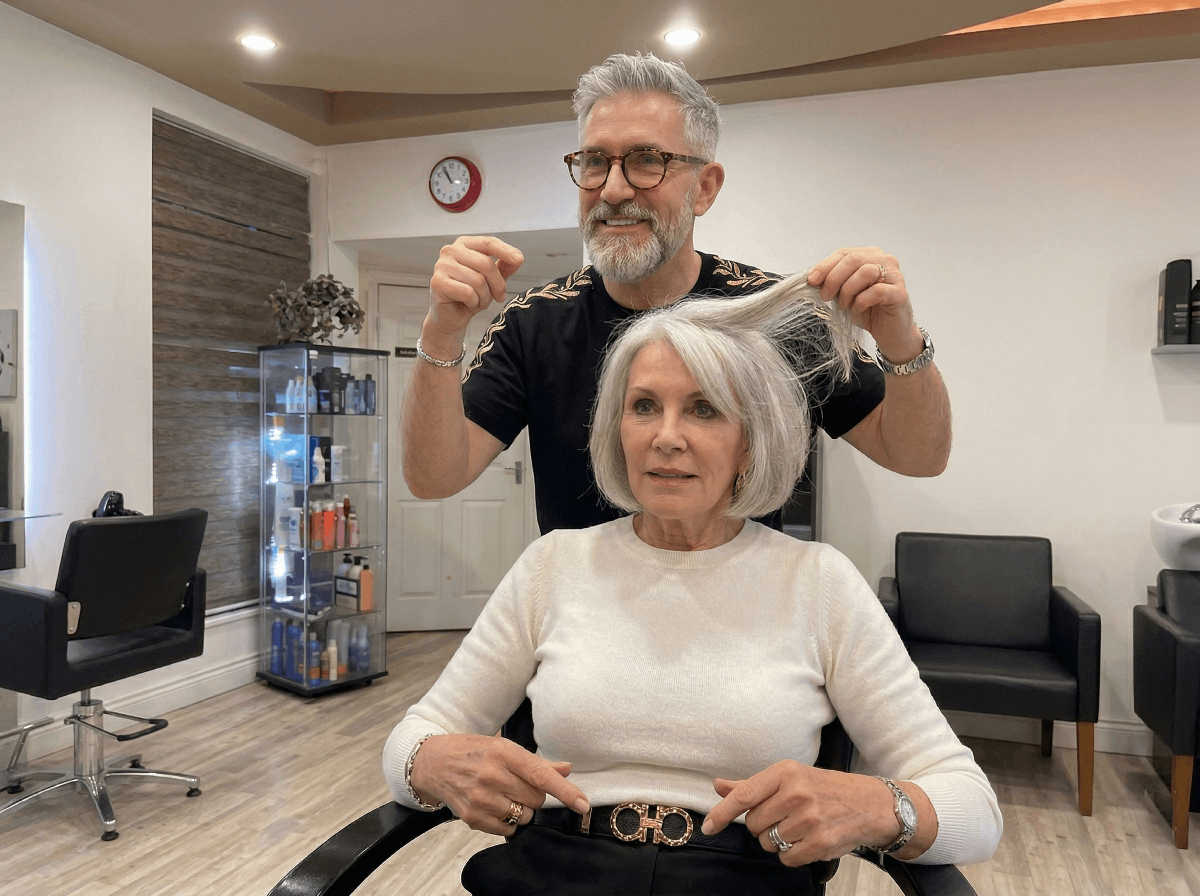

“I started noticing my hair looked thinner and felt completely different after I went through menopause. My hairdresser always says everything looks great, but I can tell she’s holding back. What is she really seeing? And what can I actually do about it?”
— Deborah M., Nashville, Tennessee
Oh, Deborah. I hear you, and I want you to know you are absolutely not imagining it. After menopause, your hair goes through some very real changes, and your hairdresser? She sees all of it. Every visit. She just has a professional smile trained to stay neutral while she quietly adjusts her technique, switches up her product recommendations in her head, and figures out how to work with what she’s got.
I’ve been covering the beauty industry for over two decades, and one of the most revealing conversations I ever had was with a senior colorist at a high-end salon in New York. She told me, “We notice everything. The texture, the density, the breakage, the scalp. But most clients don’t want to hear it, so we find workarounds instead of having the conversation.” That stuck with me.
So today, we’re having the conversation. Because you deserve to know what’s actually going on with your hair after menopause, and more importantly, what you can do about it. This isn’t about making you feel bad. It’s about giving you the real information so you can make smarter choices about your hair care routine, your products, and your treatments. Trust me, once you know what’s happening, it becomes a lot easier to feel confident and in control again.
Here are nine things your hairdresser notices about your post-menopausal hair but probably won’t say out loud, counted down to the one she notices most.
This post may contain affiliate links, meaning I may earn a small commission at no extra cost to you. I only share products I truly believe in. As an Amazon Associate, I earn from qualifying purchases. Your support helps me continue creating free content like this.
9. Your Scalp Is More Visible Than It Used to Be
This is usually one of the first things a hairdresser clocks when you sit down in the chair, especially if she’s been seeing you for years. The part looks a little wider. The scalp shows through more at the crown. You might not notice it dramatically at first, but under salon lighting, it’s one of those things that becomes very apparent very quickly.
After menopause, estrogen and progesterone levels drop significantly, and those hormones play a huge role in the hair growth cycle. With less hormonal support, more hair follicles shift into the resting phase, which means less active growth and gradually reduced density overall. This is called female pattern hair loss, or androgenetic alopecia, and it’s incredibly common. You are far from alone.
The good news is that there are some genuinely effective options now. Minoxidil, which is FDA-approved for women, has come a long way and is available in topical formulas that don’t leave your hair greasy. Brands like Hers and Keeps have made it much more accessible. Your dermatologist can also discuss prescription options like spironolactone if the thinning is significant.
On the styling side, your hairdresser may already be subtly adjusting your part or adding layers to create the illusion of fullness without saying exactly why. Ask her directly what she recommends for your specific texture and density. A good volumizing shampoo like Living Proof Full Shampoo used consistently makes a real visible difference. And if you’re open to it, this is a great time to explore a shorter cut that naturally looks thicker and more voluminous at this stage of life.
“I finally asked my stylist to just be honest with me,” says Karen T. from Phoenix, Arizona. “She told me my hair had thinned quite a bit at the crown and suggested a layered bob. It genuinely changed everything. I wish I’d asked sooner.”
8. Your Hair Texture Has Shifted, Sometimes Dramatically
Maybe your hair used to be silky and cooperative, and now it has a wiry quality you don’t quite recognize. Or maybe it’s gone in the opposite direction and feels limper than ever. Either way, your hairdresser is noticing that the hair coming out of your head is not the same hair that was coming out five or ten years ago, and she’s adjusting accordingly.
Estrogen helps keep hair in its growth phase longer and contributes to the overall smoothness and elasticity of the strand. When those levels drop after menopause, the texture of new growth can literally change. Some women experience their previously straight hair becoming coarser or slightly wavy. Others find hair that was once thick and full now feels fine and limp. Both are completely normal hormonal responses.
This is also when investing in a truly good conditioner matters more than ever. I’ve been recommending Olaplex No. 8 Bond Intense Moisture Mask to anyone who will listen, because it addresses both texture and strength in a single treatment. It’s the kind of product that makes your hairdresser notice immediately that something is different in a good way.
If your hair has gotten coarser or wiry, a smoothing treatment like a Brazilian blowout or a keratin treatment might be something to discuss with your stylist. If it’s gone fine and limp, lighter products are your best friend. Avoid heavy creams and oils at the root, and look for volumizing mousses or sprays instead. T3 and ghd both make excellent heat tools with adjustable temperatures that let you style without overdoing the damage on more fragile post-menopausal strands.
The key is communicating with your stylist about what you’re noticing at home. She can see what’s happening in the salon, but you live with your hair every day. That partnership is everything.
7. You’re Experiencing More Breakage Than You Realize
When your hairdresser runs her fingers through your hair or combs it out after washing, she can feel every bit of breakage and weakness along the strand. She might not bring it up directly, but she’s clocking it, adjusting how she handles your hair, and being more careful with color or chemical services as a result.
Post-menopausal hair tends to have lower elasticity, meaning it’s more prone to snapping under tension. This can come from brushing too aggressively, wearing tight ponytails, using heat tools without proper protection, or simply from the structural changes happening inside the hair shaft itself. The cortex of the hair, which is what gives it strength and stretch, can be weakened by hormonal shifts.
This is where a bond-building treatment routine becomes genuinely transformative. Olaplex has essentially become the gold standard in this category, and for good reason. Starting with the No. 3 Hair Perfector as a regular at-home treatment, even just once a week, can make a meaningful difference in how your hair holds up between salon visits. Kérastase also makes an exceptional range called Resistance, which is specifically formulated for weakened, damaged hair and has a devoted following among women in their 50s and 60s.
Also worth examining: your brushing technique. A wide-tooth comb used on wet hair, starting from the ends and working your way up, reduces breakage dramatically compared to brushing from root to tip. It sounds small, but it adds up significantly over time.
“I thought the little hairs I kept finding everywhere were normal shedding,” says Linda R. from Denver, Colorado. “My hairdresser finally told me gently that a lot of it was breakage, not shedding. Once I switched to an Olaplex routine, I noticed a real difference within about six weeks.”
6. Your Color Is Processing Differently Now
This is a big one, and it’s something colorists notice almost immediately but rarely explain in full detail. After menopause, hair often becomes more porous, which means it absorbs and releases color differently than it did in your 30s and 40s. Color might take faster in some areas, fade faster overall, or look brassier sooner than expected.
Increased porosity happens because the cuticle layer of the hair, which is supposed to lie flat and protect the inner structure, becomes more raised and damaged over time. It lets color molecules in quickly but also lets them escape faster, which is why you might find your color looks less vibrant or starts to fade within just a few weeks of your appointment.
A great colorist will adjust her formula and technique to account for this. She may use a filler before applying color, work in smaller sections, or use a toner to neutralize unwanted warmth. But if yours isn’t doing this, it might be worth having a conversation about it. Don’t be afraid to ask, “Has my hair’s porosity changed? Is there anything we should be doing differently with my color formula?”
At home, a color-depositing conditioner like the ones from dpHUE can help extend your color between appointments significantly. A purple or blue shampoo used once or twice a week, such as the Kérastase Blond Absolu line, is essential if you’re going lighter or fighting brassiness. And always, always use a heat protectant before hot tools. I love the Living Proof Restore Perfecting Spray for this.
The goal is keeping your color looking salon-fresh for as long as possible, which saves you both money and unnecessary chemical exposure over time.
5. Your Scalp Health Has Changed
Your hairdresser is looking at your scalp every single time you’re in the chair, often far more carefully than you might expect. And post-menopause, the scalp itself undergoes some noticeable changes that affect not just how your hair grows, but how it feels and behaves overall.
One of the most common shifts is increased scalp dryness. Estrogen helps regulate sebum production, and when estrogen decreases, the scalp can become drier, flakier, and sometimes more sensitive than it used to be. Some women also experience the opposite, an oilier scalp that needs more frequent washing. Either way, it’s hormonal, and it’s real.
A dry, flaky scalp is often mistaken for dandruff, but it’s frequently just lack of moisture. Switching to a scalp-focused serum or treatment oil used once or twice a week can make a significant difference. The Ordinary’s Multi-Peptide Serum for Hair Density has gotten a lot of attention in this space, and Kérastase’s Initialiste Advanced Scalp and Hair Serum is a salon favorite for exactly these concerns.
If you’re dealing with more itchiness or sensitivity, look at your shampoo ingredients. Sulfates can be particularly harsh on a dry, post-menopausal scalp. Switching to a gentle, sulfate-free formula like Oribe’s Gold Lust Repair and Restore Shampoo can calm things down considerably.
“I was so embarrassed about flakes on my collar,” says Margaret S. from Savannah, Georgia. “My hairdresser finally mentioned my scalp was very dry and recommended a scalp treatment. I started using a scalp oil once a week and it made such a difference. I only wish she’d told me sooner.”
4. Your Hair Takes Longer to Dry and Style
This might seem like a minor thing, but your hairdresser definitely notices it at the blowout stage. Hair that was once resilient and quick to respond to heat styling may now feel more resistant or take longer to set. It can also fall flatter faster after styling, meaning the volume she worked hard to create disappears before you’ve even left the salon parking lot.
This happens for a couple of reasons. Finer, lower-density hair has less mass to hold a style. And hair that has become more porous can absorb moisture from humidity more easily, which deflates volume and waves more quickly than before. It’s genuinely frustrating, especially if you had hair that held a blowout beautifully for years.
The right tools make an enormous difference here. A Dyson Supersonic with a concentrator nozzle gives you much more control and uses gentler heat that’s less damaging to already-fragile hair. If you’re investing in one styling tool at this stage of life, make it a high-quality hair dryer. Your hair will thank you.
For products, a lightweight volumizing mousse applied to damp hair at the roots before drying is your best weapon against flatness. I’ve loved the Living Proof Full Dry Volume and Texture Spray for a mid-day refresh when things start to fall. A light-hold flexible hairspray at the end locks everything in without that stiff, overdone look that can actually age you.
Ask your hairdresser to walk you through her blowout technique at your next appointment. Most stylists are happy to share tips when you ask directly, and learning the right brush angles and tension techniques for your current hair type is genuinely game-changing.
3. Your Hair Is More Sensitive to Chemical Services Now
This is something hairdressers think about a lot more than they typically discuss with clients, because they don’t want to scare anyone away from color or other chemical treatments. But the truth is that post-menopausal hair is generally more fragile and can react more intensely to chemical services like bleaching, perming, or relaxing.
As hair becomes finer and more porous after menopause, it’s also more vulnerable to the kind of structural damage that harsh chemicals can cause. Bleach, in particular, needs to be approached much more carefully. A colorist who isn’t factoring in your hair’s current condition might lift too quickly, leaving hair feeling gummy or breaking off at the ends. A skilled colorist will do a strand test, use bond-building additives in the bleach mixture, and process conservatively.
Olaplex mixed directly into color and bleach formulas has become essentially standard practice at good salons for exactly this reason. If your colorist isn’t doing this, it’s worth asking whether it’s something they offer. Similarly, Wellaplex and Smartbond are other in-salon bond-building systems worth inquiring about.
This is also the stage of life where going for a more natural, blended approach to color can actually serve you beautifully. Techniques like balayage, babylights, and root shadowing work with your natural base rather than fighting it, involve less overall chemical exposure, and grow out more gracefully. They also tend to look incredibly chic on women in their 50s and beyond.
“My hairdresser finally sat me down and told me my hair just couldn’t take full bleach highlights the way it used to,” says Joanne F. from Portland, Oregon. “We switched to balayage and honestly, it looks better than anything I’ve had in years. I was resistant at first, but she was completely right.”
2. You’re Losing Hair in Places You Haven’t Noticed Yet
This is one of the most delicate things for a hairdresser to bring up, so most don’t. But if she’s sectioning your hair and has a view of your crown, your temples, and your nape that you simply don’t have at home, she can see thinning in areas that don’t show up easily in a bathroom mirror. And she might be quietly adjusting your cut, your part, or your styling to compensate without explaining exactly why.
Temple thinning, in particular, is very common after menopause and is often one of the earlier visible signs of hormonal hair loss. The hairline at the sides can recede slightly, creating that gaunt or aged look that many women find distressing. It can also happen at the crown and along the part, as mentioned earlier. And because we tend to look at ourselves straight-on in the mirror, these areas often go unnoticed until someone with a 360-degree view points it out.
If you suspect this is happening, the most effective first step is a visit to a dermatologist who specializes in hair loss, not just your hairdresser. A dermatologist can assess whether what you’re experiencing is hormonal, nutritional, stress-related, or something else entirely, and create a targeted treatment plan. Treatments like platelet-rich plasma therapy, or PRP, have shown real promise for women experiencing this kind of diffuse thinning.
On the supplement side, Nutrafol Women’s Balance is specifically formulated for post-menopausal women and has a strong clinical track record. Biotin alone isn’t enough for most women, but a comprehensive formula that includes ashwagandha, saw palmetto, and marine collagen addresses the issue from multiple angles.
Don’t wait until the thinning feels severe to take action. Early intervention makes a meaningful difference in outcomes, and your hairdresser noticing it is actually an opportunity, not something to be embarrassed about.
1. She’s Watching How You Talk About Your Hair, and It Breaks Her Heart a Little
This is the one your hairdresser notices most, and it’s the one she’s least likely to address directly. It’s not about a physical characteristic of your hair at all. It’s about the way you talk about it when you sit down in that chair.
“My hair is such a mess.” “I don’t even know what to do with it anymore.” “It’s just so depressing.” “It used to be so much better.” She hears this constantly from women after menopause, and if she’s good at her job, it genuinely affects her. Because what she sees is a woman who has lost confidence in something that used to feel like a natural part of her identity, and she wants to help but doesn’t always know how to start the conversation.
I’ve sat in enough salon chairs and talked to enough hairdressers over the years to know that the clients who get the most out of their appointments are the ones who come in curious and open rather than defeated. That doesn’t mean pretending everything is fine. It means shifting from “my hair is hopeless” to “I want to understand what’s going on and figure out what actually works for me now.”
Because here’s what’s true: your hair at 55 or 60 or 65 can still be gorgeous. It might not be the same hair you had at 35, but with the right cut, the right color approach, the right products, and the right treatments, it can be something you genuinely love again. Charlotte Tilbury’s Goddess Skin Clay Mask won’t fix your hair, but taking the same energy you bring to your skincare and applying it to your hair care routine absolutely will.
The women I’ve interviewed who feel most confident about their hair after menopause share one thing in common: they stopped mourning what their hair used to be and started investing in what it is now. They found hairdressers who speak honestly with them. They tried new things. They asked questions. And they gave themselves some grace along the way.
“I used to sit in the chair and apologize for my hair the whole time,” says Susan K. from Chicago, Illinois. “My stylist finally said, ‘Stop. Your hair is beautiful. Let’s just take care of it properly.’ That honestly changed my whole mindset. I started listening instead of lamenting, and everything got better from there.”
Your hairdresser is on your team. She wants you to walk out of that salon feeling like the most polished, confident version of yourself. But she needs you to meet her halfway, and that starts with asking the real questions and being open to the honest answers.
The Bottom Line
Menopause changes your hair. That’s simply the truth, and there’s no beauty editor spin that changes it. But change doesn’t have to mean decline, and the women who come out the other side with hair they love are the ones who got informed, got honest with their hairdressers, and got intentional about their hair care.
Whether it’s adding a bond-building treatment to your weekly routine, switching to a gentler shampoo, exploring a new color technique, or finally booking that dermatology appointment you’ve been putting off, every small step adds up. Your hair is still yours. It still deserves attention and care and investment. And with the right support, it can still turn heads.
Start the conversation with your hairdresser. She’s been waiting for you to ask.