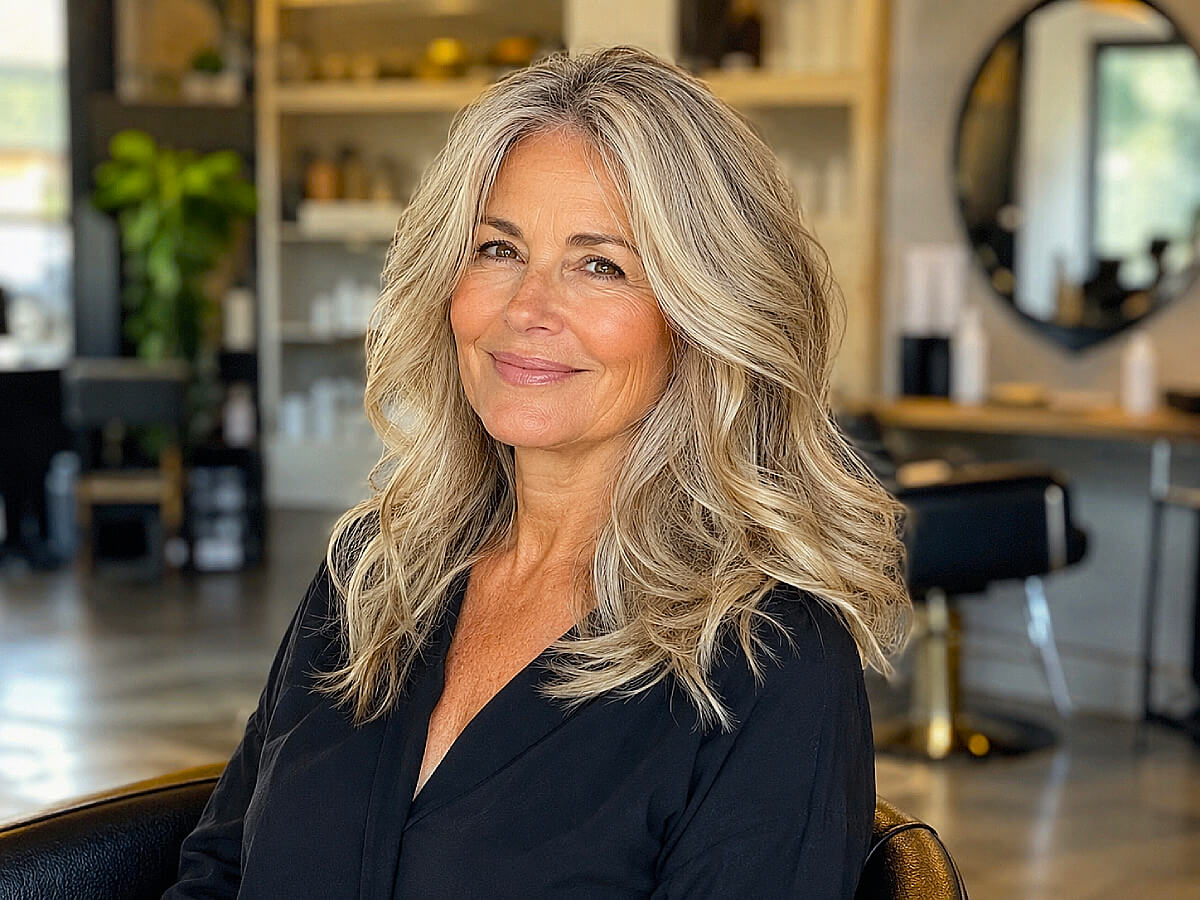

From Linda Marsh, Bozeman, Montana: “I just turned 62 and I feel like I spent my entire 50s fighting my hair instead of working with it. The texture changed, the color got weird, and everything I used to do stopped working. I wish I had known what was actually happening and what to do about it. What do I wish I had known sooner?”
There’s a particular kind of client I see more than any other. She comes in somewhere around 58, 60, maybe 62, sits down in my chair, looks at herself in the mirror and says something like, “I don’t even know what happened. My hair just… stopped being my hair.” And I always think the same thing: I wish I’d met you five years ago.
Because here’s the thing, the changes that happen to hair in your 50s are real, they’re chemical and structural and hormonal, and most women are going into that decade completely blind. Nobody warned them. Their dermatologist is focused on skin. Their gynecologist is managing everything else. And most stylists, honestly, are still giving advice that was designed for hair in its 30s. I’ve been doing this for over twenty years and I will tell you plainly: your 50s are when hair needs the most strategic thinking, and they’re usually the decade women are least prepared for. This list is what I tell my clients now. Consider it the conversation we should have had sooner.
This post may contain affiliate links, meaning I may earn a small commission at no extra cost to you. I only share products I truly believe in. As an Amazon Associate, I earn from qualifying purchases. Your support helps me continue creating free content like this.
10. Your Shampoo Is Probably the Problem
I can’t tell you how many times I’ve had a woman describe damaged, limp, weird-textured hair in her 50s and then I ask her what shampoo she’s using and she names something she’s been loyal to since 1994. I get it. You found what worked, you stuck with it, that’s sensible. But the hair you have at 52 has genuinely different needs than the hair you had at 32, and a lot of drugstore shampoos, even the nicer ones, are loaded with sulfates that strip oil from hair that is already producing less of it.
Estrogen decline, which is the main event of perimenopause and menopause, affects sebum production pretty significantly. Your scalp gets drier, your strands get drier, and then you’re washing with something that was designed to cut through excess oil… on hair that barely has any. It’s like using a degreaser on something that was already parched. I switched a client named Carol over to a sulfate-free shampoo a couple years ago, she had been complaining about frizz and brittleness for ages, and she called me two weeks later like I had performed surgery.
What I actually recommend is the sulfate-free shampoo options on Amazon or specifically something like Pureology Hydrate Shampoo, which is a salon staple for good reason. It’s gentle, it’s moisturizing, and it doesn’t strip what little natural oil your scalp is working hard to produce. Also, think about how often you’re washing. Daily washing in your 50s is usually too much. Every other day, or even every two to three days if your scalp allows, is genuinely better for the hair you have right now.
9. Protein and Moisture Are Not the Same Thing, and You Need Both
This is the one that confuses people the most and honestly it took me a while early in my career to understand the balance myself, so I’m not judging. Hair needs two things to stay strong and flexible, protein and moisture, and they work in opposite directions. Too much moisture without protein and the hair gets mushy, stretchy, limp. Too much protein without moisture and it gets brittle, snappy, almost crunchy. In your 50s, you’re usually dealing with a deficit of both, which sounds like a lot to manage but really just means you need to think about both when you shop.
Menopausal hair tends toward dryness and thinning, and the thinning part is often about the hair shaft itself getting finer in diameter. Protein treatments can actually help with that because they temporarily fill in gaps in the hair cuticle and add some thickness to each strand. I usually tell clients to use a protein treatment once a month and a deep moisture mask weekly, and to not mix those two steps up. Olaplex No. 3 is something I recommend constantly because it actually bonds broken disulfide bonds in the hair, it’s not just a conditioning agent, it’s doing structural repair work. Pair that with something like a deep moisture hair mask used in between and your hair starts to feel like itself again over a few months.
The other thing I’ll say here is that heat styling without heat protection is basically a protein-destroying activity. If you’re using a flat iron or a curling wand regularly and skipping heat protectant, you’re making the protein problem worse every single time. Heat protectant spray is not optional anymore, it genuinely wasn’t optional before either, but in your 50s you’ll feel the consequences faster.
8. The Color Strategy You Had in Your 40s Needs to Retire
All-over color, especially all-over dark color, is one of those things that ages people in their 50s and nobody really says it out loud. I will. When hair starts thinning, as it almost always does to some degree after 50, flat single-process color emphasizes that thinness because it eliminates the dimension that makes hair look full and alive. You end up with hair that looks a little helmet-y, a little flat, and weirdly it can actually make skin tone look more tired rather than fresher.
What works so much better is a technique that puts depth at the root and lighter pieces through the mid-lengths and ends. Balayage, babylights, or a well-placed highlight technique, the exact method matters less than the principle, which is that your hair should have some variation in it. I have a client who was doing box dye at home, a deep auburn, for probably ten years. When she finally came in and we transitioned her to a softer, multi-tonal approach with some lighter copper and blonde woven through, she looked five years younger and her hair visually looked thicker. Same density, completely different impression.
If you’re going gray or are already there, this still applies, just differently. Gray blending or a gray-with-highlights approach using toning techniques can make white and silver hair look incredibly sophisticated and healthy rather than washed out. Purple toning shampoo like Shimmer Lights or Clairol Shimmer Lights is an easy at-home maintenance step if you’re keeping your gray. It neutralizes brassiness and yellow tones and makes gray look clean and cool rather than dingy.
7. Hormonal Hair Loss Is Real and There Are Actual Options
I wish more women came to me earlier when they noticed their part getting wider or their ponytail getting thinner. Instead, most wait a couple of years, hoping it’ll reverse on its own, and by the time they’re in my chair they’re frustrated and a little scared. I completely understand that, but I want to say this clearly: hormonal hair shedding and thinning in your 50s is incredibly common, it is not a character flaw, and there are real options that actually help.
The first stop is your doctor, specifically to check ferritin levels, thyroid function, and hormone panels, because deficiencies in those areas are deeply connected to hair loss in midlife women and are all treatable. Minoxidil, which you probably know as Rogaine, is now available over the counter for women and there is solid clinical evidence behind it. Women’s Rogaine 5% minoxidil foam is worth a real conversation with your doctor if the thinning is bothering you. It takes about four months to see results, you have to keep using it, but it does work for many women.
On the styling side, a volumizing mousse used at the root before blow-drying, and a round brush blow-dry technique, can make a visible difference in how full your hair looks day to day. I also love Toppik hair fibers for clients who want to fill in a thinning part or crown between appointments. It sounds fussy but it takes about thirty seconds and genuinely works.
6. Your Cut Is Doing More Work Than Your Products Ever Will
This is my soapbox and I will stand on it. Women spend so much money on products trying to fix what is actually a structural problem with the cut itself. Fine, thinning hair in your 50s needs a cut that works with the density you actually have, not the density you had at 40. Layers that are too long just weigh thin hair down and make it look stringy. No layers at all, like a blunt bob, can work beautifully on fine hair if it’s the right length, because the weight line creates an illusion of fullness. But get that same blunt bob a couple inches too long and it falls flat and separates.
A good cut for this stage of life usually involves some thoughtfulness about where the weight sits and where the movement is. I personally love a chin to collarbone length on a lot of my clients in their 50s and 60s because it’s long enough to feel feminine and like you have options, but short enough that the hair isn’t pulling itself down. Curtain bangs have been genuinely great for women in this age group too, they soften the face without being a commitment, and they can be brushed back when you don’t feel like doing them.
If you have a stylist who keeps giving you the same cut you’ve had for fifteen years without any conversation about how your hair has changed, it might be worth a consultation with someone new. Not because loyalty isn’t valuable, but because your hair actually is different now and it deserves a cut that acknowledges that.
5. Scalp Health Is Where the Whole Thing Starts
Nobody talks about the scalp enough. It’s skin. It’s skin that grows hair, which means if the skin is inflamed, congested, dry, or out of balance, the hair growing out of it is going to reflect that. I started paying more attention to scalp care probably six or seven years ago and I genuinely think it’s one of the most underrated parts of hair health, especially for women in midlife.
Hormonal changes can bring on scalp dryness and sensitivity that you may never have dealt with before. Some women get sudden dandruff for the first time at 53. Some get a tight, itchy feeling. Some notice their scalp looking more visible even before the hair itself thins noticeably, which can be just inflammation and product buildup rather than actual density loss. A scalp scrub used once a week, something like the Briogeo Scalp Revival Charcoal Scrub, can make a real difference in clearing buildup and getting circulation going.
I’ve also become a believer in scalp serums, particularly ones with peptides or niacinamide that support follicle health. Scalp serums for hair growth have gotten genuinely good in the last few years, and using one consistently, the way you’d use a serum on your face, treats your scalp with the same respect you give the rest of your skin. Which, at 50-plus, it has earned.
4. The Drying Process Matters Way More Than You Think
Here’s something I notice all the time: women with nice healthy hair in their 50s and 60s almost always have a good drying routine. And women who are struggling with frizz, breakage, and texture issues are almost always rough-drying with a regular cotton towel and then hitting it hard with a blow dryer on the highest heat setting. The drying process, from the moment you get out of the shower to the moment your hair is fully dry, is where a lot of damage quietly accumulates.
Cotton towels are actually somewhat rough on the hair cuticle when you rub them, and rubbing wet hair is the most fragile thing you can do to it. Wet hair stretches and breaks more easily than dry hair. Switching to a microfiber hair towel sounds like a small thing but the texture is genuinely gentler and it absorbs water faster, which means less time you need to spend with heat. I use one myself and I bought a few for my mom when her hair started getting brittle and she noticed the difference within a couple weeks.
On the blow dryer side, a good ionic blow dryer with a concentrator nozzle dries hair faster and with less frizz than a basic drugstore dryer. The Dyson Supersonic is the dream version of this and yes it’s expensive, but there are great options at lower price points like the Revlon One-Step that combine drying and styling in a way that’s genuinely faster and easier on aging hair.
3. Going Gray Is a Decision, Not a Default, and Either Choice Is Valid
I want to spend some real time here because I think this is one of the most emotionally loaded parts of hair in your 50s, and there’s a lot of noise around it that isn’t actually helpful. The “go gray, it’s empowering” messaging has gotten so loud that I’ve had clients feel almost guilty for wanting to keep coloring. And the reverse is also true, women who want to go gray feeling pressure to keep it covered so they look “professional” or “put together.” Both of those pressures are external and neither of them is your hair’s business.
What I will tell you from a purely practical standpoint is that the transition from colored to gray, if you decide to go that route, is the hardest part. The grow-out phase can be genuinely challenging, and having a stylist who knows how to manage it with toning, blending, or strategic placement of highlights makes an enormous difference. I’ve helped many women through this transition and the ones who are happiest are the ones who committed to a plan rather than just stopping their color appointments and suffering through it.
If you’re staying with color, the maintenance piece gets more important in your 50s because gray hair grows in faster for most women and the regrowth line becomes more noticeable. Talking to your colorist about root shadow techniques, which basically blend the demarcation line so it looks intentional rather than grown-out, can buy you more time between appointments. Root touch-up sprays like the L’Oreal Magic Root Cover Up are also genuinely useful between visits and not just a stopgap, they actually look decent when applied correctly.
2. Fine Hair and Thin Hair Are Not the Same Problem, and They Need Different Solutions
This distinction changed how I approached a lot of clients and I think it’s one of the most useful things I can tell you. Fine hair means the individual strands are small in diameter. Thin hair means you have fewer of them, lower density. You can have fine hair that’s actually quite dense and full-looking. You can have thick individual strands but sparse density. Most women in their 50s are dealing with hair that’s gotten both finer in strand diameter and lower in density, but they’re not the same problem and they don’t always respond to the same solutions.
Fine hair needs lightweight products that don’t weigh it down. Heavy oils, thick creams, rich conditioners left on too long… all of these will make fine hair limp and flat. Lightweight leave-in conditioners and volumizing sprays work better. The Living Proof Full Dry Volume Blast is something I’ve recommended more times than I can count for fine-haired clients who want body without residue.
Thin hair, meaning actual low density, needs strategies that create the illusion of fullness, and that includes the cut (shorter, with weight), the color (dimension and lightness, not flat coverage), and even how you part your hair. A lot of women are still parting their hair exactly where they have since college. Switching your part, or going to a more diffuse zigzag part rather than a precise straight line, immediately makes the scalp less visible and the hair look fuller. It’s a free fix. I tell people this constantly and they’re always a little startled that something so simple works as well as it does.
1. Working with Your Hair’s Actual Texture Will Change Everything
This is the one I wish every woman walking into her 50s could hear clearly, loudly, and early. Your hair’s texture is going to change, maybe subtly, maybe dramatically, and the women who adapt to that change instead of fighting it are the ones who genuinely love their hair in their 60s. The ones who are still trying to achieve the smooth, sleek, straight, or perfectly curled result they had at 38 are the ones sitting in my chair a decade later, exhausted and defeated.
Estrogen loss changes the hair’s protein structure. Straight hair can develop a wave it never had. Wavy hair can get coarser and frizzier. Curly hair can lose definition and become more unpredictable. None of this is a malfunction. It’s just change. And the way you treat changed texture, the products you use, the techniques you apply, the cut you choose, all of that needs to be calibrated to the hair you have now, not the memory of the hair you used to have.
I had a client, Sandra, who spent probably fifteen years fighting a wave that had developed in her hair through perimenopause. She was blow-drying straight every single day, spending forty-five minutes on it, frustrated that it never looked as smooth as it used to. When she finally let me cut it to work with the wave, and I put her on a curl cream for wavy hair and a diffuser routine using a diffuser attachment, her whole morning changed. She texted me, which clients don’t usually do, to say she got ready in fifteen minutes and her hair looked better than it had in years.
Leaning into texture rather than correcting it means finding products that support what your hair is naturally doing. For newly wavy hair, that might be a DevaCurl styling cream or a light gel to define the wave. For coarser, frizzier hair, a smoothing serum used on damp hair before heat, rather than fighting the frizz after it’s dry, is the approach that actually works. The principle is the same across all of it: start with where your hair is actually going, and help it get there better, rather than redirecting it somewhere it doesn’t want to go anymore.
I’ve been in this business long enough to have watched generations of women move through their 50s and into their 60s, and I promise you the ones who come out the other side feeling good about their hair are not the ones who had the most products or spent the most money. They’re the ones who got honest with themselves about what their hair actually is now, found a stylist who talked straight to them, and stopped mourning hair they had twenty years ago. Your hair at 55 or 58 or 62 can be genuinely beautiful. It just needs you to meet it where it is.
If any of this resonated, share it with a friend who’s in the thick of it right now. And if you have questions or something you wish someone had told you, leave it in the comments. I read everything.