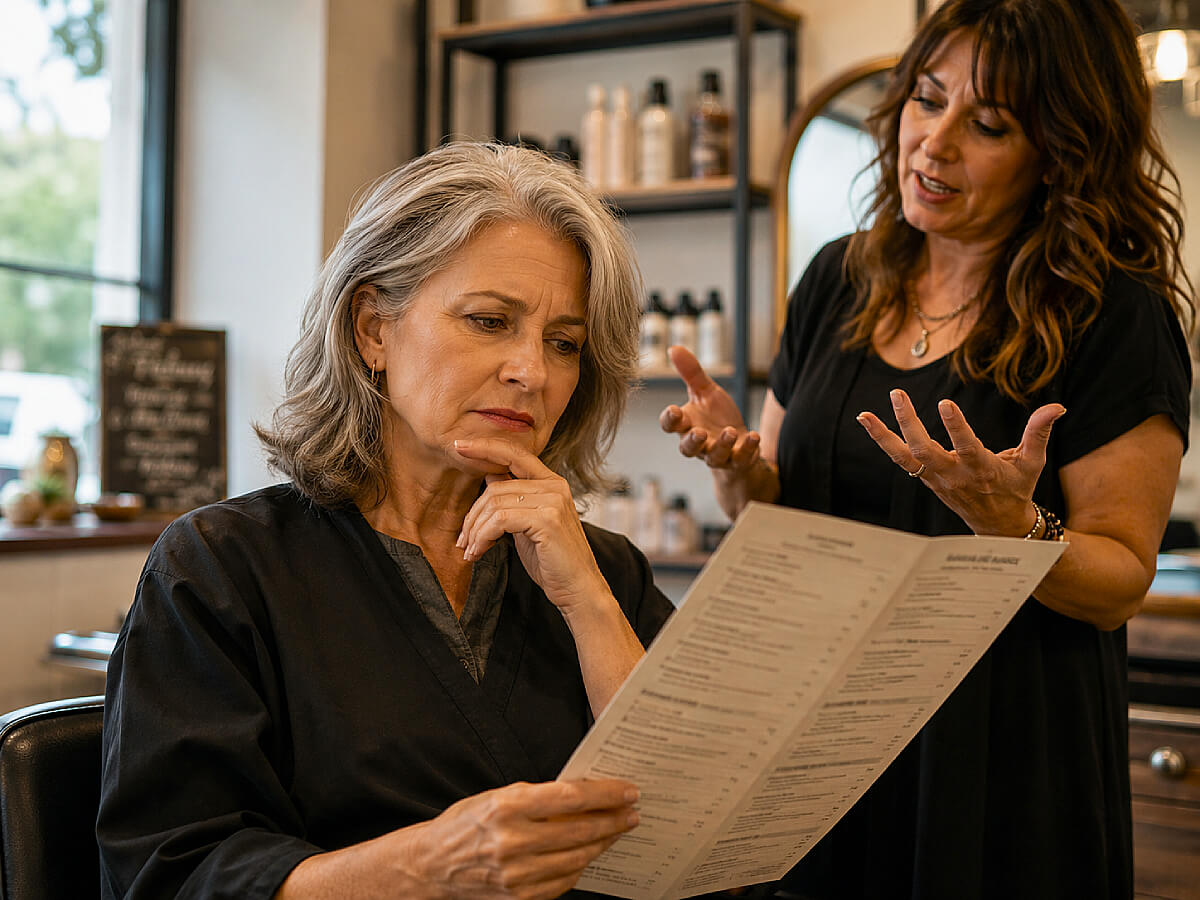

Question from Diane Kowalczyk, Fond du Lac, Wisconsin: “I feel like every time I go to the salon, someone is pushing me toward some new treatment that costs a fortune. I’ve spent probably thousands over the past few years on things that were supposed to transform my hair and honestly? I can barely tell the difference. My hair is fine, it’s getting thinner as I get older, and I just want to know what’s actually worth it and what’s a waste of money. Help!”
Diane, you are not alone, and honestly, you may have just described half the women who sit in my chair every single week. There is something about the hair care industry that loves a woman in her 50s, and not always in the way that feels good. You’re at a stage where your hair is genuinely changing, where you’re noticing things you didn’t have to think about before, like texture shifts and thinning and that weird new dryness that wasn’t there in your 40s, and the industry has figured out that you’ll pay to fix it. That’s not cynicism, that’s just the business.
In my 20+ years of doing hair I’ve watched the treatment menu at salons balloon into something that can feel more like a spa wellness brochure than a list of services that actually do something. Some of those treatments are genuinely wonderful. Some of them are beautifully packaged, smelling incredible, presented with a lot of confident language, and doing almost nothing your regular conditioner couldn’t handle. I care about your money and I care about your hair, so let’s go through the ones I’d tell you to skip, if you were sitting in my chair right now.
This post may contain affiliate links, meaning I may earn a small commission at no extra cost to you. I only share products I truly believe in. As an Amazon Associate, I earn from qualifying purchases. Your support helps me continue creating free content like this.
5. Ultrasonic or Steam Deep Conditioning Treatments
You’ve probably seen these offered at salons that are trying to position themselves as high-end or tech-forward, and the pitch is pretty compelling when you hear it for the first time. The idea is that a special steaming device or ultrasonic tool opens up your hair cuticle so that conditioning ingredients can penetrate more deeply than they could on their own. It sounds so logical. It sounds almost medical. And it costs anywhere from $40 to $120 added onto whatever you’re already spending on your appointment.
Here’s where I land on this after years of watching clients pay for it: the science behind cuticle “opening” is real, but the dramatic difference in product penetration that these devices claim to create? Much less proven than the marketing suggests. Heat does raise the cuticle slightly, which can help some conditioning agents absorb a little better, but your stylist wrapping your head in a warm towel after applying a deep conditioner accomplishes something very close to the same thing. The warm, humid environment does the work. The $300 ultrasonic device is largely theater.
What I tell my clients instead: invest in a genuinely good deep conditioner you can use at home every week. Something like Olaplex No. 8 Bond Intense Moisture Mask or Redken All Soft Heavy Cream, apply it generously, cover your hair with a shower cap, and sit under a regular hooded dryer or even just wrap a warm towel around your head for 20 minutes. Do this weekly. I promise you will see more cumulative benefit from consistent at-home treatment than from paying for the ultrasonic version a few times a year when you can afford it. Frequency matters more than the device, full stop.
For women with finer hair that’s lost some density, which is so common after 50 due to hormonal changes affecting your hair growth cycle, I’m also a little cautious about heavy steam treatments in general because over-moisturizing fine hair can make it limp and harder to style. Sometimes the treatment you’re paying for is actually working against your hair’s natural texture rather than with it.
4. Salon Scalp “Detox” Treatments
Oh, this one. I have feelings about this one, and I’m going to be honest with you in a way your salon might not be. The scalp detox treatment has become one of the most reliably upsold services in the past five years or so, and it arrived riding the wave of “scalp health” content that took over beauty media. Which, look, scalp health is real and it matters genuinely, especially as we age and our scalp’s oil production changes. But what most salons are selling as a detox is a clarifying scrub or a scalp massage with an exfoliating product, and you can do both of those things at home for about eight dollars.
I’ve seen these treatments listed at salons for $65, $85, sometimes more, and the products being used are often a scrub you could buy yourself, something like Briogeo Scalp Revival Charcoal + Coconut Oil Micro-Exfoliating Shampoo, which retails for around $42 and will last you months of weekly use. The technique, the actual massage and application, takes maybe five minutes. You are paying a significant markup for what amounts to a pleasant experience, not a clinically different outcome.
Now here’s where I’ll contradict myself a little, because I always want to be fair: if you have actual scalp conditions, like significant product buildup, seborrheic dermatitis, or psoriasis, a conversation with a dermatologist is worth so much more than a salon detox. Those conditions need targeted treatment, not a spa scrub. And if your hair loss or thinning is connected to scalp inflammation, again, that’s a dermatologist conversation, possibly involving PRP therapy or prescription topicals, not a $75 salon service. Spend your money where it actually gets you somewhere.
The one thing I will say is that the massage component of these treatments does have real benefit for circulation, and there is some legitimate research suggesting scalp massage supports hair density over time. So do yourself a favor: grab a scalp massager tool for about $10 and spend a few minutes on it when you shampoo. That’s the part worth keeping. The detox label you can drop entirely.
3. Keratin Smoothing Treatments (For Fine or Thinning Hair)
I want to be careful here because keratin treatments are not universally a waste of money. For someone with very thick, coarse, or frizzy hair, a well-done keratin treatment can genuinely change their daily routine in ways that feel almost life-changing. I’ve done plenty of them and watched clients walk out with transformed, manageable hair that held up beautifully for months. I’m not here to bash the whole category.
But for women over 50 with fine or thinning hair? This is where I’d pump the brakes seriously. Here’s the thing nobody explains clearly enough before they take your $250 to $400: keratin treatments coat the hair shaft with a layer of smoothing protein. On coarse hair, that coating is a gift. On fine hair, that coating adds weight, and weight is exactly what fine hair does not need. I have had clients come to me after a keratin treatment elsewhere wondering why their hair suddenly looked so flat and stringy, and the answer is almost always this. The treatment worked perfectly and it was still wrong for their hair type.
There’s also the formaldehyde question, which hasn’t entirely gone away even with “formaldehyde-free” formulas, since many of them release formaldehyde-adjacent compounds when heated. For anyone with chemical sensitivities or who’s spending a lot of time in a small, enclosed salon space, that’s worth knowing before you commit. And the maintenance piece, because you’ll need to use sulfate-free shampoos to extend the treatment’s life, which adds ongoing cost to what you thought was a one-time service. Products like Pureology Hydrate Sulfate-Free Shampoo are lovely but they’re not cheap.
If frizz and texture are your real concerns, and they often are post-menopause because estrogen loss affects your hair’s moisture balance, I’d suggest starting with a really good anti-humidity serum or a blow-dry technique adjustment before spending hundreds on a treatment that might flatten what little volume you’ve got. Sometimes the answer is a Kenra Platinum Silkening Mist and a round brush, and that’s not a lesser solution, that’s just the right tool for the job.
2. Protein Reconstruction Treatments (When Overused)
Protein treatments are one of those things where the gap between “helpful” and “damaging” is narrower than anyone ever tells you, and salons don’t always explain this gap because they’re not always thinking about what you had done last month. Protein reconstruction treatments are designed to temporarily fill in gaps in the hair’s cuticle and strengthen weak or over-processed strands. When your hair is genuinely damaged from coloring, heat, or chemical services, they can help. I’ve used them on clients coming to me after a bad highlight job somewhere else, and yes, they made a real difference.
The problem is that protein treatments have become almost reflexively upsold, especially to clients over 50, because aging hair is often described as “weak” or “damaged” even when it’s just fine and dry. And here’s the thing about protein: too much of it makes hair stiff, brittle, and prone to breakage, which is the exact opposite of what you were trying to achieve. I’ve seen this so many times it’s become one of my personal hobby horses. A client getting a protein treatment every single appointment because the salon keeps recommending it, and her hair gets progressively more snap-prone, and she keeps coming back for more protein because she thinks her hair is damaged, and round and round it goes.
Your hair after 50 typically needs moisture far more than it needs protein. Hormonal changes, particularly the drop in estrogen, pull natural oils away from the hair shaft and leave it drier and more porous. Moisture-based treatments, things with hyaluronic acid, aloe, glycerin, ceramides, are usually what your hair is actually asking for. If you’ve been getting protein treatments regularly and your hair feels stiff or snaps easily when you stretch a strand, you may have protein overload, and the solution is to stop the protein and focus on hydration for a few weeks. A product like SheaMoisture Jamaican Black Castor Oil Masque or a good argan oil hair mask will do more good than another round of the thing that’s been causing the problem.
Ask your stylist directly: is my hair protein sensitive? A good stylist will do a quick strand test and tell you honestly. If they just automatically add a protein treatment to every service without asking about your history, that’s worth paying attention to.
1. Stem Cell and Platelet-Rich Plasma (PRP) Scalp Treatments Sold at Hair Salons
Okay, so this is the one I feel most strongly about, and I want to be precise because the terminology matters here. PRP therapy, actual Platelet-Rich Plasma treatment, is a legitimate, clinically studied procedure for hair loss. It involves drawing your blood, spinning it to concentrate the growth factors, and injecting it into your scalp. It’s done by a medical professional, typically a dermatologist or a trichologist, and there is real peer-reviewed research supporting its use for androgenetic alopecia, which is the most common type of hair thinning in women over 50. I am not dismissing that.
What I am dismissing, completely and without apology, is the version of this that has crept into hair salons as a “stem cell scalp treatment” or a “PRP-inspired” treatment or a “growth factor serum service.” These are topical products with marketing language borrowed from the medical procedure, and they are not the same thing. Not even close. The growth factors and peptides in a topical product cannot penetrate your scalp the same way an injection does. The mechanism of action is fundamentally different, and the clinical evidence for topical “stem cell” products in hair regrowth is, to put it charitably, thin. I have seen these services priced at $150 to $300 per session at salons, with the suggestion that you’ll need a series of them, and it genuinely upsets me on behalf of women who are spending serious money on something that has almost no scientific backing at that level.
If you are experiencing real hair thinning, and so many women are, especially after menopause when estrogen and progesterone drop and the hair growth cycle shortens, please spend that money on a consultation with a dermatologist who specializes in hair loss. They can assess whether your thinning is hormonal, nutritional, related to thyroid function, or pattern-related, and they can recommend actual interventions. Minoxidil, which you can find as Women’s Rogaine Foam, is FDA-approved, inexpensive, and genuinely effective for many women. Certain supplements like Nutrafol Women’s Hair Growth Supplement have actual clinical trials behind them. Low-level laser therapy devices, like the iRestore Laser Hair Growth System, are FDA-cleared and have solid evidence for stimulating follicle activity.
The salon stem cell treatment cannot compete with any of those things because it’s operating on a completely different, far less effective level, and nobody selling it to you is required to tell you that. I am telling you because you deserve to know where your money actually goes to work.
So What’s Actually Worth Spending On?
If Diane’s question resonated with you, I want to leave you with something useful rather than just a list of things to stop buying. The treatments worth paying for at a salon are the ones a skilled stylist performs, meaning a precision haircut that suits your current hair density and face shape, a color service done with proper timing and formulation, a genuine bond-building treatment like Olaplex if you’re coloring regularly, and an honest conversation about what your hair actually needs right now versus what it needed ten years ago. Those things have value because they require expertise and attention.
The treatments that mostly ask you to pay for hope, the detoxes, the stem cell serums, the ultrasonic devices, the protein stacking, these tend to thrive in the space between what you’re worried about and what you actually know. And I don’t say that to make you feel like you’ve been taken advantage of, because the marketing is genuinely convincing and the desire to do something real for your hair is completely understandable. I say it because the best thing I can do for you, whether you’re sitting in my chair or just reading this at your kitchen table, is tell you what I’d actually tell my closest client. Skip those. Know your hair. Spend smarter. Your hair at 50 or 60 or beyond can be beautiful and healthy, it just needs the right things, not the most expensive ones.