
From Sandra Kowalski, Terre Haute, Indiana: “I see women walking around who just look like they have expensive, healthy hair and I can never figure out what they’re doing differently. My hair is fine and I color it at home, and no matter what I try it always looks a little dull and kind of rough around the edges. What’s the actual secret? Is it all just money spent at a fancy salon?”
Sandra, I love this question so much, partly because I get asked some version of it almost every single week in my chair. There’s this woman I think about when I answer it, a client of mine named Deborah who came in for a trim about two years ago and I genuinely could not figure out her budget just from looking at her hair. It was that kind of shiny, healthy, moves-when-she-walks hair that looks like an expensive shampoo ad. Turns out she was using drugstore products and hadn’t been to a salon in four months. But she had habits, really specific, consistent habits, and that was the whole difference.
The truth that nobody in the beauty industry is rushing to tell you is that expensive-looking hair is mostly about maintenance behavior, not a price tag. There are women spending three hundred dollars every six weeks at a salon who leave with gorgeous color and a great cut, and then they go home and absolutely destroy it by week two. And there are women like Deborah who just quietly do a few things right every single day. This list is for Sandra, but honestly it’s for everyone who has ever stood in the shower aisle feeling overwhelmed and wondering if they’re just missing something obvious. You might be, and that’s okay, because it’s fixable.
This post may contain affiliate links, meaning I may earn a small commission at no extra cost to you. I only share products I truly believe in. As an Amazon Associate, I earn from qualifying purchases. Your support helps me continue creating free content like this.
8. You Stop Washing Your Hair Every Single Day
I know this one gets said a lot, but I don’t think people really understand the why behind it, so let me actually explain what’s happening at the follicle level because once you understand it, you’ll stop fighting the habit change. Every time you shampoo, you strip the natural sebum from your scalp and your strands. That sebum is not a problem, it’s actually a lightweight conditioning oil your body produces for free and it genuinely cannot be replicated by any product on the market regardless of the price point. When you wash it away every morning, your scalp overproduces to compensate, which is exactly why daily washers often have oily roots by noon. You’ve trained your scalp into a panic cycle.
Extending your washes to every two or three days, or even every four if you can get there, genuinely changes the texture and appearance of your hair within about three weeks of being consistent. I’ve watched this transformation happen in real time with clients. The hair gets softer, the ends stop looking so splintered, and the color, whether it’s natural or chemically treated, holds its depth so much longer because you’re not constantly opening the cuticle with hot water and shampoo.
If you’re transitioning from daily washing and the oiliness feels impossible to manage, a good dry shampoo buys you time while your scalp recalibrates. I like Batiste for the price point and the variety of shades, though if your hair is darker, go for their brunette formula because the white cast on dark hair is not doing anyone any favors. Give the transition a full month before you decide it’s not working. Your scalp will catch up, I promise.
7. You’re Actually Using a Heat Protectant Every Single Time
Not most times. Not when you remember. Every. Single. Time you pick up a hot tool. I have had this conversation more times than I can count, and I understand why people skip it because it feels like an extra step that slows you down on a Tuesday morning. But let me tell you what I see when someone who heat styles without protection sits down in my chair regularly. The ends have this particular look I call “ghost ends,” they’re not split exactly, they’re just kind of pale and thin and fragile-looking, and the mid-shaft of the hair has lost its elasticity so when I do the stretch test it barely gives before it snaps. That’s heat damage, and it accumulates slowly over months until one day your hair just looks tired all the time and you can’t figure out why.
The good news is a heat protectant is genuinely one of the most affordable habits on this whole list. You do not need a luxury version for this to work. I’ve been recommending TRESemmé Thermal Creations Heat Tamer Spray to clients for years and it holds up against anything three times the price that I’ve tried. If your hair is thick or coarse, something like CHI 44 Iron Guard gives a little more coverage. Apply it when your hair is still slightly damp before blowdrying, or on dry hair before you flat iron or curl, and let it sit for thirty seconds before you touch a tool to it. That thirty seconds matters.
6. Your Haircut Is Actually Current
Here’s the one that might sting a little, and I say this with genuine warmth because I’ve seen this situation hundreds of times. A cut that was beautiful eighteen months ago can read as dated today, and dated cuts, even on healthy hair, have a way of making the whole look feel a little low-effort. It’s not always about the shape itself, sometimes it’s about the weight distribution or the way it was layered or the fact that trends have shifted just enough that your silhouette now reads as a previous era. Hair fashion moves slower than clothing fashion, but it does move.
What I notice most often with my clients who have that perpetually expensive-looking hair is that they see their stylist on a schedule, usually every eight to ten weeks for most cuts, every twelve if the cut really grows out gracefully. They don’t wait until it’s a crisis. Waiting until your hair is completely shapeless means your stylist has to make aggressive corrections, which often means more length off than you wanted. Coming in while the cut still has most of its structure means a small refinement keeps it looking intentional all the time.
If budget is the real concern here, and for a lot of women it is, talk to your salon about doing a full cut less frequently but adding in a quick dusting appointment between visits. A lot of stylists, myself included, will do a very minimal trim for less because it takes half the time. It keeps the ends looking clean without the cost of a full appointment every time.
5. You Deep Condition on an Actual Schedule
There’s a difference between conditioning and deep conditioning, and I think a lot of women are doing the first and thinking they’ve done the second. Your regular rinse-out conditioner is great, it’s hydrating the surface of the cuticle and giving you slip and softness, but it’s not doing structural repair. A deep conditioning treatment, meaning something with a longer sit time and a more concentrated formula, works differently. It’s penetrating further into the cortex and actually replacing some of the moisture and protein that heat, color, and environmental stress have stripped away over time.
Once a week is ideal for color-treated or heat-styled hair, and honestly for fine hair too because fine hair might not feel as visibly damaged but it loses moisture and protein incredibly fast. I’ve been obsessed with Briogeo Don’t Despair, Repair! Deep Conditioning Mask for a few years now, and I put a lot of clients onto it because it works for almost every hair type without feeling heavy. If you want something more budget-conscious, SheaMoisture’s Manuka Honey and Mafura Oil Intensive Hydration Masque is genuinely impressive for the price.
The one thing I’ll add about technique is that heat actually helps these treatments penetrate, so if you put your mask on, wrap your hair in a warm towel or sit under a hooded dryer for twenty minutes instead of just leaving it on in a cold bathroom, you’ll get noticeably better results from the same product. I started doing this myself and the difference was real enough that I mentioned it to everyone in the salon for about a week straight.
4. You’ve Figured Out Your Water Situation
This is the one that almost nobody talks about in mainstream hair care content, and it quietly ruins more hair than almost any other factor I’ve seen in my years behind the chair. Hard water, which is water with a high mineral content, primarily calcium and magnesium, builds up on the hair shaft over time and creates this dull, rough, almost gummy texture that doesn’t respond well to any products layered on top of it. If you live somewhere with hard water and you haven’t addressed this, you could be using the most expensive products in the world and your hair is still going to look a little off. The mineral buildup is essentially coating every strand.
The most accessible fix is a clarifying shampoo used once or twice a month. I like Kenra Clarifying Shampoo or the more budget-friendly Neutrogena Anti-Residue Clarifying Shampoo, and either one will strip the buildup and immediately make your hair feel lighter and look shinier. A chelating treatment a few times a year goes even deeper if the buildup is significant. And if you want to address it at the source, a filtered showerhead is a genuinely worthwhile investment, the kind you can install yourself in ten minutes. I got one years ago and I noticed a difference within two weeks, not subtle either.
3. You’re Protecting Your Hair While You Sleep
Cotton pillowcases are doing quiet damage every single night, and most people don’t realize it until I mention it and they start doing some research and have a small revelation. Cotton is a rough fiber, and when your hair moves against it for seven or eight hours, it creates friction that roughens the cuticle, causes breakage along the mid-shaft, and contributes to frizz that no product can fully smooth out the next morning because the damage happened while you were sleeping. If you’ve ever woken up with hair that looks slept-on even after you styled it the night before, the pillowcase is often a major piece of that.
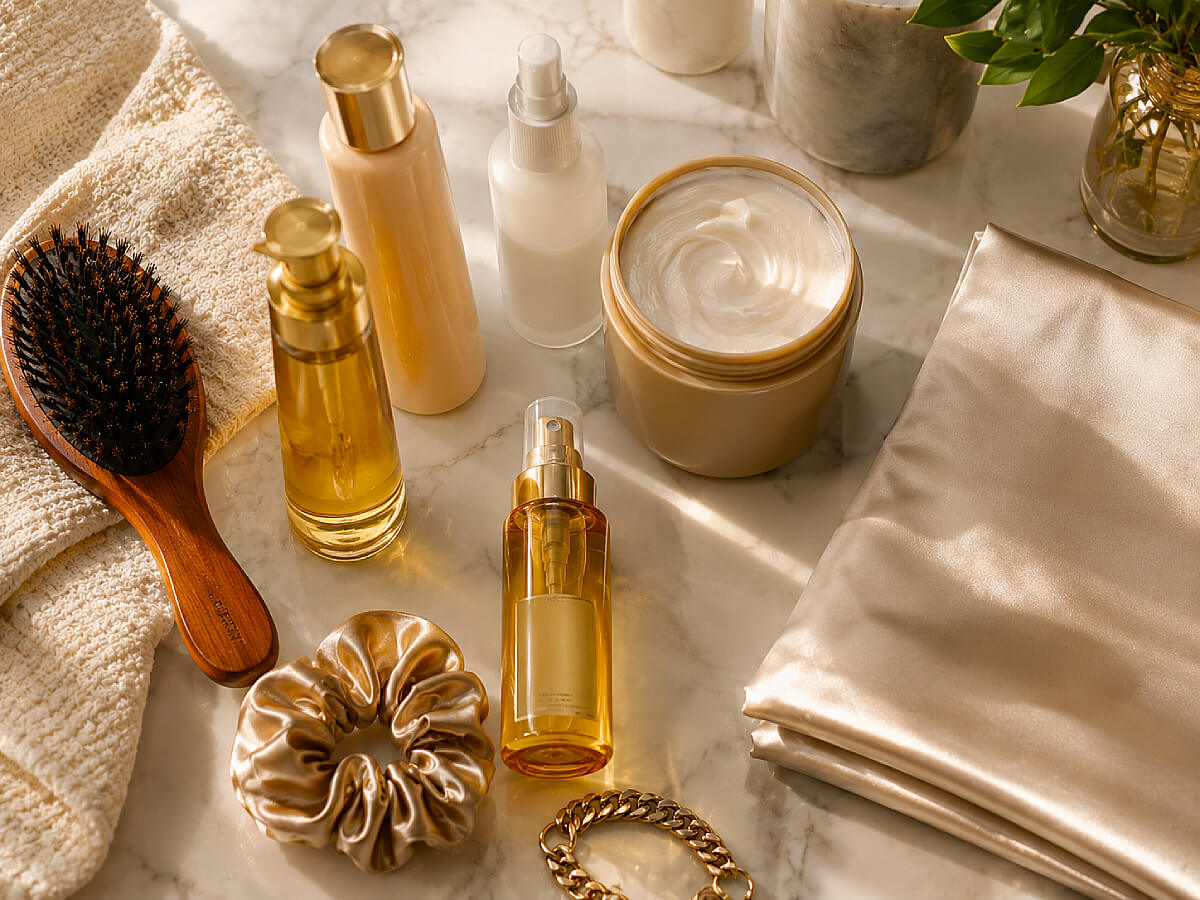
Switching to a silk or satin pillowcase is one of those changes that costs you maybe thirty dollars and then just keeps working for you every night for years. Blissy makes a genuinely nice silk option if you want to invest in a real mulberry silk, and satin pillowcases are a more affordable alternative that still provides significantly less friction than cotton. I also keep a silk bonnet recommendation handy for my clients with textured hair or anyone who tosses and turns a lot because the bonnet stays with your hair in a way a pillowcase can’t.
A loose braid or a scrunchie-secured low bun before bed also helps, but please not a tight elastic, and not a rubber band, I have removed rubber bands from people’s hair before and it is always a sad situation. A silk scrunchie is so much gentler and it costs almost nothing.
2. You’re Using the Right Brush and Actually Knowing How to Use It
I have strong feelings about brushes. Probably stronger than most people expect, but I’ve watched bad brushing technique create breakage that took years to grow out, so I’ve earned my opinions here. The biggest mistake I see is brushing from the root down on tangled or wet hair. Wet hair is incredibly elastic and fragile, and dragging a brush from the scalp through a tangle is essentially snapping the strand in slow motion. Start from the ends, work your way up in sections, and give the hair a chance to detangle in stages rather than forcing it all at once. This alone, just changing the direction you start your brush stroke, will reduce your breakage dramatically.
For detangling wet hair, a wide-tooth comb is your best friend and the Felicia Leatherwood Detangler Brush is wonderful for thicker or curlier textures. For blowdrying and styling, a good boar bristle brush makes an enormous difference in the finish, it distributes your scalp oils down the length of the hair and creates a smoothness that synthetic brushes just can’t replicate. I personally use a Mason Pearson and yes it is expensive, but I’ve had mine for nine years and it’s still perfect. If that price point is not happening right now, Denman makes a more accessible boar bristle option that I recommend to clients regularly and have never had anyone complain about.
1. You’ve Found a Shampoo and Conditioner That Actually Match Your Hair’s Specific Needs
I saved this for last because it is genuinely the foundation everything else rests on, and because I think it’s the habit most women get wrong for the longest time without realizing it. The issue isn’t usually that people are using bad products, it’s that they’re using products designed for a different hair situation than the one they’re actually dealing with. Moisture-heavy formulas on fine hair weigh it down and make it go limp by noon. Protein-heavy formulas on hair that needs moisture can make it feel stiff and oddly brittle. Sulfate-heavy formulas on color-treated hair strip the pigment faster than almost anything else. Using the wrong product consistently is like watering a plant with the wrong amount of water, it keeps it alive but it never quite thrives.
For fine hair, I almost always steer clients toward a volumizing or balancing shampoo with a lighter conditioner applied only from mid-shaft to ends. Pureology Pure Volume is a salon favorite for fine color-treated hair specifically. For dry or coarse hair, something more emollient like Moroccanoil Moisture Repair or Olaplex No.4 Bond Maintenance Shampoo addresses the structural issues alongside the hydration. For scalp concerns like dandruff or excess oil that’s coming from an imbalanced scalp rather than dirty hair, Nizoral used once a week alongside your regular shampoo can make a significant difference.
What I tell every new client is to think about what your hair looks like on its third day without washing, because that’s its honest default state, and build your product routine around addressing that specific reality. Shiny but flat? You need volume support. Frizzy and rough? You need moisture and cuticle-smoothing ingredients like argan oil or keratin. Dull and lifeless even when clean? That’s usually a buildup issue or a protein imbalance. Once you figure out your actual hair situation rather than the one you maybe wish you had, you stop wasting money on things that don’t work and you find the two or three products that genuinely do, and then expensive-looking hair stops being a mystery.
So, Sandra, Here’s the Real Answer
The women whose hair you’re admiring from across the room are almost certainly not doing anything dramatically different or spending dramatically more than you. They’ve just built a handful of small, consistent habits that work with their hair’s biology instead of against it, and over time those habits compound into something that reads as effortless and expensive even when it genuinely isn’t. The good news is every single thing on this list is learnable and most of it is affordable, some of it is free.
Start with the one that feels most relevant to your specific situation rather than trying to overhaul everything at once, because that’s a recipe for giving up on all of it by week three. If your hair is dull, look at your water and your clarifying routine first. If it’s breaking, look at your sleeping habits and your brushing technique. If it’s just not behaving, spend some time really figuring out what your hair is asking for and find a shampoo and conditioner that actually answer that question. Give each change a full month before you judge it because hair changes slowly, much more slowly than we want it to, but it does change. And when it does, you’ll be the woman someone else is watching from across the room wondering what you’re doing differently.