
Reader Question from Diane Kowalski, Sheboygan Falls, Wisconsin:
“I’m 57 and I’ve been wearing basically the same haircut for about eight years. My stylist never says anything, and I never ask, but honestly I suspect it stopped working for me a while ago. I don’t even know how to bring it up without it being weird. How do I know when it’s time to change, and what should I actually be changing?”
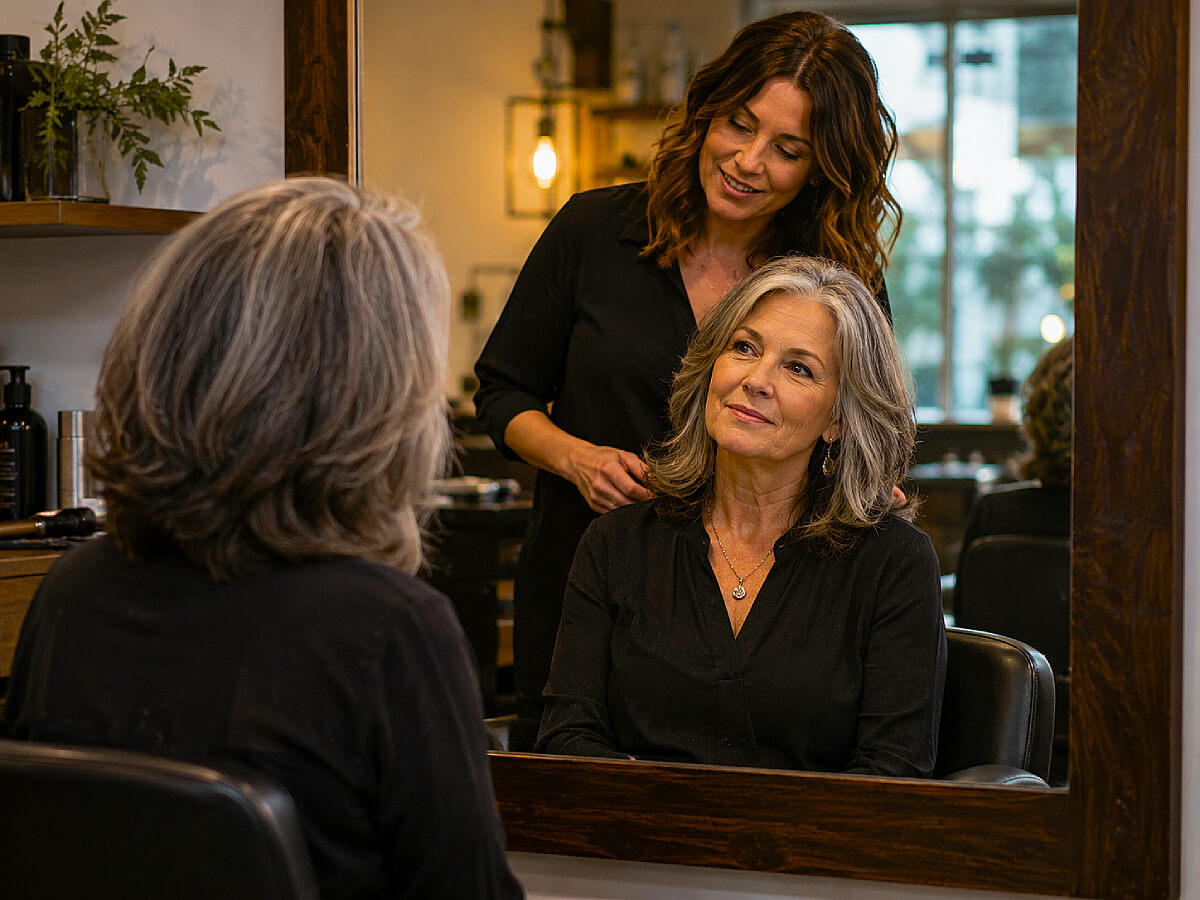
There’s a certain kind of appointment that happens all the time in my chair, and it’s the one where a woman sits down, I ask what we’re doing today, and she says “same thing” before I’ve even finished the sentence. She doesn’t make eye contact in the mirror when she says it. She’s already bracing for the next hour to feel routine, almost administrative, and somewhere in the back of her mind she’s wondering if the cut she’s been getting since her daughter’s quinceañera is still serving her. It’s not. But she’s not going to say that, and honestly, a lot of stylists aren’t going to bring it up either, because that conversation feels risky in a way that’s hard to explain unless you’ve been on both sides of it.
I’ve been behind the chair for like… 20-something years now and trust me, the most common mistake I see women over 50 making isn’t a bad color choice or the wrong sheer shampoo, it’s staying in a cut they’ve quietly outgrown because they don’t know how to start that conversation or even what they’d ask for instead. So Diane, this one’s for you, and honestly it’s for about half the women who’ve sat in my chair in the last decade. Let’s go through the real things, the ones that actually matter, and build up to the big one that I see more than anything else.
This post may contain affiliate links, meaning I may earn a small commission at no extra cost to you. I only share products I truly believe in. As an Amazon Associate, I earn from qualifying purchases. Your support helps me continue creating free content like this.
8. Skipping Toner and Wondering Why Your Color Looks Dull
This one flies under the radar because toner sounds like an optional add-on, the kind of thing a salon charges you extra for and you can probably skip, right? Wrong, and I say that with love. If you’ve got any gray coming in, or you’ve been coloring your hair for a while, or your natural color has shifted warmer with age (which it does, very commonly, especially through menopause), then skipping toner is why your color looks a little flat or a little brassy and you can’t figure out why. Color without toner is like painting a wall and not doing the finish coat. It’s fine but it’s not finished.
What toner actually does is neutralize unwanted warmth and deposit a small amount of color pigment to even everything out and give your hair that polished look that makes people ask if you just got a blowout even when you didn’t. At-home toners have gotten genuinely good in the last few years. I like Clairol Shimmer Lights for anyone with silver or light blonde tones, and for warmer brunettes who are going gray, a blue-tinted toning shampoo used once a week makes a meaningful difference. You don’t have to go to a salon every time you want to address brassiness. But you do have to address it, because dull brassy color on women over 50 reads as aging in a way that even a great cut can’t fully compensate for. This isn’t about chasing youth, it’s just about your color looking intentional instead of tired.
7. Using the Same Products You’ve Used Since the Early 2000s
I’m not going to pretend this isn’t personal for me because it absolutely is. I had a client, lovely woman, mid-sixties, beautiful bone structure, and she was using the same Pantene from a pump bottle that she’d probably been buying since Clinton was in office. Her hair was fine, like the actual texture, fine and a little thin through the crown, and she was essentially coating it every wash with something designed for a different hair type entirely, and then wondering why it felt limp and a little sticky by noon. When I asked her about her routine she got a little defensive at first, which I completely understood because nobody wants to feel like they’re doing it wrong, but the truth is hair changes significantly with age and what worked at 35 is genuinely not formulated for what your hair needs at 55 or 65.
Hair after menopause tends to be drier at the ends but more prone to oiliness at the scalp, finer in texture, and more fragile overall because estrogen plays a real role in hair strength and elasticity. That means heavy moisturizing shampoos can weigh it down, and protein treatments that felt great years ago might now make it brittle. I currently love René Furterer Volumea for fine aging hair and Olaplex No. 4 for anyone with color-treated hair that needs some structural support without heaviness. Updating your products is honestly one of the highest-return changes you can make, and it costs less than a cut.
6. Getting Layers Cut in the Wrong Place
Layers are one of those things where the difference between a great result and a frustrating one comes entirely down to placement, and that placement has to change as your face changes. I see a lot of women in their 50s and 60s who were told at some point that layers are universally flattering, and that’s loosely true, but generic layers cut without consideration of where your face has lost volume or where you’ve gained it can work against you in ways that are genuinely hard to pinpoint when you’re looking in the mirror. You just know something’s off and you can’t name it.
As we age, we tend to lose volume in the temples and cheek area, and the jawline softens. Layers that frame the face too aggressively or start too high can actually draw attention to that softening rather than away from it. What I usually recommend instead are layers that start at or just below the chin, so they don’t remove weight from areas that already need it, while still giving the hair movement and preventing that heavy blunt-edge look that can feel matronly. This is the kind of conversation worth having explicitly with your stylist, telling them where you feel like your face has changed and asking them to factor that in. If they look at you blankly when you say that, that’s useful information about whether they’re the right fit for you at this stage.
5. Avoiding Gray When Going Gray Could Actually Be the Better Choice
Okay, I know this one is a whole conversation, and I’m not here to tell anyone to stop coloring their hair because that’s a personal decision and I respect it completely. But I want to talk about the specific group of women who are spending a significant amount of money every four to six weeks on color maintenance, and the root situation has become genuinely difficult to manage, and the hair is showing some damage from years of processing, and honestly they’re exhausted by the whole thing but feel like they can’t stop. Because stopping feels like giving up somehow, and nobody’s given them a real picture of what a well-executed gray transition could look like.
I’ve taken several clients through gray transitions in the last few years and the results, when the transition is handled thoughtfully, have been genuinely beautiful. The key is not going cold turkey unless your hair is short enough to grow it out quickly. For longer hair, a colorist can use highlights and toning to blend the demarcation line and ease the transition over several appointments. This takes time but it saves your hair from the kind of damage that comes from trying to maintain a full color over increasingly resistant gray. Once you’re through it, gray hair that’s properly cared for, meaning hydrated, toned to avoid yellowing, and cut in a way that suits your texture, can be incredibly striking and genuinely lower maintenance than you’d expect. A good purple shampoo used once or twice a week is basically the foundation of the whole routine.
4. Holding On to Length for the Wrong Reasons
This is where I’m going to be a little direct, and I hope you’ll hear it the way it’s meant, which is with genuine warmth and zero judgment. A lot of women over 50 are holding onto long hair not because it suits them and makes them feel great, but because they have an idea that cutting it would mean something, that it would be an admission of something, or that they’d lose a part of themselves. I’ve heard this so many times, almost word for word, and I understand it on a human level. But I also see the hair in front of me, and what I often see is length that’s adding weight and pulling everything down, thinning ends that are doing the hair no favors, and a woman who might genuinely love a cut she’d never ask for because she’s decided in advance it would make her look old.
Here’s the thing I’ve seen play out enough times to say with confidence: a well-executed cut that removes the bottom few inches, adds some shape, and works with the hair’s natural texture instead of fighting it can take years off your appearance in a way that’s hard to explain until you’ve seen it. I’m not talking about a pixie unless that’s genuinely what you want. I’m talking about a cut that ends at the collarbone or the shoulder, has some intentional shape built in, and isn’t just hanging there. Longer isn’t always more feminine and it isn’t always more flattering, and your stylist may not tell you that unless you ask directly and make it clear you want an honest answer.
3. Neglecting the Scalp While Focusing Only on the Ends
We spend so much time and money on the ends of our hair, the split ends, the moisture, the smoothing serums, and almost no time thinking about the scalp, which is genuinely where the whole story starts. After 50, scalp health becomes more of a factor than most women realize, especially because hormonal shifts can change how much oil the scalp produces, how quickly the scalp cells turn over, and in some cases can contribute to thinning that feels sudden but has actually been building for years. A scalp that’s congested or inflamed or just dry and ignored is not an environment where hair is going to thrive, and no amount of great product on the lengths is going to compensate for that.
I started recommending scalp treatments to clients a few years ago and the ones who actually tried it came back noticeably converted. Briogeo Scalp Revival Charcoal + Coconut Oil Micro-Exfoliating Shampoo is one I recommend often, and for something a little more targeted, Nioxin’s scalp treatment system has genuinely helped clients who were starting to notice thinning around the part or temples. Monthly scalp exfoliation, even just using your fingertips with a little diluted clarifying shampoo, makes a real difference in how your hair grows and how it behaves between washes. It’s one of those habits that takes almost no time and the payoff compounds over months.
2. Letting Your Cut Stay the Same While Everything Else Changes
This one is close to the top because it’s so incredibly common and so rarely talked about directly. Your face changes as you age, your hair texture changes, your lifestyle changes, and yet so many women are sitting in the same cut they’ve had for years, sometimes a decade or more, because it felt safe and familiar and at some point someone said it was flattering and that felt good enough to hold onto. I’m not saying your cut is definitely wrong. I’m saying that a cut that was designed for your face at 42 may not be accounting for everything your face is doing at 56, and there’s a real chance that a small but intentional update could make a significant difference in how you feel every morning.
What I see most often is that the cut itself isn’t terrible but it’s static, it has no relationship to where the woman’s face is now or how her hair behaves now, especially if her texture has changed with age or if she’s working with more gray, which has a completely different behavior than pigmented hair and usually needs more moisture and a slightly different cut structure to look its best. This is the appointment worth scheduling, not for a dramatic transformation but just for a real conversation with your stylist where you say “I’ve had some version of this for years and I want to know if it’s still right for me.” Most stylists will appreciate that opening more than you think, and the ones who give you a real, thoughtful answer are the ones worth keeping.
1. Not Telling Your Stylist That Something Has Changed
Here it is. The thing I see more than anything else, the thing I wish someone would say out loud more often, the actual mistake that sits underneath almost every other one on this list. Women come in and they don’t tell me things. They don’t tell me that they’ve been going through menopause and their hair has changed in ways they don’t fully understand. They don’t tell me that they’ve been stressed or that their diet has shifted or that they’ve noticed their part looking wider than it used to. They don’t tell me that they cried in the car after their last appointment because the cut didn’t feel like them anymore but they said it looked great when I asked. And I get it, because the salon is supposed to be a pleasant experience and bringing up something vulnerable or complicated feels like it might make it uncomfortable or weird, and honestly, some stylists don’t make it easy to have that conversation.
But here’s what I want you to know, really know, if you’re Diane in Sheboygan Falls or any woman who has quietly outgrown something she’s been too polite to name. Your stylist needs that information to do right by you. When your hair changes because of hormones or stress or medication or just age, the cut and color that worked before might genuinely not work anymore, not because you’re doing anything wrong but because the hair itself is different. Telling me “my hair feels different lately and I don’t know what to do with it” is one of the most useful things you can say in that chair. It opens the whole conversation. It lets me actually look at what’s happening instead of just executing what we’ve always done. The best appointment I ever had with a long-term client started with her saying “I need you to just look at me and tell me the truth,” and we completely rebuilt her look from the color to the cut and she left looking like herself in a way she hadn’t in years. That appointment changed how I think about what I do.
If you’re nervous about starting the conversation, here’s exactly what you can say: “I feel like my hair has been changing and I’d love to know what you think would actually work best for me right now, even if it’s different from what we’ve been doing.” That’s it. That gives your stylist permission to be honest, and any stylist worth their shears will take that opening and run with it. And if they don’t, if they just nod and do the same thing again, then that’s its own answer, and you might start looking for someone who will.
Before You Go
Diane, I really hope this helps, and not just the list itself but the permission underneath it, to ask the question you’ve been sitting on, to say the thing that feels a little awkward, to walk into that salon and actually tell someone what you need instead of settling for what’s familiar. You’ve been wearing your hair for over half a century and you know more about what feels right than you give yourself credit for. A good stylist’s job is to meet you where you are right now, not where you were eight years ago, and you deserve someone who’s paying that kind of attention.
The products I mentioned throughout, the toning shampoos, the scalp treatments, the quality shampoos for aging hair, they all make a difference but none of them matter as much as walking in and starting an honest conversation. Hair is so personal and it changes with us, and the women who look the best at 50, 60, 70 and beyond aren’t the ones who found a look and froze it in time, they’re the ones who stayed curious about it and kept showing up and kept asking questions. Go be one of those women. You’ve got the right instinct already or you wouldn’t have written in.