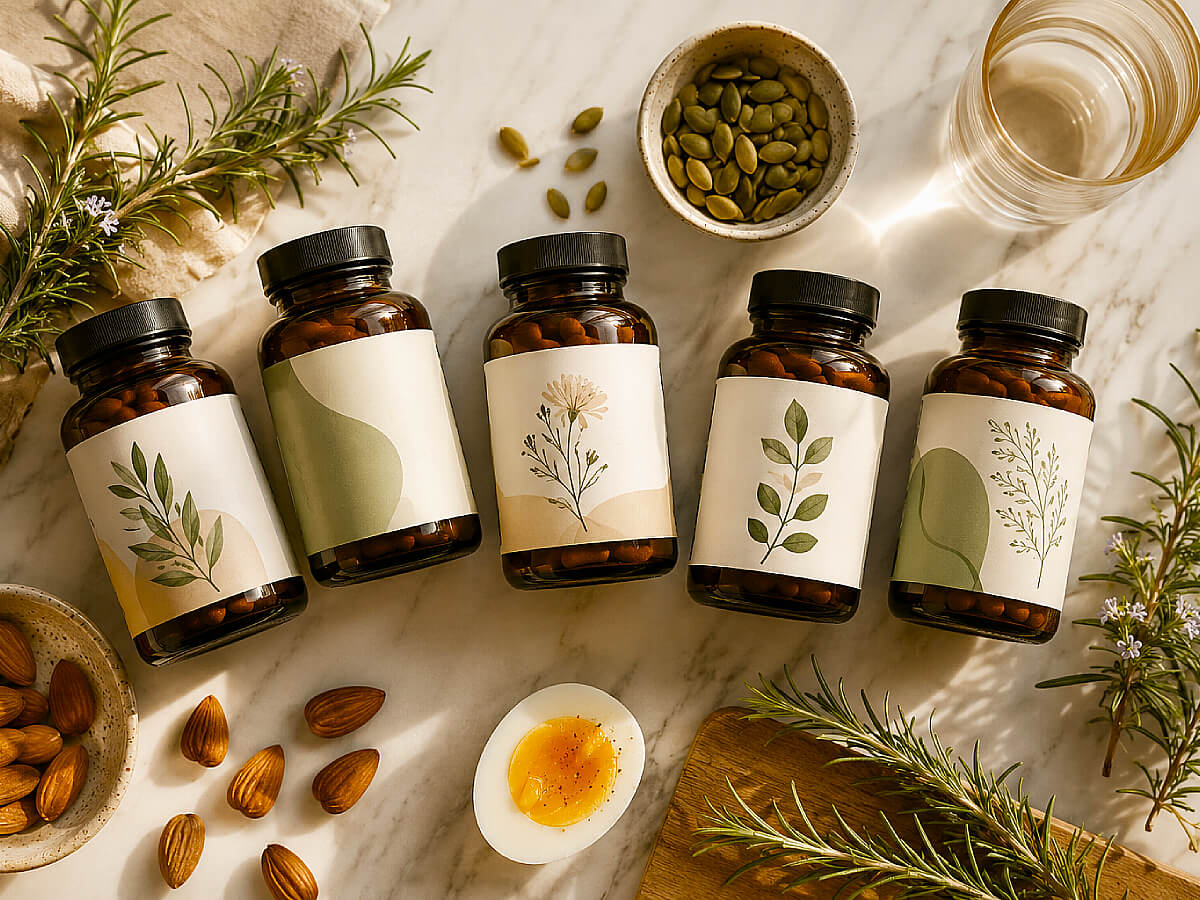

Question from Deborah Lentz, Flagstaff, Arizona: “I’ve been dealing with noticeable thinning around my temples and part line for about two years now. My doctor ran bloodwork and said everything looks ‘normal,’ but my hair just isn’t what it used to be. A friend suggested I look into vitamins for hair growth, but there are so many options I don’t even know where to start. Which ones actually work, and which ones are just expensive pee?”
Deborah, I love that last line, and honestly, you’re asking the right question. The supplement aisle for hair growth has become its own kind of chaos, with every brand promising thicker, longer, stronger hair in 30 days if you just buy their pretty pink gummy. I’ve been behind the chair for over 20 years, and I can tell you that the number of clients who come in clutching a bottle of something they found on Instagram, hoping it’ll fix what’s going on at their hairline, is genuinely a lot. Some of them are onto something. Most of them are not.
Here’s what I’ve learned, partly from watching clients over the years and partly from going through my own shedding phase after a particularly stressful period in my early 40s: the vitamins that actually support hair growth are not mysterious or exotic. They’re mostly nutrients your body already needs, and when you’re running low on them, your hair is often the first place it shows. The tricky part is knowing which ones are worth your money, what forms are actually absorbable, and how to take them in a way that gives your follicles a real fighting chance.
This post may contain affiliate links, meaning I may earn a small commission at no extra cost to you. I only share products I truly believe in. As an Amazon Associate, I earn from qualifying purchases. Your support helps me continue creating free content like this.
5. Vitamin D, Because Most of Us Are Running on Empty
If I had to guess which deficiency is showing up in the bloodwork of women who are losing hair, and their doctors are calling it “normal” the way Deborah’s did, Vitamin D would be near the top of my list almost every single time. The reference range for “normal” on standard bloodwork is frustratingly broad, and plenty of women walk around at levels that are technically in range but functionally too low to support things like mood, immunity, and yes, hair follicle cycling.
Hair follicles have Vitamin D receptors on them, which means they’re actively looking for it. When levels drop, follicles can shift into a resting phase earlier than they should, which is one of the mechanisms behind the kind of diffuse thinning Deborah is describing, where everything just looks less full rather than there being one specific bald spot. I had a client, a woman in her early 50s named Patricia who came in every six weeks for a blowout, and she mentioned offhand one day that her ponytail had gotten so thin she’d switched to a different elastic. We talked about what she was taking, and Vitamin D wasn’t on her list at all. She started supplementing, got her levels actually optimized rather than just “normal,” and about four months later she came in and said her ponytail felt different. Not miraculous, but genuinely different.
What I’d suggest looking for is a D3 form rather than D2, because D3 is what your body makes from sunlight and it converts more efficiently. Taking it with a meal that has some fat helps absorption too. A good starting point that I’ve seen clients do well with is something like NatureWise Vitamin D3 5000 IU, though your ideal dose really does depend on where your baseline levels actually land. If you haven’t had your 25-hydroxy Vitamin D levels tested specifically, it’s worth asking for that number rather than accepting a general “your labs look fine.”
4. Iron, the One That Gets Missed Most Often in Women Over 40
This is the one that makes me want to gently shake the shoulders of every woman who’s been told her iron is fine. Because ferritin, which is the stored form of iron and the number that actually matters for hair growth, has a reference range that bottoms out somewhere around 12 in many labs. Twelve. Hair loss research consistently shows that ferritin below 70 can contribute to shedding, and some practitioners argue the sweet spot for hair health is closer to 80 or above. So a woman with a ferritin of 15 gets told she’s normal, her hair keeps thinning, and nobody connects the dots.
Iron is critical because it helps carry oxygen to your hair follicles, and follicles are metabolically demanding little structures that don’t respond well to being starved. When iron is low, the body prioritizes vital organs, and hair, being non-essential in the survival sense, gets deprioritized. The hair you lose from low ferritin tends to be that overall diffuse thinning, the kind where you’re not going bald in patches but your part is getting wider and your shower drain is more eventful than it used to be.
Women in perimenopause and menopause sometimes assume their iron issues resolve once periods lighten up or stop, but it doesn’t always work that way, especially if levels were chronically low for years before that. If you do supplement iron, the form matters a lot because some types cause significant GI discomfort. I’ve heard good things from clients about ferrous bisglycinate formulas like Thorne Iron Bisglycinate, which tends to be gentler on digestion. Always take iron with Vitamin C to improve absorption, and not at the same time as calcium, which blocks it. This one is worth confirming with your doctor before you add it, since supplementing iron when you’re not actually deficient isn’t helpful and can cause its own problems.
3. Biotin, But Not in the Way You’ve Been Sold It
Okay, so I have feelings about biotin. It is probably the most marketed hair supplement on the planet, and the disconnect between what’s in the research and what’s on the packaging is genuinely something. Biotin deficiency does cause hair loss, that part is real. But true biotin deficiency is relatively rare in women eating a reasonably varied diet, because biotin is found in eggs, salmon, nuts, sweet potatoes, and a whole lot of other foods that most of us are eating in some form. The majority of women taking 5,000 or 10,000 mcg biotin supplements daily are not actually deficient, which means the extra biotin isn’t doing what the label implies.
What I tell clients is this: if you’ve been eating well and your biotin is already adequate, more biotin isn’t going to dramatically change your hair. What it might do is interfere with certain lab tests, particularly thyroid panels and cardiac troponin tests, which is something a lot of women don’t know and their doctors don’t always think to ask about. That said, if your diet has been restricted, if you’re vegan or eat very few eggs and animal proteins, or if you’ve been under prolonged stress that depletes B vitamins generally, then yes, biotin as part of a B-complex makes a lot of sense.
Rather than a standalone mega-dose biotin supplement, I tend to think a B-complex that includes biotin at a reasonable level alongside B12, B6, and folate gives you a more complete picture of what your hair actually needs. Something like Garden of Life Vitamin B Complex is one I’ve recommended because it’s a whole-food based formula and the levels are sensible rather than astronomically high. If your hair is growing and healthy and you’re just on biotin because someone told you to be, it might be worth redirecting that money toward the nutrients you’re actually missing.
2. Zinc, the Quiet One That Does a Lot of the Heavy Lifting
Zinc doesn’t get the same marketing budget as biotin, and I genuinely think that’s why it flies under the radar for so many women dealing with hair thinning. It’s involved in DNA synthesis, cell division, protein synthesis, and the normal functioning of oil glands around the follicle, which means it’s touching almost every part of the process that keeps your hair growing. When zinc is low, follicles can miniaturize, meaning they start producing finer and shorter hairs over time, which is a pattern that looks a lot like hormonal hair loss and often gets mistaken for it.
A few years back I went through a period of genuinely stressful life stuff, and I noticed my own hair was shedding more than usual and looking duller than it normally does. I’d already been taking D3 and a B-complex, so I had my levels checked and my zinc was on the low end of normal, that familiar pattern again. I added a zinc supplement and within a couple of months my hair felt different in texture, more like itself, which is a subtle thing but noticeable when you know what you’re looking for. I also stopped getting the small white spots on my nails that I’d been ignoring, which is a classic sign of zinc insufficiency that a lot of women don’t recognize.
The catch with zinc is that too much causes its own problems, including copper depletion, so you don’t want to go overboard. A dose around 15 to 25 mg daily from a supplement is generally considered reasonable for women, especially if it includes a small amount of copper to maintain balance. Designs for Health Zinc Supreme uses a chelated bisglycinate form that absorbs well and includes copper for balance, which is the kind of thoughtful formulation I appreciate. Take it with food because zinc on an empty stomach can make you nauseous in a fairly convincing way.
1. Vitamin E (and the Full Antioxidant Picture It Represents)
I know putting Vitamin E at number one might raise an eyebrow or two, especially when you were probably expecting something more dramatic. But here’s why it earns the top spot for me, at least when we’re talking about hair growth as a whole system rather than just plugging a single deficiency. Vitamin E is a fat-soluble antioxidant that directly addresses oxidative stress at the scalp level, and oxidative stress is increasingly understood to be one of the underlying drivers of hair follicle aging, miniaturization, and the kind of slow, progressive thinning that women in their 40s and 50s tend to notice creeping in.
There was a small but genuinely interesting clinical study where people with hair loss supplemented with tocotrienols, a specific form of Vitamin E, for eight months and saw about a 34 percent increase in hair count compared to a placebo group. That’s not a massive study, and I’m not saying Vitamin E is a cure for anything, but 34 percent is not a number you dismiss either, especially when we’re talking about something that’s also good for your cardiovascular health, your skin, and your immune function. Vitamin E works partly by improving circulation to the scalp, which means follicles get better blood flow and better delivery of all the other nutrients we’ve been talking about. It’s a bit like fixing the roads so everything else can actually get there.
The form of Vitamin E matters here just like it does with D and iron. You want a mixed tocopherols and tocotrienols supplement rather than just alpha-tocopherol, which is what most cheap supplements contain and which in isolation can actually block the absorption of the other tocopherols. Jarrow Formulas Tocotrienols is one I’ve looked into and recommended because it provides that broader spectrum. Take it with dinner since it absorbs best with dietary fat, and if you’re also supplementing iron, give them a few hours apart since Vitamin E and iron can interfere with each other’s absorption when taken simultaneously.
One more thing worth mentioning here because it connects everything together: the scalp itself benefits from topical Vitamin E as well, and if you’re dealing with thinning that seems to involve scalp health, dryness, or inflammation, adding a scalp serum or oil that contains Vitamin E alongside something like rosemary extract, which has genuinely good research behind it for hair growth, can work really well alongside what you’re taking internally. Something like Mielle Organics Rosemary Mint Scalp Oil has become a staple recommendation from me for clients who want to address things from the outside in as well as the inside out.
Before You Buy Anything, a Few Honest Notes
Deborah, and anyone else reading this who’s been quietly worrying about their hair for longer than they’d like to admit, I want to be honest with you about the timeline because nobody in the supplement marketing world will be. Hair growth cycles are long. The follicle has to wake up, restart the growth phase, and then actually produce visible hair length before you see anything meaningful in the mirror. That means you are typically looking at a minimum of three to four months before you notice a change, and six months is more realistic for a real assessment. If you start something and quit after six weeks because you don’t see results, you will never know if it would have worked.
I’d also say, and I mean this genuinely, that supplements work best when the basics are in place. Your protein intake matters enormously for hair growth because hair is protein, and a lot of women over 40 are chronically under-eating protein especially if they’ve spent decades on various lower-calorie diets. Chronic stress, poor sleep, and blood sugar swings all affect your hair in ways that no supplement can fully compensate for. The vitamins are real and they help, but they’re working within a system, and the system matters too.
Finally, if you can get a comprehensive blood panel that includes ferritin specifically, 25-hydroxy Vitamin D, zinc, and full thyroid function including free T3 and T4 and not just TSH, you’ll have actual information to work with instead of guessing. It changes everything to know where you actually are rather than throwing money at the problem from all directions and hoping something sticks. You deserve to know what’s going on with your own body, and “your labs are normal” is not always the whole story.
Your hair has been with you for a long time, and so has your body’s ability to support it. Sometimes it just needs a little more of the right things to find its way back.