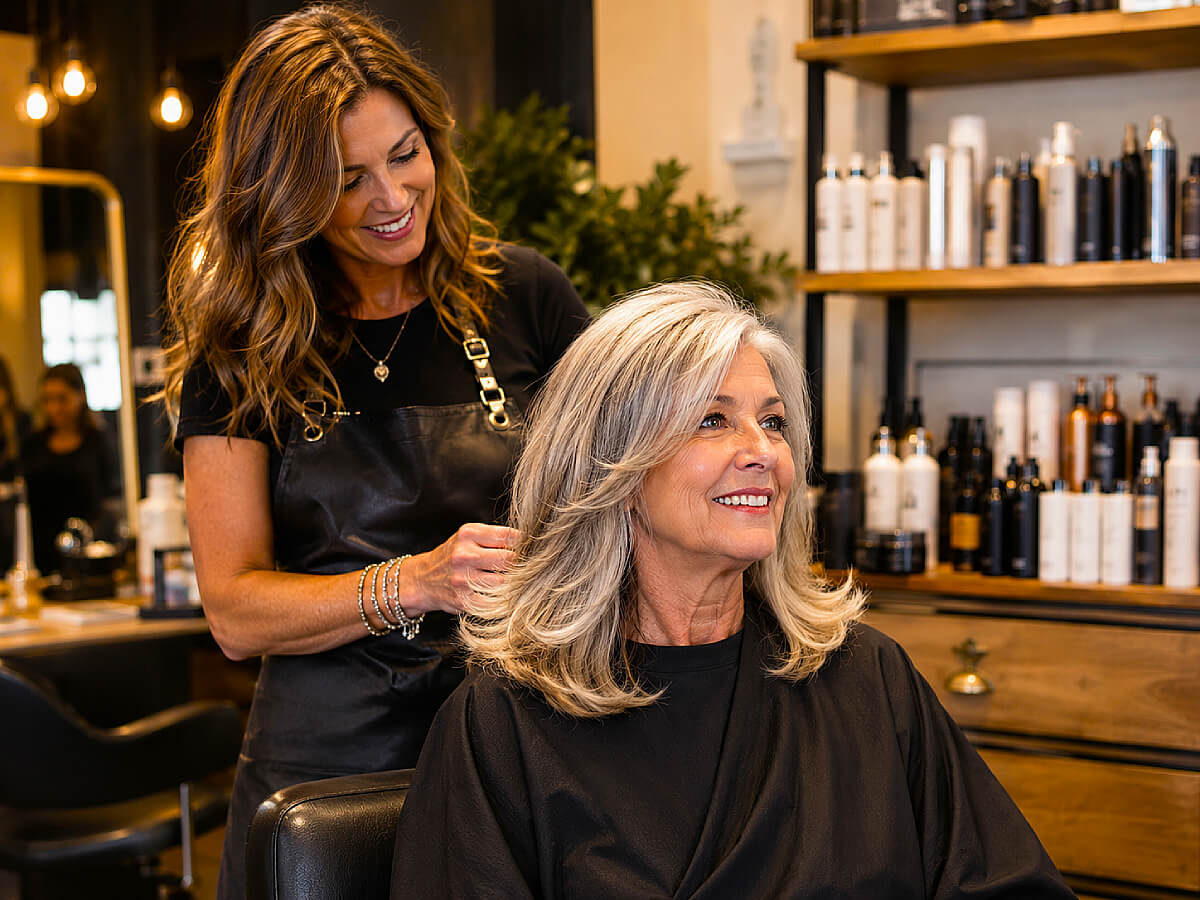

From Diane Kowalczyk, Terre Haute, Indiana: “I feel like every time I go to the salon I get the same shampoo, cut, and color, and I’m out the door. My stylist has mentioned a few add-on services but honestly I tune it out because it feels like an upsell. But lately my hair has been looking kind of dull and flat and it doesn’t hold a style the way it used to. Am I missing something? Is there actually a service worth adding in, or is it all just extra money for not much difference?”
Diane, you are absolutely not alone in this, and I say that as someone who has had this exact conversation more times than I can count while standing behind the chair. There is a specific kind of client who comes in like clockwork, takes great care of her color, gets a good cut, and still walks around wondering why her hair never quite looks the way she wants it to at home. The answer is almost always the same thing, and it is something most women in their 60s skip every single time, usually because nobody explained it properly or it got lumped in with a bunch of other services that did feel like upsells.
Hair in your 60s is genuinely different from the hair you had in your 40s. The texture shifts, the density changes, and the way it responds to color and heat is just not the same situation anymore. It is not a matter of finding the right shampoo or buying a better flat iron. There is a foundational need that changes as we get older, and the salon service I am talking about addresses exactly that. I am going to walk you through some of the runners-up first, because there are a few services that genuinely do make a difference, but I want to build up to the one I think matters most so you have the full picture by the time we get there.
This post may contain affiliate links, meaning I may earn a small commission at no extra cost to you. I only share products I truly believe in. As an Amazon Associate, I earn from qualifying purchases. Your support helps me continue creating free content like this.
7. Scalp Exfoliation Treatments
Most women have never had one and have never really thought about it either, which is exactly why I am putting it on this list. The scalp is skin. It behaves like skin. It gets product buildup, it gets flaky, it gets sluggish circulation over time, and when it is not in good condition the hair that grows from it reflects that pretty directly. Dull, flat, slow-growing hair is often a scalp problem before it is a hair problem, and a good scalp exfoliation treatment addresses the root cause in the most literal way possible.
In the salon, a scalp exfoliation usually involves a physical or chemical exfoliant worked into the scalp before your shampoo service, sometimes followed by a scalp massage or a targeted scalp serum. Some salons use a tool that looks a little like a silicone brush, and the combination of the product and the circulation it creates honestly feels incredible. I have had clients fall asleep during it. One of my regular clients, a retired teacher named Carol, came in complaining that her hair had stopped growing past a certain length for about two years. We started doing a monthly scalp treatment and within three or four months she had noticeably more length and her hair felt thicker at the root. I cannot promise that for everyone, but the scalp connection is real.
At home, something like the Briogeo Scalp Revival Charcoal + Coconut Oil Micro-Exfoliating Shampoo is a solid option for between appointments, and a silicone scalp massager used while shampooing makes a real difference in product distribution and circulation. But the in-salon version goes deeper than anything you can fully replicate at home, especially when a stylist can see what they are working with and customize accordingly. If you have never asked your stylist about this, it is worth bringing up next time.
6. Gloss and Toning Services
Here is something that does not get talked about enough, and it kind of drives me a little crazy because it is so effective and so underused. A gloss treatment, sometimes called a toning service or a clear gloss, is a semi-permanent color service that does not change your base color but does about four things at once that all matter a lot if you have gray or color-treated hair. It smooths the cuticle, adds reflective shine, refreshes the tone of your existing color, and it coats the hair in a way that makes it feel noticeably softer and more substantial.
Women with gray hair often skip this because they think it is only for people who color their hair. That is genuinely not true. A clear or tinted gloss on natural gray can make it look luminous and intentional rather than flat and wiry. I have put a violet-based gloss on clients who were embracing their silver and the transformation is honestly dramatic, all without touching their natural color. The hair goes from looking a little yellow and frizzy to looking like they paid a lot of money for that silver, even though it grew out of their head for free.
For color-treated hair, a gloss between your regular color appointments can extend the life of your color significantly, which actually saves money over time. Most glosses fade gradually and evenly, so there is no harsh line between colored and uncolored hair. The service itself usually takes about twenty minutes and the price point is reasonable compared to a full color service. Brands like Redken Shades EQ are what a lot of salons use, and at-home versions like John Frieda Gloss Treatments are fine for maintenance but not quite the same as what happens under a professional’s hands.
5. Bond-Building Treatments (Olaplex and Similar)
You have probably heard of Olaplex by now because it became genuinely famous, which is not something that happens often with a professional hair product. But the reason so many women in their 60s skip it is that it gets presented as something for people who have a lot of color damage or bleach, and that feels like it does not apply to them. The thing is, bond damage is not only from chemical services. It accumulates from heat styling over decades, from environmental exposure, from the natural changes in hair structure that come with hormonal shifts after menopause. Your bonds can be compromised even if you have never bleached your hair a day in your life.
Bond-building treatments like Olaplex No. 3 or the in-salon versions like Olaplex No. 1 and No. 2 work at a structural level, reconnecting broken disulfide bonds in the hair cortex. What that translates to in real life is hair that snaps less, feels less brittle, and responds better to styling. I had a client in her late 60s who was convinced she just had bad hair. She had been saying that for years. We added a bond-building service to her color appointments and within a couple of visits she stopped talking about her “bad hair” entirely because there was nothing left to complain about.
The category has expanded a lot since Olaplex first came out, so there are now options like K18 and Wellaplex that work similarly but with slightly different chemistry. Some stylists prefer one over another and honestly it can come down to what your hair specifically needs. The at-home versions are worth using between appointments, but the in-salon concentrations are significantly stronger, which is why the professional version of this treatment produces results the retail product cannot quite match on its own.
4. Keratin Smoothing Treatments
I want to be careful here because there is a wide range of what gets called a keratin treatment and they are not all the same thing. Some of them are quite heavy and can flatten the hair in a way that does not suit everyone, particularly women with finer hair who need volume more than they need smoothing. But a lighter keratin or smoothing service, sometimes called a blowout treatment or a soft keratin, can be genuinely life-changing for women dealing with frizz, coarsened texture, and hair that fights them every morning.
After menopause, a lot of women notice their hair gets dryer, frizzier, and more unpredictable in humidity, and that is partly hormonal and partly just the way the hair structure changes over time. A good smoothing treatment does not eliminate curl or wave the way a traditional relaxer would, but it quiets the frizz and makes the hair behave more cooperatively. Your blowout time at home drops significantly and the results last anywhere from six to sixteen weeks depending on the treatment and how often you wash your hair.
Brands I have worked with that I feel good about include Brazilian Blowout and GK Hair Keratin Treatment, and there are gentler at-home options like Keratin Complex Smoothing Therapy that give you a taste of what the professional version does. The key with any keratin service is talking to your stylist honestly about the result you want, because there is a version of this for almost every hair type when it is applied by someone who knows what they are doing.
3. Scalp and Hair Density Treatments for Thinning Hair
Thinning hair is one of the most common concerns I hear from women in their 60s, and it is also one of the most emotionally loaded ones because hair is so tied to identity. What I want to say first is that there is a lot more that can be done than most women realize, and the salon is actually a good place to start that conversation even if the longer-term solution involves a dermatologist or other medical support. What salons can offer are targeted trichology-adjacent treatments that improve scalp health, stimulate circulation, and reinforce the hair that is there.
Some of these are standalone services, some are add-ons to your existing appointment. Things like Nioxin in-salon treatments or growth-stimulating serum services using products with ingredients like peptides, caffeine, or biotin applied directly to the scalp are gaining real traction in salons that specialize in mature hair. I have seen women use these consistently for a few months and genuinely see a difference in density at the hairline and temples, which is often where the thinning is most visible and most distressing.
One of my clients, a woman in her early 60s who had been on a medication that accelerated her hair loss, started coming in for monthly scalp treatments combined with a Vegamour serum application at the scalp. She also started using a derma roller at home between visits. The combination approach is not instant, but it is cumulative, and she was genuinely emotional when she noticed the baby hairs coming back around her part. This is an area where consistent professional support really does matter, and it is worth having an honest conversation with your stylist about what is available to you.
2. Conditioning and Moisture Masking Services
Deep conditioning treatments might sound basic but the version you get in a salon is not the same as what the box says when it tells you to leave your conditioner on for three minutes. A professional conditioning mask service uses higher-concentration products, sometimes with heat to open the cuticle and drive the ingredients deeper, and sometimes with a processing time that is actually long enough to make a meaningful difference. It sounds simple because moisture is not a glamorous concept, but dry, porous, low-moisture hair is the actual underlying issue behind a huge percentage of the styling struggles women in their 60s deal with every day.
After menopause, the scalp produces less sebum, which means the natural conditioning mechanism the body has always provided just quietly steps back, and the hair is left drier from root to tip than it was at any other point in your life. Color adds porosity on top of that. Heat styling adds more. By the time you factor in years of cumulative exposure, a lot of women are dealing with hair that is significantly moisture-depleted, and no amount of leave-in conditioner you spray on at home is going to correct that at the structural level.
In the salon, treatments like Oribe Gold Lust Repair and Restore or Kerastase Masquintense are the kinds of things I reach for when someone’s hair has that stressed, straw-like quality to it, and the difference after one treatment is noticeable enough that most clients immediately ask why they haven’t been doing this all along. Adding a professional mask service every four to six weeks, even if you rotate it in instead of getting it every single visit, is a meaningful investment in the health of your hair and it shows in how your hair looks and behaves in the weeks that follow.
1. A Personalized Consultation-Led Haircut Designed Specifically for Your Hair Now
This is the one, and I want to be really direct about why I put it at the top, because it might surprise you. It surprised some of my clients when I started being more explicit about it. The service most women in their 60s keep skipping is not an exotic treatment or a complicated chemical service. It is the experience of sitting down with a stylist who truly assesses what their hair is doing right now, at this stage of life, and builds a cut around that specific reality rather than the same version of the cut they have been getting for fifteen years.
Here is what I mean. I have had clients come in with a photo from 2008, or a description of the cut they got when they were 48, and ask for the same thing. And I understand that impulse completely, because that was a good haircut and it worked and it felt like you. But the hair you have now is structurally different. The texture is different. Where it grows from is different. The density at the crown may have changed, the hairline may have shifted slightly, the natural part may have moved. A cut that doesn’t account for all of that is going to fight your hair instead of working with it, and you will spend your mornings fighting it too.
What I am describing is less a specific technique and more an approach, which is why it is hard to put a name to it and why it often gets missed entirely. It involves a stylist who looks at your hair dry before they cut, who assesses the natural movement and growth patterns, who asks about how you style at home and what your morning actually looks like, and who is willing to suggest something different than what you came in with if the evidence points that direction. Some salons now offer this as a paid consultation service separate from the cut itself, and I think that is worth every cent for anyone who has been feeling like their hair just doesn’t cooperate anymore.
The right cut for mature hair, meaning hair that may be finer, possibly mixed with gray, possibly dealing with some thinning or texture changes, looks completely different from the right cut for hair in its 30s or 40s. Weight distribution matters more. Where the length falls in relation to the jaw and neck matters more. Layers that add movement without removing density become a whole different conversation. I have given clients the best haircut of their lives at 63 that they never would have chosen on their own, because they were still thinking about their hair as it used to be rather than as it is.
The tools that support this are simple, things like a good pair of professional shears for the stylist and a wide-tooth comb for you at home, but the real value is in the expertise and the honesty of the stylist doing the work. If your current stylist gives you the same cut every time without really looking at your hair and asking questions, it might be worth seeking out someone who specializes in mature hair, a stylist who genuinely finds this demographic interesting and challenging to work with, because that enthusiasm shows up in the results.
A lot of salons that cater to older women now offer what they call a “hair wellness consultation” or a “hair assessment service” that goes beyond just what cut to get, looking at scalp health, density, hair loss patterns, and styling challenges all together. If you can find a stylist who offers something like that, paired with a cut that’s actually built for your hair today, you will notice the difference from the first blowout. That’s the service worth every penny. Not because it is the most expensive or the most dramatic, but because everything else you do, every treatment, every product, every styling step, works better when the foundation is right.
The Bottom Line
Diane, coming back to your original question, your instinct that something is being missed is absolutely right, it is just that the thing being missed might be simpler and more foundational than you expected. Hair changes significantly after 60, and the salon services that served you well in your 40s may need to be updated along with everything else. The services I walked through here are all genuinely worth considering, and none of them are just upsells for the sake of it. They address real, specific things that happen to hair as we get older.
Start by having an honest conversation with your stylist about what you are experiencing, the dullness, the flatness, the styling struggles, and see what they suggest. If they do not engage meaningfully with that conversation, that is useful information too. You deserve a stylist who is as interested in solving your hair problems as you are, and the right professional relationship combined with the right services can genuinely change how you feel about your hair in your 60s. Which, I promise you, can be some of the best hair years of your life once you figure out what it actually needs.