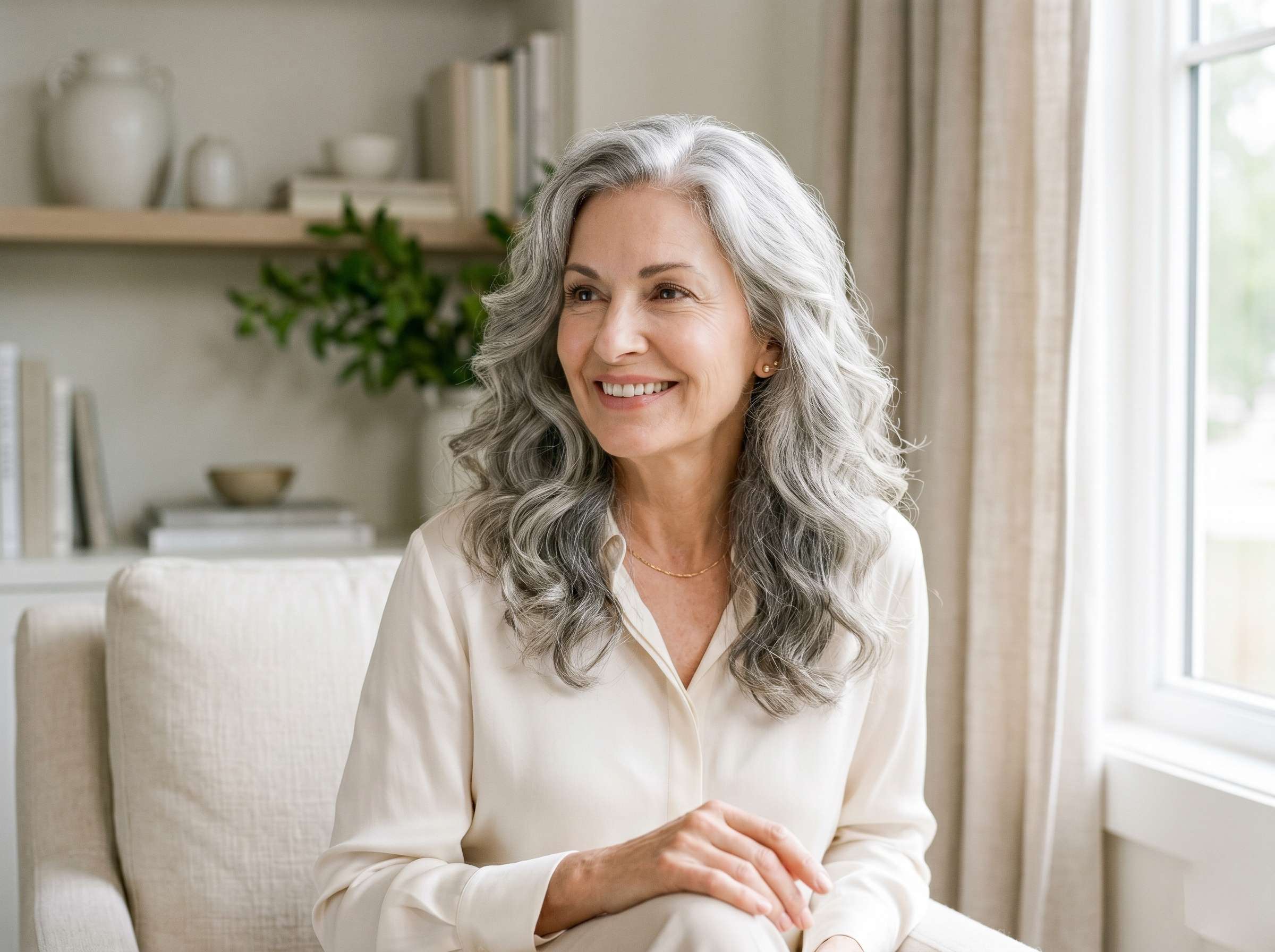

“I’m 63 and I feel like my hair has lost all its life. I see other women my age with these gorgeous, full heads of hair and I just wonder what they’re doing differently. Is it genetics or are there actual habits I should be picking up? I’d love to know the real secrets.” — Lorraine Mitchell, Savannah, GA
Lorraine, I love this question because I hear some version of it almost every single week. And I’ll tell you right now, it’s rarely just genetics. Sure, DNA plays a role, but when I talk to women in their 60s who genuinely have stunning hair, a pattern always emerges. They’re doing specific, consistent things that most people either don’t know about or have gotten away from over the years.
I’ve spent over a decade in the beauty industry talking to hairstylists, trichologists, dermatologists, and real women who are navigating hair changes after 50 and beyond. And what I’ve learned is that gorgeous hair in your 60s isn’t about vanity or spending a fortune. It’s about intention. It’s about small, smart choices that add up over time.
The women who get compliments on their hair at 63, 67, 72? They’re not doing anything extreme. They’re just doing the right things consistently. So let’s break down exactly what those things are, because every single one of them is something you can start today.
Here are the 9 things women in their 60s with beautiful hair are almost always doing.
This post may contain affiliate links, meaning I may earn a small commission at no extra cost to you. I only share products I truly believe in. As an Amazon Associate, I earn from qualifying purchases. Your support helps me continue creating free content like this.
9. They’ve Found the Right Stylist and They Stay Loyal
This might sound basic, but it’s honestly one of the biggest differentiators. Women with gorgeous hair in their 60s almost always have a stylist they trust deeply, and they don’t bounce around from salon to salon chasing deals or trends. They’ve found someone who understands the texture changes that happen with aging hair, who knows their growth patterns, and who isn’t trying to make them look 30 again.
“I’ve been seeing my stylist for 11 years,” says Diane R., from Scottsdale, AZ. “She knows my hair better than I do at this point. She’s the one who told me to stop fighting my natural wave and start working with it. That one piece of advice changed everything for me.”
A good stylist who specializes in mature hair care is worth their weight in gold. They’ll tell you when a cut isn’t serving you anymore. They’ll adjust your color formula as your skin tone shifts. They’ll be honest with you when you need to hear it. The relationship matters because consistency in care leads to consistency in results.
If you don’t have a stylist you trust yet, ask women in your area whose hair you admire. That personal referral is almost always how the best matches happen. Don’t be shy about it. I’ve never met a woman who wasn’t flattered by “Your hair looks amazing, who does it?”
8. They Prioritize Scalp Health Like It’s Skincare
Here’s something I didn’t fully appreciate until a few years ago: your scalp is skin. And just like the skin on your face needs cleansing, exfoliation, and hydration, your scalp does too. Women with beautiful hair in their 60s tend to understand this on an intuitive level, even if they wouldn’t phrase it that way.
As we age, our scalps produce less oil, which can lead to dryness, flakiness, and even a buildup of dead skin cells that actually blocks healthy hair growth. A scalp exfoliating brush used gently in the shower a couple of times a week can make a noticeable difference. Products like the Kérastase Genesis Scalp Serum or the The Ordinary Multi-Peptide Serum for Hair Density are popular options that support scalp circulation and follicle health.
“I started treating my scalp like I treat my face, and within a few months my hairdresser noticed new growth coming in,” says Pam T., from Portland, OR. “I wish I’d started ten years earlier.”
Scalp care is one of those anti-aging hair secrets that sounds almost too simple. But healthy hair starts at the root, literally. If you’re spending money on expensive shampoos and conditioners but ignoring what’s happening at the scalp level, you’re skipping the foundation. A weekly scalp treatment for thinning hair is one of the smartest investments you can make.
7. They Use Heat Tools Sparingly and Wisely
I know this one can be a tough pill to swallow, especially if you’ve been blow-drying and flat-ironing your hair daily for decades. But the women I’ve met who have the healthiest, shiniest hair in their 60s have either dramatically reduced their heat styling or upgraded their tools to ones that minimize damage.
Aging hair is naturally more fragile. The cortex thins, moisture retention decreases, and each strand is simply less resilient than it used to be. Blasting it with 450-degree heat on a regular basis accelerates breakage and dullness in a way that’s really hard to reverse.
That doesn’t mean you have to give up your styling routine entirely. It means being smarter about it. A Dyson Airwrap or a T3 Cura Luxe blow dryer uses lower, more controlled heat that styles without frying. And always, always use a heat protectant spray before any hot tool touches your hair. I personally love the Living Proof Restore Instant Protection spray for fine and aging hair.
“I went from flat-ironing every morning to using my iron maybe once a week, and my hair literally feels different,” says Carol M., from Nashville, TN. “It’s softer and it actually moves now instead of just sitting there like straw.”
Try air-drying when you can. Try heatless curling methods overnight. Give your hair a break and it will reward you.
6. They Invest in Quality Hair Products (and Skip the Drugstore Fillers)
I want to be careful here because I’m not saying you need to spend $50 on shampoo to have nice hair. But I will say this: women in their 60s with gorgeous hair are almost never using the same generic shampoo they grabbed off a drugstore shelf without thinking. They’ve done their homework. They know what ingredients to look for and, maybe more importantly, what to avoid.
Sulfates, for example, strip aging hair of the little natural oil it still produces. Silicones can create a false sense of smoothness while actually building up and weighing hair down. Women with beautiful mature hair tend to gravitate toward salon-quality or professional-grade products that are formulated with hydration, strengthening, and volume in mind.
Brands like Olaplex, Oribe, and Redken have specific lines designed for fine, thinning, or aging hair. The Kérastase Densifique line is another favorite I hear about constantly from women who’ve seen real improvement in thickness and texture.
“I used to think expensive shampoo was a scam,” admits Janet L., from Charlotte, NC. “Then my daughter bought me Olaplex for Christmas and I couldn’t believe the difference. My hair felt stronger after just a few washes. I haven’t gone back.”
Think of it this way: your hair is thinner and more delicate now than it was 20 years ago. It deserves products that are actually designed to work with its current needs, not against them. A little research into the best shampoo for women over 60 goes a long way.
5. They Get Regular Trims (Even When It Feels Counterproductive)
This is one of those pieces of advice that makes women groan, especially if you’re trying to grow your hair out or hold onto every inch of length. But it’s true. Women with stunning hair in their 60s get trimmed consistently, usually every 6 to 8 weeks, and they don’t skip appointments.
Here’s why it matters so much at this age: aging hair is more prone to split ends, and those splits don’t just stop where they start. They travel up the hair shaft, causing breakage and making hair look scraggly and thin at the ends. A regular trim removes that damage before it spreads, which actually helps your hair look and feel thicker overall.
“My stylist talked me into coming in every six weeks instead of every three months, and honestly, my hair has never looked better,” says Gail W., from Austin, TX. “I was so worried about losing length but my ends are so much healthier now that my hair actually looks longer.”
You don’t need to take off much. Even a quarter of an inch can make a big difference when it comes to removing damaged ends and keeping your shape fresh. And speaking of shape, a great haircut is the foundation of great hair. No amount of product or styling can compensate for a cut that’s grown out and lost its structure.
If you’re on a budget, many salons offer trim-only pricing that’s significantly less than a full cut and style. It’s one of the most affordable things you can do to keep your hair looking polished and intentional. Think of it as routine maintenance, like getting your car’s oil changed. It’s not glamorous, but it keeps everything running beautifully.
4. They Protect Their Hair While They Sleep
This one surprised me when I first learned about it, but it makes perfect sense. Cotton pillowcases create friction against your hair all night long, and for aging hair that’s already fragile, that friction leads to breakage, frizz, and tangles. Women who wake up with smoother, more manageable hair have usually made one simple switch: a silk or satin pillowcase.
It sounds almost too easy, right? But the reduction in friction is real and measurable. Silk allows your hair to glide across the surface instead of getting caught and pulled. It also helps retain moisture in your strands, which is critical for mature hair that’s already fighting dryness.
“My daughter gave me a silk pillowcase as a stocking stuffer and I thought it was silly,” laughs Barbara K., from Raleigh, NC. “But after a week I noticed I wasn’t waking up with that bird’s nest on one side of my head anymore. Now I won’t sleep on anything else.”
Beyond pillowcases, some women also use a loose satin hair bonnet or a very gentle silk scrunchie to keep hair loosely gathered without creating tension or creasing. The key is avoiding anything tight that pulls at the hairline or creates stress on already delicate strands.
This is truly one of those effortless anti-aging hair tips that costs almost nothing but delivers noticeable results. Your nighttime routine for your hair should be just as intentional as your nighttime skincare routine. They both protect and repair while you rest.
3. They Nourish Their Hair from the Inside Out
You can apply all the serums and masks in the world, but if you’re not giving your body the building blocks it needs to grow healthy hair, you’re fighting an uphill battle. Women with beautiful hair in their 60s tend to be very aware of the nutrition connection, and many of them supplement intentionally.
After menopause, declining estrogen levels affect hair thickness, growth rate, and texture. Nutritional gaps that might not have mattered much at 35 can have a real impact at 65. Key nutrients for hair health include biotin, iron, zinc, omega-3 fatty acids, vitamin D, and protein. A supplement like Nutrafol Women’s Balance, which is specifically designed for post-menopausal hair health, has become incredibly popular for good reason.
“I started taking Nutrafol about eight months ago and I’m not exaggerating when I say my ponytail is noticeably thicker,” says Marilyn C., from San Diego, CA. “My doctor also had me start taking vitamin D and omega-3s, and between all of it, my hair just feels alive again.”
Of course, supplements work best alongside a balanced diet. Foods like salmon, eggs, spinach, sweet potatoes, and nuts are all packed with hair-friendly nutrients. And staying hydrated matters more than you’d think. Dehydrated hair is brittle hair, period.
I always recommend talking to your doctor before starting any new supplement, especially if you’re on medications. But the connection between internal health and external beauty is undeniable. The best hair growth vitamins for women over 50 can make a genuine difference when used consistently over several months.
2. They’ve Embraced Their Natural Texture (Instead of Fighting It)
This is a big one, and it’s as much a mindset shift as it is a styling choice. So many women spend decades forcing their hair into something it isn’t. Straightening their curls. Curling their straight hair. Fighting their natural wave pattern with blowouts and chemicals. And by the time they reach their 60s, all that manipulation has taken a real toll.
The women with the most beautiful hair at this age have usually reached a point where they’ve stopped fighting. They’ve learned to work with what they have, and the result is hair that looks effortless, healthy, and authentically them.
“I straightened my hair for 30 years,” says Vivian S., from Chicago, IL. “When I finally let my natural waves come through in my early 60s, I got more compliments on my hair in one month than I had in the previous five years combined. People kept saying it looked so natural and pretty. And I was doing less to it than ever.”
Working with your natural texture also means less heat damage, less chemical processing, and less daily manipulation, all of which are better for aging hair. A good curl enhancing cream or a lightweight texturizing spray from Oribe can bring out your hair’s natural movement without weighing it down or creating crunchiness.
If you’re not sure what your natural texture even looks like anymore, ask your stylist to help you discover it. Many women are genuinely surprised by the beautiful wave or curl pattern that emerges when they stop overriding it. There’s something incredibly freeing about letting your hair just be itself. And honestly? That confidence shows.
1. They’re Consistent (That’s the Real Secret)
If there’s one thing that ties all of these habits together, it’s this: consistency. The women with the most beautiful hair in their 60s aren’t doing anything revolutionary on any given day. They’re just doing the right things repeatedly, week after week, month after month, without taking long breaks or getting lazy about it.
They wash and condition with the right products every time. They get their trims on schedule. They take their supplements daily. They sleep on their silk pillowcases every night. They use their scalp serums regularly. They protect their hair from heat. None of these things are difficult on their own. The hard part is doing them consistently, and that’s where most people fall off.
“People ask me what my secret is and I almost feel bad telling them because it’s so boring,” laughs Elaine D., from Denver, CO. “I just do the same things every day and I don’t skip steps. That’s it. There’s no magic product. There’s no trick. It’s just showing up for your hair the same way you show up for your skincare or your health.”
Elaine nailed it. Beautiful hair in your 60s isn’t about one miracle product or one salon visit. It’s about building a routine that supports your hair’s current needs and then sticking with it. It’s about treating your hair with the same care and attention that you give to the rest of your body.
And here’s what I think is the most encouraging part: it’s never too late to start. Even if you’ve been neglecting your hair for years, even if you feel like the damage is done, your hair is always growing. New strands are always coming in. And with the right habits in place, those new strands can be the healthiest, most beautiful hair you’ve had in years.
Final Thoughts
Lorraine, I hope this helps. And I hope every woman reading this feels encouraged, not overwhelmed. You don’t have to overhaul everything overnight. Pick one or two of these habits and start there. Maybe it’s switching to a silk pillowcase tonight. Maybe it’s booking a consultation with a stylist who specializes in mature hair. Maybe it’s finally tossing that old drugstore shampoo and investing in something your hair actually deserves.
Whatever you choose, know that the women you admire for their gorgeous hair aren’t lucky. They’re intentional. And you can be too.