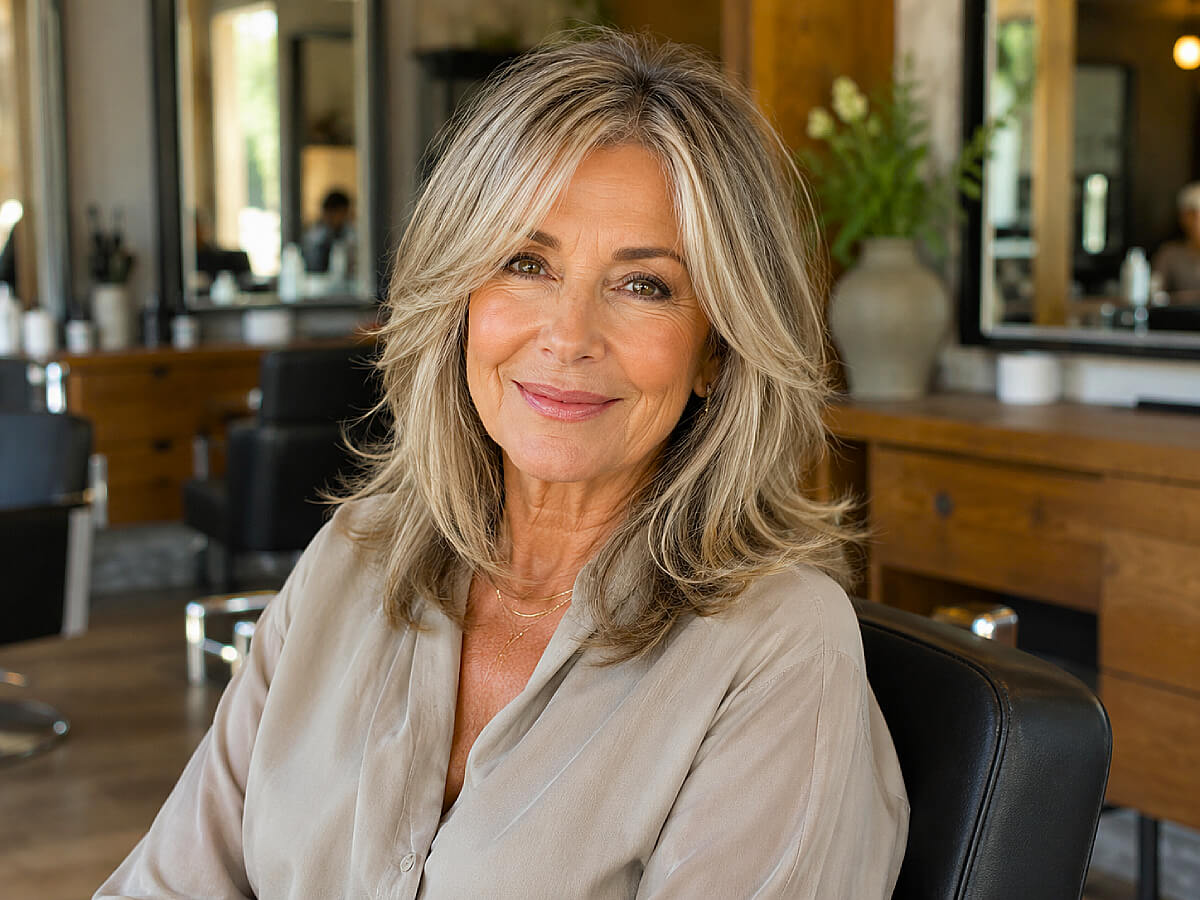

Question from Sandra Whitmore, Terre Haute, Indiana: “I feel like my hair has aged me more than my actual age has, if that makes sense. I’m 61 and I’ve been wearing basically the same style since my late 40s. My hairdresser retired last year and I haven’t found a new one I really click with yet, so I’ve been kind of winging it. Is there a way to know if your hair is working against you without someone just telling you to cut it all off?”
Sandra, I hear this exact thing more than almost anything else in the salon. And you’re right, there’s a real difference between hair that ages gracefully with you and hair that’s quietly adding years you haven’t earned yet. The tricky part is that most of the mistakes I see aren’t dramatic. They’re not a bad perm or a color disaster. They’re small, accumulated choices that made total sense at the time and just… haven’t been revisited.
I’ve been doing hair for over two decades, and I will tell you honestly, the women who come in looking the most refreshed after an appointment aren’t always the ones who did the most. Sometimes it’s just undoing one habit that had slowly been working against them. So let’s talk about what those habits actually are, because I think you’ll recognize a few of these.
This post may contain affiliate links, meaning I may earn a small commission at no extra cost to you. I only share products I truly believe in. As an Amazon Associate, I earn from qualifying purchases. Your support helps me continue creating free content like this.
7. Holding Onto a Part You Chose Decades Ago
Here’s something I noticed years into doing hair, the part line is almost never something women think about consciously, but it shapes the entire silhouette of your face. Most women I see over 55 have had their part in the exact same place since at least their 30s, sometimes longer. And I get it, you found what worked, you stuck with it. But hair changes. The density changes, the texture changes, the way it falls changes, and a part that was flattering at 38 might be doing something completely different at 61.
What I see most often is a deep side part that was once full and voluminous on top but now, because of natural thinning, is creating a flat sweep across the crown that emphasizes exactly the areas women want to minimize. The scalp shows more along that old part line because the hair has been trained to separate there for years. It’s one of the first things I look at when someone sits in my chair.
Switching to a softer side part, or even experimenting with a middle part if your face shape supports it, can redistribute volume in a way that genuinely looks like you got a whole new cut. I had a client, Diane, who had worn a severe left part since 1987. We moved it about an inch and a half toward center and she called me two days later saying her husband thought she’d done something major. She hadn’t. It was a part line.
If you want to retrain your hair, try blow drying it in the new direction while it’s damp and holding it with a good sectioning clip while it cools. It takes about a week of consistency before the hair stops fighting you.
6. Using Products Formulated for Younger Hair
This one gets me a little fired up, honestly, because the beauty industry is not particularly helpful here. Walk down any drugstore aisle and you’ll see “volumizing” shampoos and “strengthening” masks everywhere, most of which are formulated with younger, oilier hair in mind. The ingredients that give a 30-year-old’s thick hair a nice weightless bounce can absolutely flatten or dry out hair that’s already gone through hormonal changes.
After menopause especially, hair tends to get finer, drier at the ends, and sometimes oilier at the scalp, which is a confusing combination that most one-size-fits-all products completely miss. Heavy moisturizing conditioners meant for thick or coarse hair? They’ll weigh down fine strands and make your hair look limp by noon. Sulfate-heavy clarifying shampoos used too frequently will strip what little moisture your ends are holding onto.
What I actually recommend to clients in their 50s and 60s is looking at products specifically designed for aging or mature hair, or at minimum, looking at “fine hair” lines combined with a separate treatment for the ends. The Nioxin system for thinning hair has genuinely helped a lot of my clients with scalp health and density, and for moisture without weight, I like Olaplex No. 4 for its ability to address bond damage without leaving hair heavy.
Read your labels. If the first few ingredients are heavy oils or butters and your hair is fine, that product probably isn’t for you regardless of what the front of the bottle says.
5. Skipping Toner and Wondering Why Hair Looks Brassy or Flat
Color-treated hair without toner maintenance is one of the most common things I see, and it’s completely understandable because toner feels like a “salon only” step that nobody tells you can be done at home between appointments. But if you’re coloring your hair, whether professionally or at home, and you’re not maintaining the tone, the color shifts in a way that can make the whole look feel dated or tired.
Gray blending and silver highlights are incredibly popular right now, and done well, they’re genuinely beautiful on women over 50. But those cool, ashy, sophisticated tones do not maintain themselves. Heat, hard water, sun exposure, even certain shampoos push silver and blonde tones warm over time. And warm, in this context, usually means yellow or orange, which reads harsh against skin that has naturally lost some of its warmer undertones with age.
A purple or blue toning shampoo used once a week is the simplest fix, and I mean the difference between hair that looks polished and hair that looks like it needs attention. I’ve been recommending Shimmer Lights purple shampoo to my gray and blonde clients for years and it holds up. For deeper toning needs, Joico Color Balance Blue Shampoo handles brassiness that purple alone doesn’t fully correct.
The one thing I’ll say about toning shampoos is don’t leave them on too long if your hair is very light or very porous. Two to three minutes is plenty. I had a client leave Shimmer Lights on for twenty minutes because she figured more was better, and she showed up to her nephew’s wedding with lavender hair. We laughed about it eventually.
4. Getting the Same Haircut Out of Habit Rather Than Intention
Sandra, I think this one might be specifically for you based on your question, and I say that with nothing but warmth. There’s a version of loyalty to a hairstyle that’s actually just avoidance of the conversation about whether it’s still working. I’ve had clients sit in my chair and say “just the usual” for fifteen years, and I’ll be honest, some of them it served beautifully, and some of them I wish I’d spoken up sooner.
Hair changes as we age in ways that affect what cuts actually perform well. Layers that once added movement might now be taking away the density you need. A blunt bob that was sleek and polished at 45 might feel heavy and matronly at 62 if the weight line is sitting in the wrong place. Bangs that worked with a certain texture don’t always cooperate when that texture shifts. None of this means you need something radical. It means the cut should be a living, evolving conversation rather than a standing order.
What I suggest to anyone who hasn’t had a real hair consultation in a while is to go in and specifically ask your stylist to evaluate the cut fresh, not just execute what you’ve been doing. A good stylist should be able to tell you whether your current cut is still your best option or whether something needs adjusting. If they’re not willing to have that conversation, that tells you something too.
Face-framing layers around the cheekbones and jaw are almost universally flattering for women over 50 and are one of the most underused tools I see. A good set of shears if you’re doing any dusting or trimming at home makes a difference, but honestly, this particular item is really better left to someone you trust in person.
3. Over-Relying on Box Color Without Addressing Gray Coverage Strategy
I have complicated feelings about box color, and I’ll just be upfront about that. It’s not that it never works, it’s that it often works fine for a few years and then quietly starts creating a problem that compounds over time. Specifically, the way it deposits color at the roots while the previously colored hair continues to lift and shift means you can end up with a banding effect that no amount of single-process color corrects easily. And for women with a significant percentage of gray, most box colors simply aren’t formulated to cover it effectively, so you get uneven results that look more stark than intended.
The real issue, though, is commitment. Box color requires pretty frequent reapplication to maintain, and that repeated chemical processing on already-processed hair, especially fine or dry aging hair, adds up to breakage and porosity problems that make everything harder: the color, the styling, the moisture retention. I’ve seen beautiful hair that was in really rough shape structurally because of years of consistent box color with no protein or bond treatments to compensate.
If you’re committed to coloring at home, I’d really encourage you to look at Madison Reed, which is a significantly better formulated at-home color option that includes conditioning agents and tends to be gentler on the hair over time. Pair it with a bond-building treatment like Olaplex No. 3 used before or after your color session and you’ll protect the integrity of your hair in a way that makes a visible difference in how healthy it looks and feels.
If gray coverage is your primary goal, also consider whether a gray blending or highlight approach might actually serve you better than solid color, because the regrowth is far more forgiving and the overall effect tends to look softer and more expensive.
2. Using Heat Styling Without Protecting Aging Hair That’s Already Fragile
Aging hair and high heat are not a good combination, and I’ll say that clearly because I think it gets glossed over. The hair shaft changes as we get older, it’s more porous, often finer, sometimes more fragile at the ends, and it does not bounce back from heat damage the way it did at 35. And yet I see so many women still using the same flat iron at the same temperature they’ve used for twenty years, because nobody told them that what worked before doesn’t automatically work now.
High heat, meaning anything above about 380 degrees, is something I’d steer most women over 55 completely away from unless their hair is unusually coarse. Fine or color-treated hair generally doesn’t need more than 300 to 350 degrees to achieve what you’re going for, and the difference in long-term health is significant. Repeated high-heat exposure on aging hair leads to chronic dryness, split ends that travel up the shaft, and that kind of duller, less light-reflective appearance that makes hair look older than it needs to.
Heat protectant is non-negotiable for me, and I mean that. I have used and recommended Kenra Platinum Silkening Mist for years because it works, it smells good, and it doesn’t leave a residue. TRESemmé Thermal Creations is a solid drugstore option that I genuinely don’t think is inferior to the salon stuff for most hair types. Apply it to damp hair before blow drying, and again before any hot tool.
While we’re here, a ceramic ionic hair dryer is genuinely worth the investment if you’re blow drying regularly. Ionic technology reduces frizz and drying time, which means less total heat exposure. That’s a real difference, not a marketing claim.
1. Choosing Hair Color Based on What You Used to Look Good In
This is the one I feel most strongly about, and it’s the one I see cause the most visible aging of any mistake on this list. The colors that were beautiful on you at 40 are often working against you at 60, not because you’ve gotten less attractive, but because the relationship between hair color and skin tone genuinely changes as we get older, and what was once a harmonious match can become a contrast that reads as harsh.
Here’s what happens over time, skin loses some of its warmth, its pigment, its depth. The colors that naturally occurred in your face when you were younger, rosy cheeks, a little golden undertone, deeper contrast around the eyes, those soften. And when they soften, a very dark or very warm hair color that once looked rich and complementary can start to look stark and drag attention to things like under-eye shadows or uneven skin tone rather than away from them.
I have had this exact conversation, kindly and carefully, with more women than I can count. There was a client I’ll call Marlene who had been coloring her hair a deep mahogany brown since her late 30s. It had looked genuinely gorgeous on her. By 63, she came in and I could see she knew something was off but couldn’t name it. We lightened her base by about three levels and added soft, warm highlights around her face, nothing dramatic, just a shift from dark and flat to lighter and dimensional. She cried a little. I did not cry, but I thought about it.
Going lighter as you age is almost always more flattering, though I want to be careful about saying it like it’s a rule, because nothing in hair is a rule. What I mean is that softer, more dimensional color tends to work with changing skin tones rather than against them. Solid dark color can look beautiful if it’s warm and has some dimension, but flat, single-process dark brown with no variation is one of the most aging things I see on women over 55, and it’s also one of the easiest to address.
If you’re not ready for a dramatic shift, ask your colorist about adding a few face-framing highlights just around the hairline, not a full highlight, just something to soften the contrast where your hair meets your skin. It costs less than a full service, takes less time, and the difference in how it interacts with your face is noticeable immediately. Products like Wella Color Charm toners can also help you maintain softer, more nuanced tone at home between appointments.
The goal isn’t to look younger in some obvious trying-too-hard way. It’s just to let your hair work with you instead of against you, and color is probably the single most powerful tool you have for doing that.
One Last Thing
Sandra, I hope this gives you a real starting point. You don’t need to overhaul everything at once, and honestly, I’d caution against trying to. Pick the one item on this list that you immediately recognized yourself in, because there’s always one, and start there. Hair responds well to thoughtful, incremental changes, and so do we.
Finding a new stylist after losing one you trusted is genuinely hard, and I don’t want to minimize that. But when you do find someone, go in with a few of these things in mind, ask them to look at your color with fresh eyes, ask whether your current cut is still serving you, and see how they respond. The right person will be glad you asked.
Your hair can absolutely work for you at 61, at 71, at any age. It just occasionally needs someone, or some honest article on a Tuesday afternoon, to point out where the small habits have quietly piled up.